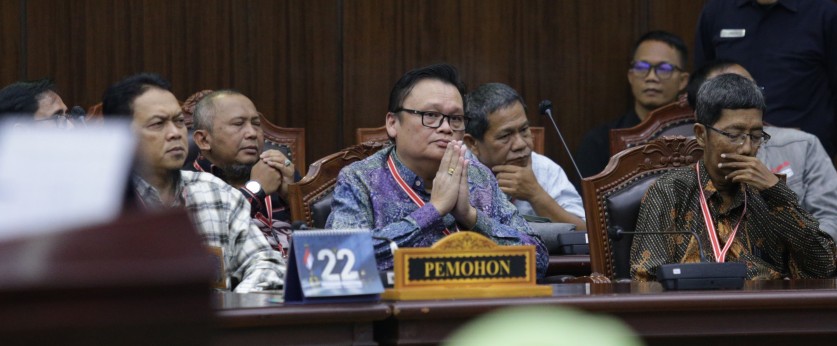
The Petitioners at the ruling hearing for the judicial review of the Law on Financial Sector Development and Reinforcement for case No. 152/PUU-XXII/2024, Thursday (8/14/2025). Photo by MKRI/Bayu.
JAKARTA (MKRI) — The Constitutional Court (MK) rejects the entire material judicial review petition of Article 161 paragraph (2) of Law No. 4 of 2023 on the Financial Sector Development and Reinforcement (PPSK Law). The ruling hearing for Decision No. 152/PUU-XXII/2024, chaired by Chief Justice Suhartoyo, took place on Thursday, August 14, 2025 in the plenary courtroom.
For the petition filed by Freddy T.H. Sinurat and fifteen other petitioners, all of whom are private-sector employees, Constitutional Justice Enny Nurbaningsih delivered several of the Court’s legal considerations in response to the constitutional arguments against the contested provisions. The Petitioners claimed that the interpretation of the phrase “periodically and/or in a lump sum” in the definition of pension benefits under the law a quo does not automatically grant every participant in a pension program the right to receive their pension benefits in a lump sum as an alternative to periodic payments. The term “lump sum” refers to exceptions or special circumstances as regulated under Article 164 of Law No. 4 of 2023. Accordingly, such a payment method is not a matter of choice for either the participant or the pension program institution, as opting for a lump sum payment may only be done if specific requirements or conditions are met.
The Petitioners argued that the payment of pension benefits on a periodic basis violated their rights. In the Court’s view, when examined in light of the underlying normative philosophy, the provision on the procedure and mechanism for such payments must take into account the national economic condition, as reflected in the values of Pancasila and the 1945 Constitution. Therefore, Justice Enny continued, pension programs must consider sustainability and economic resilience, ensuring a balance between individual rights and the State’s obligations.
“When viewed in relation to the concept of pension benefits, there is an element of State responsibility to ensure that workers continue to receive economic protection even after they are no longer employed. The State must be present through procedures for fulfilling such rights, as the purpose of accumulating pension funds is to maintain income continuity in old age, thereby achieving social justice,” she explained.
Paid on a Monthly Basis
With respect to the argument concerning Article 61 paragraph (2) of Law No. 4 of 2023, which regulates the payment of pension benefits, the Court emphasized that this provision pertains to the administration of pensions by pension fund institutions. Thus, the provision must be understood as part of an integrated pension program framework. As Justice Enny clarified, the provision in Law No. 4 of 2023 stipulates that pension benefits may be received by participants periodically and/or in a lump sum as retirement income, corresponding to the retirement age, length of service, or contribution period.
More specifically, the provision a quo essentially establishes that pension benefits are the entitlement of the participant’s widow/widower/children and must be paid periodically. The elucidation to the provision clarifies that “periodically” means pension benefits paid on a monthly basis in accordance with pension fund regulations. This does not negate the pension benefit itself, as it remains a right of the worker for as long as they are registered as a participant in the pension program.
“Accordingly, the provision setting a limit that pension benefits are to be paid periodically is not a rule that deprives participants of their entitlement to such benefits. In this context, the provision regulates the method of payment, whereas the amount and value of the pension benefits are determined under implementing regulations,” Justice Enny explained.
Also read:
Employees Challenge Provision on Periodic Pension Payment
Petitioners of Periodic Pension Payment in PPSK Law Challenge More Articles
Govt: Periodic Pension Payments Help Manage Participants’ Financial Risks
Govt’s Expert Reveals Why Pension Be Paid Periodically
The Petitioners argued that Article 161 paragraph (2) of the PPSK Law, which reads, “Payment of pension benefits to participants and their widows/widowers or children shall be made periodically,” is in violation of Article 28H paragraph (4) of the 1945 Constitution. They believe that the phrase “shall be made periodically” implies coercion and arbitrariness in the takeover of the Petitioners’ private property rights in the form of pension benefits. They believe the word “shall be” does not provide any choice.
However, the mandate concerns the Petitioners’ personal asset, which is deducted from their monthly salaries. Therefore, the Petitioners argued that the provision in the norm has deprived them of their right to choose and determine the payment method of their pension benefits. In addition, it has also deprived them of the right and opportunity to utilize the pension benefits in accordance with their and their families’ plans, aspirations, needs, and personal challenges.
Author : Sri Pujianti
Editor : Lulu Anjarsari P.
PR : Fauzan Febriyan
Translator : Yuniar Widiastuti (NL)
Disclaimer: The original version of the news is in Indonesian. In case of any differences between the English and the Indonesian versions, the Indonesian version will prevail.
Thursday, August 14, 2025 | 16:36 WIB 226