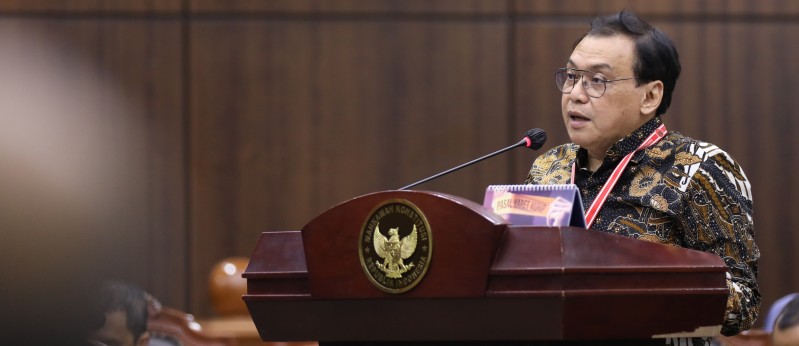
The Finance Minister’s Advisor on Financial Services and Capital Market Arief Wibisono testifying for the judicial review of the Law on Financial Sector Development and Reinforcement, Wednesday (5/7/2025). Photo by MKRI/Ifa.
JAKARTA (MKRI) — Periodic pension payment helps participants manage financial risks. It helps minimize the risk of large lump-sum expenditures that can deplete pension funds as well as the risk of unwise fund management, thus ensuring pension participants receive pension benefits on an ongoing basis.
The statement was made by the Finance Minister’s Advisor on Financial Services and Capital Market Arief Wibisono on behalf of the Government at a material judicial review hearing of Article 161 paragraph (2) of Law No. 4 of 2023 on the Financial Sector Development and Reinforcement (PPSK Law) on Wednesday, May 7, 2025 in the plenary courtroom. The hearing for case No. 152/PUU-XXII/2024, filed by Freddy T.H. Sinurat and fifteen other private employees, was presided over by Chief Justice Suhartoyo, Deputy Chief Justice Saldi Isra, and the other seven constitutional justices.
Arief further explained that sociologically, periodic pension payment actually provides legal certainty and justice for all participants in the pension program and can mitigate many risks compared to lump sum payment, which is not in line with the purpose of establishing a pension fund. The objectives in question include, first, minimizing the risk of unwise fund management. Meanwhile, lump sum pension payment could potentially lead to the pension being spent in the early days of retirement. Second, the risk of longevity due to lifespan uncertainty. Periodic pension payment minimizes the risk of no income for participants when they live longer than expected. Third, investment risk because periodic pension payment will reduce the risk of poor investment returns.
“So, periodic payments by the Pension Fund provide more security. Receiving pension in a lump sum means shifting the responsibility for managing pension from the Pension Fund to the recipient,” Arief explained.
Arief explained that although pension payment be made periodically, there are conditions when it can also be made in a lump sum, provided that the amount is smaller than a certain amount determined by the OJK (Financial Services Authority) and there are certain conditions determined by the OJK. The provision regarding first-time pension payment in a lump sum, adopted from Law No. 11 of 1992, stipulates that only a maximum of 20% is paid. This is to ensure that the pension can be enjoyed optimally in accordance with the main objectives of the Pension Fund, while the recipients still have 100% rights to their pension.
“Based on this description, the provisions of Article 161 paragraph (2), Article 163 paragraph (1), and Article 164 paragraph (2) of Law No. 4 of 2023 on Financial Sector Development and Reinforcement do not conflict with Article 28H paragraph (4), Article 281 paragraph (1) and paragraph (2), and Article 28D paragraph (1) of the 1945 Constitution of the Republic of Indonesia,” Arief emphasized.
Also read:
Employees Challenge Provision on Periodic Pension Payment
Petitioners of Periodic Pension Payment in PPSK Law Challenge More Articles
At the preliminary hearing, the Petitioners argued that Article 161 paragraph (2) of the PPSK Law, which reads, “Payment of pension benefits to participants and their widows/widowers or children shall be made periodically,” in violation of Article 28H paragraph (4) of the 1945 Constitution. They believe that the phrase “shall be made periodically” implies coercion and arbitrariness in the takeover of the Petitioners’ private property rights in the form of pension benefits. They believe the word “shall be” does not provide any choice.
However, the mandate concerns the Petitioners’ personal asset, which is deducted from their monthly salaries. Therefore, the provision in the norm has deprived the Petitioners of their right to choose and determine the payment method of their pension benefits. In addition, it has also deprived them of the right and opportunity to utilize the pension benefits in accordance with their and their families’ plans, aspirations, needs, and personal challenges.
In the revised petitum, the Petitioners request that the Court declare the clause “Payment of pension benefits to participants and their widows/widowers or children shall be made periodically” in Article 161 paragraph (2) of the PPSK Law unconstitutional and not legally binding if not interpreted as “Payment of pension benefits to Participants and their Widows/Widowers or Children shall be made periodically upon approval by the Participants, their Widows/Widowers or Children; or the payment of pension benefits shall follow the wishes of Participants and their Widows/Widowers or Children.”
Author : Sri Pujianti
Editor : Lulu Anjarsari P.
PR : Fauzan Febriyan
Translator : Yuniar Widiastuti (NL)
Disclaimer: The original version of the news is in Indonesian. In case of any differences between the English and the Indonesian versions, the Indonesian version will prevail.
Wednesday, May 07, 2025 | 16:14 WIB 269