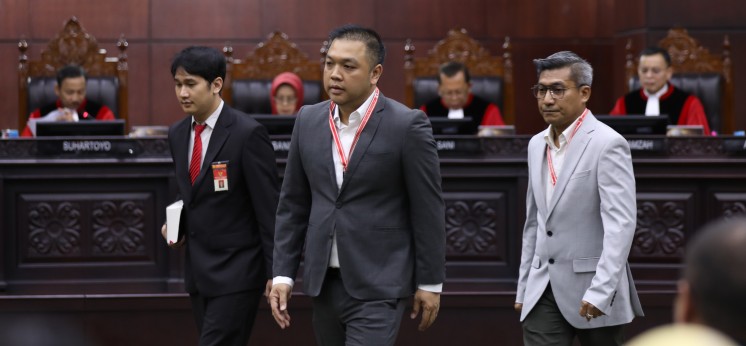
Petitioners’ experts, Marulam J Hutauruk and Albert Aries, after having their oath taken in front of the Panel of Justices during the resumed hearing of the judicial review of Law No. 28 of 2014 on Copyright, Thursday (31/7) at the Courtroom. Photo by MKRI/Ifa.
Jakarta (MKRI) – Petitioners of Case No. 37/PUU-XXIII/2025 presented two witnesses, Rina Aprilla (Rinna April) and Denny Rachman (Azum), who are professional singers or performers in Café, restaurants, hotels, wedding events, birthday parties, and other events, during the material judicial review of several articles of Law No. 28 of 2014 on Copyright. Both, as singers who perform songs owned by others, expressed concern, anxiety, and fear about singing songs created by Indonesian citizens due to the threat of criminal imprisonment.
“Turns out that it is not just me, the conversation in the WhatsApp Group of Music Performers, everyone is talking about this. Besides being afraid to perform songs from creators whose cases are now going viral, there is information not to perform songs from Creator A or Creator B, and other things. Because of the confusing information, this concern, in short, many conclude that they won’t perform Indonesian songs; they are more comfortable singing Western songs. It is even though we like to perform Indonesian songs, because it can also increase the popularity of the songs,” Rinna stated during the hearing on Thursday, July 31, 2025.
Rinna, a professional singer with 30 years of experience, said that in one event, she performs at least 20 songs, with fees ranging from 300 thousand to 1.5 million rupiah, depending on the event's scale. If every singer must pay for a couple of million per song, she admitted that her fees won’t be enough to cover that.
Meanwhile, some event hosts or guests often asked her to perform popular songs, nostalgic songs, or 90s songs. However, she was afraid to be involved in a legal issue if she performed songs by Indonesian creators, especially those currently suing singers for performing their songs.
Similarly, Azum, a professional singer since 2011, stated that he had recently been prohibited from performing songs created by Anji at the outlet where he performed. At the same time, Anji was playing billiards in the next outlet. Upon knowing that, the manager asked not to sing Anji’s songs because he was afraid of getting into trouble. He immediately obeyed the request, despite having to change the song list he had prepared for the session.
Because of that, Azum said that he lost the freedom to perform songs requested by the guests. Moreover, he stated that there was a rumor that the outlet would cut his fees to pay for the royalty.
“I am not a popular singer, but because of café singers like myself, songs from popular singers become more popular and remembered by many. But will I be affected by the royalty issue on these songs? Do I have to pay the royalty, since my fees are only a couple of hundred thousand rupiah? I work to entertain guests/audiences by performing songs created by others. Then, if I am to be prohibited from performing those songs, how can I work?” Azam said.
The Petitioners also presented Marulam J Hutauruk as an expert in Copyright and Alber Aries, who is an expert in criminal law. Albert Aries viewed the phrase “without rights and/or permission” in Article 113 paragraph (2) of the Copyright Law as containing disharmony between the individual permission system and the mechanism under the LMK and LMKN.
Article 87 paragraph (1) of the Copyright Law does not oblige creators, copyright owners, and holders of related rights, in getting their economic rights, to become members of LMK so that they can have a reasonable fee from users who use the copyright in the form of commercial public service. Therefore, nobody is sure of the mechanism to exercise this obligation. Albert stated, a reasonable use of a song should have a positive impact on artists, musicians, and all parties involved to improve their creativity, which should not be limited by ambiguous regulation, without violating economic rights, and more importantly, the moral rights of the creator.
Then, Marulam said that the creator can prohibit others only if the song is performed with the intention of damaging the creator's honor and reputation. The obligation to obtain the creator’s permission or license is a regulation intended to ensure that the creator can receive rights over the economic utilization of the song they created, not the right to prohibit others from singing the song in a performance.
According to him, performers should be given the freedom to sing other people's songs without being burdened with excessive responsibilities. Thus, performers can develop their creativity because the development of creativity is the main purpose of copyright protection itself.
Also read:
Copyright Law’s Petitioners Compare Collective Management Organizations in Other Countries
Copyright Law: Criminal Prosecution May Be Pursued if Civil Remedies Fail
LMKN, PAPPRI, and AKSI Appointed as Related Parties in Copyright Law Review
Sammy Simorangkir and Lesti Kejora Attend Copyright Law Review Hearing as Witnesses
Case No. 28/PUU-XXIII/2025 on the judicial review of Copyright Law was held simultaneously with Case No. 37/PUU-XXIII/2025. Petitioners in Case No. 28/PUU-XXIII/2025, consisting of Tubagus Arman Maulana, known as Armand Maulana, Nazriel Irham, commonly called Ariel, along with 27 other musicians active in the Indonesian music industry, argue that they face potential legal issues arising from the challenged provisions.
This judicial review is prompted by several cases, such as that involving Agnes Monica, better known as Agnezmo. Agnezmo was sued and criminally reported by Ari Bias, the creator of the song “Bilang Saja,” on the grounds that Agnezmo allegedly did not obtain direct permission or pay royalties directly to Ari Bias. The Commercial Court Panel at the Central Jakarta District Court ruled against Agnezmo, ordering her to pay compensation of IDR 1.5 billion to Ari Bias. Subsequently, Agnezmo was also criminally reported to the Indonesian National Police for alleged violation of Article 113 paragraph (2) of the Copyright Law.
Case No. 37/PUU-XXIII/2025 was submitted by five performers of a musical group inspired by Koes Plus of T’Koes Band and Saartje Sylvia, a performer dubbed the first Lady Rocker. T’Koes Band often performs old songs by other musicians, such as Koes Plus, D’Mercys, The Everly Brothers, and The Beatles. However, as of September 22, 2023, Koes Plus’ beneficiaries banned T'Koes from performing Koes Plus.
According to them, it proves that the implementation of Article 9 paragraph (2) of the Copyright Law has harmed the Petitioner, and there is no legal certainty to get permission. However, the Petitioners stated that in every performance, T’Koes Band has asked for a license and/or paid royalties to the LMK in Indonesia, and approached Koes Plus’ beneficiaries, paying them compensation, although not to the extent the beneficiaries wished.
Member of the Commission III of the House of Representatives, I Wayan Sudirta, who was present in the courtroom, stated that the refusal of the heirs as copyright holders to allow the Petitioners to perform works by Koes Plus constitutes a concrete issue and an implementation of the provisions of the Copyright Law. Therefore, in his view, a joint resolution is necessary between the Petitioners, the copyright holders, and the Collective Management Organizations (LMK/LMKN), which serve as the forum for the Petitioners to pay royalties.
Author: Mimi Kartika
Editor: Lulu Anjarsari P.
PR: Raisa Ayuditha M.
Translator: Rizky Kurnia Chaesario
Disclaimer: The original version of the news is in Indonesian. In case of any differences between the English and the Indonesian versions, the Indonesian version will prevail.
Thursday, July 31, 2025 | 14:53 WIB 954