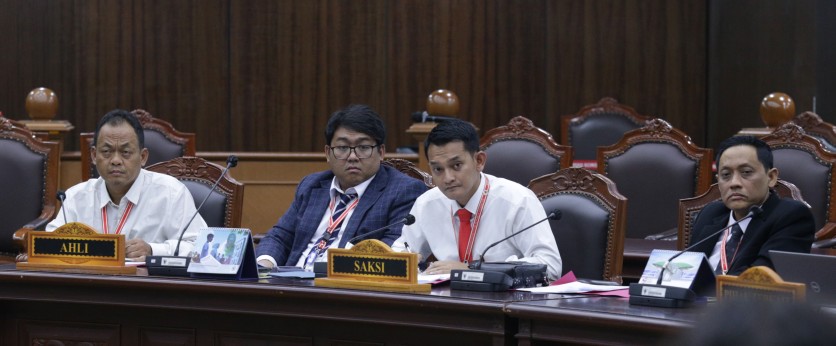
Experts and witnesses for the president at the fifth judicial review hearing of Law No. 17 of 2023 on Health for case No. 156/PUU-XXII/2024, Monday (6/2/2025). Photo by MKRI/Bayu.
JAKARTA (MKRI) — The Constitutional Court (MK) held the fifth material judicial review hearing of Law No. 17 of 2023 on Health for case No. 156/PUU-XXII/2024 on Monday, June 2, 2025 to hear the president’s experts and witnesses. Law professors Suparji and Ibnu Sina Chandranegara testified as experts; while member of the Professional Disciplinary Council (MDP) and former member of the Indonesian Medical Disciplinary Board (MKDKI) Prasetyo Edi and Ngawi Regency Criminal Detective Unit Police Inspector 2nd Class (Ipda) Agus Marsanto testified as witnesses.
Prasetyo Edi pointed out that several offenses by medical personnel had been processed without any recommendations by the MDP, including an anesthesia resident committing sexual harassment at a health facility in Bandung and an on-duty doctor committing sexual harassment at a health facility in Malang. He said the local police had discovered evidence convincing them that the medical personnel had committed sexual harassment under Law No. 12 of 2022 on the Criminal Acts of Sexual Violence, so an investigation was carried out without asking for the MDP’s recommendation as stipulated in Article 308 of the Health Law.
“So this is actually the police’s prerogative to be convinced that case presentation can be carried out so that they can determine the suspect or not,” said Prasetyo Edi.
MDP’s Recommendation Terminated Investigation
Meanwhile, Ipda Agus Marsanto shared the experience of handling a case of alleged tooth extraction malpractice by dentist Silvya Wardah, reported by Nira Pranita Asih. The investigators encountered difficulties due to limited medical knowledge, so they could not determine the classification of the victim’s impaction teeth only from the victim’s dental X-rays.
Therefore, Ngawi Police wrote to the Central MKDKI to request a recommendation as well as assessments on whether the dentist’s practice has met professional standards and whether the practice was the direct cause of the victim’s death. However, it turned out that the MKDKI no longer existed and, in accordance with the Health Law, the request for recommendation was submitted to the MDP.
Five days after receiving the request letter, the MDP conducted a field inspection of the case. Two days later, Ngawi Police received a recommendation letter from the MDP, which basically stated that the case could not be investigated because dentist Sylvia Wardah had followed protocol for the treatment.
Furthermore, the police invited the MDP to Ngawi police station because investigators wanted to discuss and get further explanation regarding the reported party’s standard of professional practice. At that time, as a representative of the MDP, Prasetyo Edi explained that the victim’s impaction tooth had been classified as 1A Mesio-angular, for which treatment could be carried out by a general dentist.
“Based on the MDP’s recommendation letter and explanation, and by referring to the provision of Article 308 of Law No. 17 of 2023 on Health, the case we handled became clear, so the Ngawi police investigators conducted a case presentation for termination of investigation (SP2Lid) with a decision that it was not a criminal offense,” Ipda Agus Marsanto explained.
Article 308 Not Discriminatory
In addition, law professor at Muhammadiyah University of Jakarta Ibnu Sina explained that Article 308 of the Health Law is a form of equality protection of law or equality among the equals. He said the article does not reflect discrimination or a form of special treatment, but rather a form of protection of the nature of the legal relation that arises uniquely between a patient and health workers or medical personnel that is inspanningverbintennis in nature.
“Differences as far as the stages taken cannot be interpreted as a form of discrimination as referred to in Article 28I paragraph (2) of the 1945 Constitution. This is because the stages of submitting recommendation as referred to in Article 308 of the Health Law are not intended for direct or indirect restriction, harassment, or exclusion, but rather a form of fulfillment of the right to recognition, guarantees, protection and fair legal certainty,” explained Ibnu Sina in the plenary courtroom.
Inspanningverbintennis is a relationship that puts emphasis on effort or process rather than results. As a consequence of such a relationship, the results are not guaranteed, as long as optimum efforts have been made.
He added that if this is only done at the evidentiary stage in a civil case or even assessed by law enforcement in a criminal context, the assessment of professional standards, service standards, and standard operating procedures would actually be obscured. The process of submitting recommendation actually helps provide legal certainty in the investigation by law enforcement officials, especially in determining whether all medical treatments have followed protocol, while in the case of a civil lawsuit, recommendation can be used to obtain professional verification of the arguments to be submitted in a civil lawsuit and does not reduce or inhibit a person’s legal right to file a civil lawsuit.
“Article 308 of the Health Law is a test of professional standards, service standards, and standard operating procedures as a consequence of the nature of inspanningverbintennis legal relationship between patients, health workers, and medical personnel,” said Ibnu Sina.
Next, law professor Suparji explained that the examination of criminal and civil cases by the MDP based on the phrase “a recommendation from the assembly must first be requested as referred to in Article 304” in Article 308 paragraphs (1) and (2) of the Health Law cannot be seen to have eliminated or delayed the fulfillment of the constitutional right to justice for citizens who intend to fight for justice through criminal law mechanism through investigation or to obtain compensation through the lawsuits in court as a result of treatment by medical and/or health personnel, who are suspected of violating the law or causing harm.
Such a preliminary examination focuses on assessing whether the health services performed by medical personnel and health workers have been in accordance with professional standards, service standards, and standard operating procedures, is the reason for the establishment of the MDP under Article 304 paragraph (1) of the Health Law, i.e. in order to support the professionalism of medical personnel and health workers. The provision in the phrase “a recommendation from the assembly must first be requested” cannot be seen as obstruction of justice, because the authority of the examination is only limited to providing recommendations within a maximum of 14 workdays, thus ensuring legal certainty.
“The MDP’s authority to provide recommendations for criminal or civil cases [means it] basically only examines whether the health service the medical personnel and/or health worker provided for the patient has been in accordance with professional standards, service standards, and standard operating procedures. The examination of criminal and civil cases is only limited to the disciplinary aspect, not assessing whether or not there is a violation of law committed by medical personnel and/or health workers,” Suparji said.
Also read:
Medical or Health Disciplinary Council’s Recommendation on Criminal or Civil Sanction Questioned
Medical Disciplinary Council’s Recommendation on Sanction Asked to Be Abolished
Govt: Medical Disciplinary Council’s Recommendation Does Not Hinder Law Enforcement
Disciplinary Council Maintains Discipline Among Medical and Health Workers
Article 304 concerns provision on disciplinary actions for the profession to support the professionalism of medical and health personnel. The minister formed an assembly that deals with the profession’s discipline. The permanent or ad hoc assembly determines whether a professional disciplinary violation has been committed. The regulation is then delegated to the Government Regulation (PP) No. 28 of 2024 on Health as the implementing provisions, which regulates the establishment, duties, functions, and membership of the MDP.
The Association of Medical and Health Law Consultants (PKHMK) and two advocates believe it would be inappropriate for an ethics council to be given authority to recommend and examine any violation of criminal or civil law.
In their petitum, the Petitioners request that the Court declare the phrase “a recommendation from the assembly must first be requested as referred to in Article 304” in Article 308 paragraphs (1), (2), (3), (4), (5), (6), (7), and (8) of the Health Law unconstitutional and not legally binding.
Author : Mimi Kartika
Editor : Lulu Anjarsari P.
PR : Fauzan Febriyan
Translator : Yuniar Widiastuti (NL)
Disclaimer: The original version of the news is in Indonesian. In case of any differences between the English and the Indonesian versions, the Indonesian version will prevail.
Monday, June 02, 2025 | 15:32 WIB 276