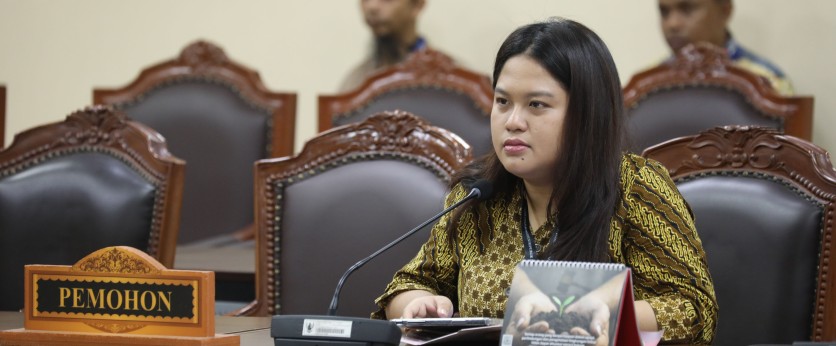
Counsel for Petitioner of Case No. 241/PUU-XXIV/2026 Priskila Octaviani presenting the revised petition for the judicial review of Law No. 14 of 2005 on Teachers and Lecturers, Wednesday (7/15/2026). Photo by MKRI/Panji.
JAKARTA (MKRI) — The Constitutional Court held a second hearing to examine Article 26 paragraph (6) and Article 35 paragraph (1) of Law No. 20 of 2003 on the National Education System (Sisdiknas) as well as Article 1 point 1 of Law No. 14 of 2005 on Teachers and Lecturers on Wednesday, July 15, 2026. The petition, registered as Case No. 241/PUU-XXIV/2026, was filed by Jangkung Sido Sentosa, head of an education unit and tutor at Aji Sakti Migunani Community Learning Center (Pusat Kegiatan Belajar Masyarakat or PKBM) in Blora Regency, Central Java Province.
At the petition revision hearing, through counsel Priskila Oktaviani, the Petitioner explained the revisions made in accordance with previous recommendations by the panel chaired by Constitutional Justice Enny Nurbaningsih. The revisions included the section on the Constitutional Court’s jurisdiction, clarifying that the petition is not barred by the principle of ne bis in idem. In the section on legal standing, the Petitioner supplemented the explanation of the constitutional harm allegedly suffered.
“With respect to legal standing, Your Honors, we have made revisions by adding the constitutional harm under point D concerning the right to legal certainty under Article 28D paragraph (1) of the 1945 Constitution, on pages 14 to 15; the harm to the right to develop oneself under point C, on pages 17 to 18; and the harm to the right to work and to earn a decent livelihood under Article 27 paragraph (2) of the 1945 Constitution, on pages 18 to 20,” Priskila outlined several of the revisions made to the petition.
Accordingly, in the petitums (requests for relief), the Petitioner requests the Court to declare Article 1 point 1 of the Teacher and Lecturer Law unconstitutional and not legally binding insofar as it is not interpreted to mean that the phrase “formal education” also includes non-formal education pathways that are recognized and administered by the State, such that educators serving in officially registered non-formal educational institutions providing equivalency education, and who satisfy the academic qualifications prescribed by law, are entitled to equal access to the Teacher Professional Education (PPG) program as a means of obtaining recognition as professional educators.
The Petitioner also requests the Court to declare Article 26 paragraph (6) of the National Education System Law unconstitutional and not legally binding insofar as it is not interpreted to mean, “The outcomes of non-formal education shall be recognized as equivalent to those of formal education programs.”
Also read: Petitioner Seeks Recognition for Non-Formal Educators
The Petitioner argues that the provisions under review impose disproportionate standards on non-formal education participants. In the petition, he contends that the norms have led to the imposition of disproportionate standards, which create structural barriers for the Petitioner in developing both himself and the education institution he manages. This uniform application of standards, he stated, undermines educational inclusiveness and violates the right to equal legal protection because the State has failed to treat situations that are inherently different according to their distinct characteristics.
Priskila Oktaviani, representing the Petitioner, previously explained that Article 26 paragraph (6) of the National Education System Law provides: “The outcomes of the non-formal education may be recognized as equivalent to those of formal education following an equivalency assessment conducted by an institution appointed by the Central Government or Regional Government in accordance with the national education standards.” Meanwhile, Article 35 paragraph (1) provides: “The national education standards shall consist of standards for the content, process, graduate competencies, education personnel, facilities and infrastructure, management, financing, and educational assessment, which shall be continuously and periodically improved.”
Explore Case No. 241/PUU-XXIV/2026 (in Indonesian).
Author : Ilham W. M.
Editor : Lulu Anjarsari P.
PR : Raisa Ayuditha M.
Translator : Yuniar Widiastuti (NL)
Disclaimer: The original version of the news is in Indonesian. In case of any differences between the English and the Indonesian versions, the Indonesian version will prevail.
Wednesday, July 15, 2026 | 15:58 WIB 31