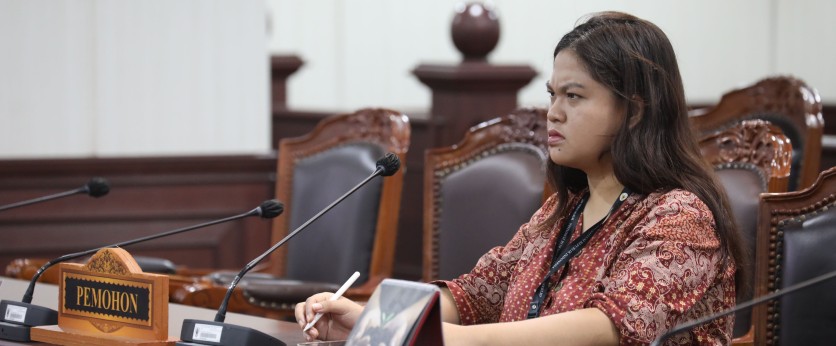
Counsel for Petitioner of Case No. 241/PUU-XXIV/2026 Priskila Octaviani presenting the petition for the judicial review of Law No. 14 of 2005 on Teachers and Lecturers, Thursday (7/2/2026). Photo by MKRI/Panji.
JAKARTA (MKRI) — The Constitutional Court held a preliminary hearing on Thursday, July 2, 2026 to examine Article 26 paragraph (6) and Article 35 paragraph (1) of Law No. 20 of 2003 on the National Education System (Sisdiknas) as well as Article 1 point 1 of Law No. 14 of 2005 on Teachers and Lecturers. The petition, registered as Case No. 241/PUU-XXIV/2026, was filed by Jangkung Sido Sentosa, head of an education unit and tutor at Aji Sakti Migunani Community Learning Center (Pusat Kegiatan Belajar Masyarakat or PKBM) in Blora Regency.
Priskila Oktaviani, representing the Petitioner, explained that the challenged provisions include Article 26 paragraph (6) of the National Education System Law, which provides: “The outcomes of the non-formal education may be recognized as equivalent to those of formal education following an equivalency assessment conducted by an institution appointed by the Central Government or Regional Government in accordance with the national education standards.” Article 35 paragraph (1) provides: “The national education standards shall consist of standards for the content, process, graduate competencies, education personnel, facilities and infrastructure, management, financing, and educational assessment, which shall be continuously and periodically improved.”
Meanwhile, Article 1 point 1 of the Teacher and Lecturer Law states: “A teacher shall be a professional educator whose primary duties are to educate, teach, guide, direct, train, assess, and evaluate students in formal early childhood education, primary education, and secondary education.”
The Petitioner argued that these provisions impose disproportionate standards on non-formal education participants. “The imposition of disproportionate standards creates structural barriers for the Petitioner in developing both himself and the education institution he manages. This uniform application of standards undermines educational inclusiveness and violates the right to equal legal protection because the State has failed to treat situations that are inherently different according to their distinct characteristics,” Priskila stated.
On that basis, the Petitioner requested that the Constitutional Court interpret non-formal education as being directly equivalent to formal education. “The provisions are contrary to the 1945 Constitution and have no binding legal force insofar as they are not construed to mean that: (a) the outcomes of non-formal education have legal status directly equivalent to those of formal education,” Priskila said while reading one of the Petitioner’s petitums (requests for relief).
In response to the petition, Constitutional Justice Arsul Sani advised the Petitioner to clarify the constitutional harm he allegedly suffers so that the claimed injury would be more apparent. “As I understand it, the Petitioner asserts his position as the head of an education unit, who also actively serves as a tutor at PKBM Aji Sakti Migunani in Blora Regency. You should describe these two roles and relate them to the alleged constitutional harm resulting from the challenged provisions. By doing so, the causal relationship will become much clearer,” he stated.
He further cautioned that if tutors are to be equated with teachers, then the rights and obligations applicable to teachers under the Teacher and Lecturer Law must likewise apply. “If you seek to have tutors treated the same as teachers, then the provisions of the Teacher and Lecturer Law relating to teachers’ rights and obligations must also apply. The matter does not end with simply equating the two,” he remarked.
Next, Constitutional Justice Ridwan Mansyur advised the Petitioner to address both legal standing and whether the petition is barred by the principle of ne bis in idem. “You should provide a stronger explanation as to why this petition should not be categorized as ne bis in idem. From what I have seen, the constitutional provisions serving as the benchmark in this case have previously been the subject of judicial review,” he stated. He added that the Petitioner must present arguments that are materially different from those raised in previous cases to avoid the ne bis in idem bar.
Finally, Constitutional Justice Enny Nurbaningsih advised that changing the definition contained in the Teacher and Lecturer Law would have implications for the entire statute. She also requested that the Petitioner clearly explain the constitutional harm he allegedly suffers. “Where exactly is the constitutional injury suffered by Mr. Jangkung in his capacity as a tutor?” she asked, while encouraging the Petitioner to develop arguments demonstrating the constitutional harm allegedly caused by the challenged provisions and to explain how their rejection would result in legal uncertainty.
Before adjourning the hearing, Justice Enny informed the Petitioner that he may submit revisions no later than 12:00 WIB on Tuesday, July 15, 2026, either offline or online. Revisions to the petition may be submitted only once.
Explore Case No. 241/PUU-XXIV/2026 (in Indonesian).
Author : Ilham W. M.
Editor : Lulu Anjarsari P.
PR : Raisa Ayuditha M.
Translator : Yuniar Widiastuti (NL)
Disclaimer: The original version of the news is in Indonesian. In case of any differences between the English and the Indonesian versions, the Indonesian version will prevail.
Thursday, July 02, 2026 | 16:00 WIB 87