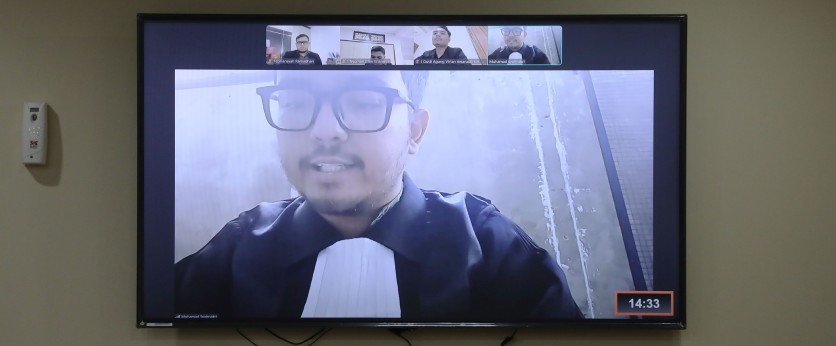
Petitioner’s legal counsel Muhamad Syahnakri presenting the revisions to the petition for the judicial review of the Hajj and Umrah Pilgrimage Administration Law online, Wednesday (7/15/2026). Photo by MKRI/Panji.
JAKARTA (MKRI) — On Wednesday, July 15, 2026, the Constitutional Court (MK) held a petition revision hearing for the material judicial review of provisions governing Umrah Pilgrimage Travel Organizers (PPIU) under Articles 115 and 122 of Law No. 8 of 2019 on Hajj and Umrah Pilgrimage Administration (Hajj and Umrah Law). The hearing for Case No. 239/PUU-XXIV/2026 took place in the Courtroom.
Through his legal counsel, Petitioner Febriansyah Ramadhan, a lecturer at the Faculty of Law at Universitas Pendidikan Nasional, Bali, stated that he had revised the petition in accordance with the advice of the panel chaired by Constitutional Justice Enny Nurbaningsih. Among the revisions was a clarification of his legal standing. The Petitioner explained that he neither owns nor operates a business providing Umrah pilgrimage travel services.
“The Petitioner does not operate an Umrah travel business, offer travel packages to the public, market travel services, collect pilgrims’ funds for commercial purposes, make a profit, or hold himself out as an Umrah pilgrimage travel organizer,” said Muhamad Syahnakri, one of the attorneys representing the Petitioner.
The Petitioner further explained that independent Umrah travel remains inseparable from the official administrative system involving PPIUs. The processing of Umrah visas and registration in the Integrated Umrah and Special Hajj Management System (Siskopatuh) must also go through a PPIU.
“Although the Petitioner undertakes the Umrah pilgrimage independently, his Umrah visa and Siskopatuh registration must still be processed through, or at the very least connected to, a limited liability company or business entity holding a PPIU license,” Syahnakri said.
According to the Petitioner, this arrangement creates a legal problem. On the one hand, he is an independent Umrah pilgrim who arranges his own journey with his family and relatives. On the other hand, because the Umrah visa and Siskopatuh registration must still be processed through a PPIU, the administrative records make it appear as though he and his family are traveling on a trip arranged by a particular PPIU.
The Petitioner argued that the challenged provisions have generated differing interpretations among the public, including the view that a person who invites another person—even a relative—to undertake the Umrah pilgrimage could face criminal penalties.
“Such an interpretation is highly detrimental to the Petitioner because, whenever he undertakes an independently arranged Umrah pilgrimage in a group, he serves as the trip leader and must necessarily carry out coordinating tasks, including inviting family members, collecting documents, arranging visas and Siskopatuh registration, organizing the departure, and accompanying the group,” Syahnakri said while outlining several revisions to the petition.
In his revised petitums, the Petitioner asked the Court to declare Article 115 of the Hajj and Umrah Law, which reads, “No person may, without authorization, act as a PPIU by gathering and/or dispatching Umrah pilgrims,” contrary to the 1945 Constitution.
He also asked the Court to declare Article 122 of the Hajj and Umrah Law, which reads, “Any person who, without authorization, acts as a PPIU by gathering and/or dispatching Umrah pilgrims as referred to in Article 115 shall be punishable by imprisonment for up to 6 (six) years and/or a fine not exceeding Category VI,” contrary to the 1945 Constitution.
Read
Petitioner Questions Criminal Charges against Independent Umrah Pilgrims
Previously, the Petitioner argued that the challenged provisions could expose him to criminal prosecution merely for inviting family members to undertake the Umrah pilgrimage independently. He maintained that Articles 115 and 122 of the Hajj and Umrah Law could create legal uncertainty for him because their wording could be used as a basis for prosecuting him for independently undertaking the Umrah pilgrimage, which he has done in the past and plans to do again in the future, even though independent Umrah travel is permitted under the Hajj and Umrah Law.
Author: Ilham W.M.
Editor: Lulu Anjarsari P.
PR: Raisa Ayuditha
Translator: Siti Rosmalina Nurhayati
Disclaimer: The original version of the news is in Indonesian. In case of any differences between the English and the Indonesian versions, the Indonesian version will prevail.
Track the Case: Petition No. 239/PUU-XXIV/2026
Wednesday, July 15, 2026 | 15:30 WIB 11