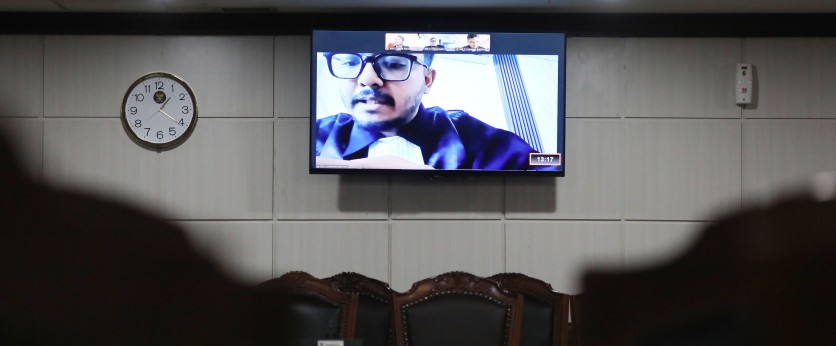
The Petitioner’s legal counsel Muhamad Syahnakri presenting the petition’s key arguments virtually at the preliminary hearing for the material judicial review of the Law on Hajj and Umrah Pilgrimage Administration on Thursday (7/2/2026). Photo by MKRI/Panji.
JAKARTA (MKRI) — Provisions on Umrah Pilgrimage Travel Organizers (PPIU) under Articles 115 and 122 of Law No. 8 of 2019 on Hajj and Umrah Pilgrimage Administration (Hajj and Umrah Law) have been challenged before the Constitutional Court (MK). The Court held the preliminary hearing for Petition No. 239/PUU-XXIV/2026 on Thursday, July 2, 2026, in the Court’s courtroom.
The Petitioner, Febriansyah Ramadhan, a lecturer at the Faculty of Law of Universitas Pendidikan Nasional in Bali, challenged Article 115 of the Hajj and Umrah Law, which states, “No person shall, without authorization, act as a PPIU by gathering and/or dispatching Umrah pilgrims.” Meanwhile, Article 122 states, “Any person who, without authorization, acts as a PPIU by gathering and/or dispatching Umrah pilgrims as referred to in Article 115 shall be sentenced to imprisonment for a maximum of 6 (six) years and/or a fine of up to Category VI.”
In the petition, the Petitioner argued that the challenged provisions could expose him to criminal prosecution for inviting family members to perform Umrah independently with him.
“The application of Articles 115 and 122 of the Hajj and Umrah Law could create legal uncertainty for the Petitioner because the provisions could be used as a basis for prosecuting him for having performed—and planning to continue performing—Umrah independently, even though the Law in question permits independent Umrah,” said Muhamad Syahnakri, legal counsel for the Petitioner.
According to the Petitioner, the uncertainty arose because performing Umrah independently did not necessarily mean traveling alone; he might also travel with relatives or family members.
On that basis, the Petitioner asked the Court to declare Articles 115 and 122 of the Hajj and Umrah Law unconstitutional and not legally binding.
Responding to the petition, Justice Arsul Sani advised the Petitioner to reorganize the petition so that it would be easier to read and review. He also asked the Petitioner to explain how the challenged provisions conflicted with the provisions of the 1945 Constitution cited as the standards of review.
“The more constitutional provisions you rely on as grounds for review, the more you must show the Court precisely where the conflict lies—namely, how Articles 115 and 122 of Law No. 8 of 2019 conflict with those constitutional provisions,” Justice Arsul told the Petitioner and his legal counsel, who attended the hearing in person.
According to Justice Arsul, the Petitioner was required to present arguments identifying the alleged constitutional conflict so that the constitutional justices could assess it.
Justice Arsul further asked the Petitioner to address the possibility that, if the challenged provisions were declared unconstitutional, anyone could promote themselves as an Umrah travel organizer and offer Umrah travel services to others.
“Can you imagine everyone marketing themselves without any assurance that they are capable of organizing Umrah travel, and then offering such services to others?” Justice Arsul asked.
He urged the Petitioner to weigh the benefits and potential harms of declaring the provisions unconstitutional without an interpretive qualification designed to protect Umrah pilgrims.
Justice Ridwan Mansyur then advised the Petitioner to read Constitutional Court Regulation No. 7 of 2025 on Procedures for Judicial Review Cases. He also observed that the Petitioner had not clearly explained his legal standing, particularly how the application of the challenged provisions impaired his constitutional rights.
“You must explain in detail whether the provisions you are challenging create legal uncertainty. You must also thoroughly explain how the provisions that you believe impair your constitutional rights conflict with the relevant provisions of the 1945 Constitution,” Justice Ridwan said.
Finally, Justice Enny Nurbaningsih asked the Petitioner to identify the impairment of his constitutional rights.
“If you are not acting as a PPIU and simply travel independently in the ordinary manner, is that prohibited? It is not. That is what you need to consider: what impairment of your constitutional rights have you suffered that led you to seek review of Article 115?” Justice Enny said.
Justice Enny stated that the Petitioner must explain and consider what would happen if the provisions were declared unconstitutional and PPIUs ceased to exist. According to her, the Petitioner needed to strengthen his argument that the application of the challenged provisions impeded his ability to perform Umrah and that the provisions were unconstitutional.
Before closing the hearing, Justice Enny informed the Petitioner that he could submit a revised petition no later than 12:00 p.m. WIB on Wednesday, July 15, 2026, either electronically or in person. The revised petition could be submitted only once. (*)
Author: Ilham W.M.
Editor: Lulu Anjarsari P.
PR: Raisa Ayuditha
Translator: Siti Rosmalina Nurhayati
Track the case: Petition No. 239/PUU-XXIV/2026
Disclaimer: The original version of the news is in Indonesian. In case of any differences between the English and the Indonesian versions, the Indonesian version will prevail.
Thursday, July 02, 2026 | 15:50 WIB 10