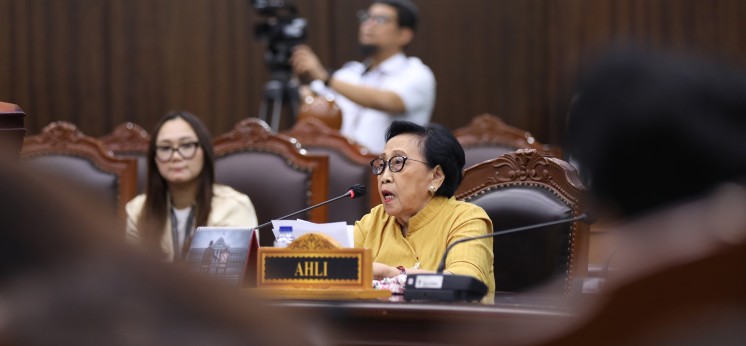
Maria Sri Wulani Sumardjono testifying as an expert witness for the Government at a hearing for Case No. 64/PUU-XXIV/2026 on the Basic Agrarian Law of 1960, Thursday (6/25/2026). Photo by MKRI/Ifa.
JAKARTA (MKRI) — The Constitutional Court held another hearing for the material judicial review of Basic Agrarian Law No. 5 of 1960 (UUPA) on Thursday, June 25, 2026. At this sixth session for Petition No. 64/PUU-XXIV/2026, filed by Ariyanto Zalukhu, Desimeni Larosa, Christina W. Zega, Masnidarti Harefa, and Vendy Setiawan (Petitioners I-V), the constitutional justices heard testimonies by the Petitioners’ and the President/Government’s expert witnesses.
The President/Government presented two expert witnesses: agrarian law expert of Universitas Gadjah Mada Maria Sri Wulani Sumardjono and law professor of Universitas Gadjah Mada Nurhasan Ismail. Meanwhile, the Petitioners presented Yamin, legal scholar and Head of the Advocacy Division of the Indonesian Association of Customary Law Lecturers at the Center for Customary Law Studies, Law Faculty of Universitas Pancasila.
Maria Sri Wulani Sumardjono explained that, contrary to the Petitioners’ contention that the land registration system disregards historical rights and the recognition of customary rights, the Basic Agrarian Law recognizes pre-existing rights, namely individual ownership rights acquired under customary law in good faith and exercised by the rights holder. Where such pre-existing rights are supported by written evidence, they may be formally recognized and, upon satisfaction of the relevant requirements, a land certificate may be issued. Where the rights holder physically possesses the land but lacks written proof, those pre-existing rights are nevertheless recognized, and pursuant to Article 7, a land certificate may still be issued.
“Accordingly, the land registration system recognizes and provides protection as well as legal certainty for customary land rights, whether they are supported by written evidence or merely by physical possession without documentary proof,” Maria explained at the plenary hearing chaired by Deputy Chief Justice Saldi Isra.
Recognition of Customary Law Communities
Maria further addressed the Petitioners’ arguments concerning historical rights and the recognition of customary rights in relation to Article 18B paragraph (2) of the 1945 Constitution. She explained that Article 18B paragraph (2) serves as the constitutional foundation for the protection and recognition of customary law communities (masyarakat hukum adat, or MHA) and their rights, including ulayat rights, which are communal in nature. The existence of ulayat rights is expressly recognized under Article 3 of the Basic Agrarian Law.
To provide legal certainty and minimize conflicts involving communal land, the Government enacted Ministerial Regulation of the Ministry of Agrarian Affairs and Spatial Planning/National Land Agency Number 14 of 2024 concerning the Administration and Registration of Customary Law Communities’ Ulayat Land Rights. Under this regulation, the state is obliged to administer communal land belonging to customary law community groups (Kelompok Masyarakat Hukum Adat, or KMHA), irrespective of whether the relevant community has formally obtained recognition from the local government in whose jurisdiction the land is located.
Maria explained that members of customary law community groups (KA MHA) are entitled to have their land recorded in the communal land register (daftar tanah ulayat, or DTU). Copies of the register are provided both to the relevant communities and to the local government. Such documentation may subsequently serve as a basis for the formal recognition of such groups. Upon application by a KMHA or KA MHA, communal land that has been recorded in the DTU may be registered either as a right of management (HPL) in the name of the KMHA or as joint ownership rights in the name of the KA MHA. Consequently, the registration of communal land remains optional.
“By contrast, the Petitioners’ land status concerns individual customary ownership rights acquired through inheritance. The registration of individually owned land, whether granted over State land or derived from customary law, is regulated under Government Regulation No. 24 of 1997. There are distinct regulatory regimes regulating the registration of individually owned land on the one hand and the administration and registration of communal ulayat rights of MHA on the other. Therefore, there is no relevance in linking a private civil dispute arising from the implementation of individual land registration to Article 18B paragraph (2) of the 1945 Constitution,” explained Maria.
Indicators of Legal Certainty
The Government’s expert witness Nurhasan Ismail stated that, in the context of land registration as regulated by Article 19 paragraph (1), legal clarity and freedom from multiple interpretations can only be achieved through physical data identifying the location, size, and boundaries of the land. This must be accompanied by juridical data concerning the origin of the land, the nature of the rights involved, and supporting evidence, all of which must be established through field study.
“In other words, the process of collecting physical and juridical data must produce both material truth and factual truth. That is the first indicator of legal certainty in the land registration process,” Nurhasan explained.
The second indicator of legal certainty is consistency in land registration. According to Nurhasan, this means that the physical and juridical data obtained through field study and reflecting material and factual truth must remain consistent both within official documentation and with the realities on the ground. The third indicator is predictability with respect to legal consequences. Once physical and juridical data have been established through field study and embody factual and material truth, they must be documented consistently.
“Both textually and contextually, the formulation of Article 19 paragraph (1) is already clear and certain. There is no need to add further requirements, because the State’s obligation to guarantee legal certainty inherently includes responsibility,” Nurhasan stated.
Discrimination in Land Registration Services
The Petitioners’ expert witness, Yamin, testified that the Basic Agrarian Law emerged within a broader ideological struggle and socio-political dynamics. This is reflected in Article 5 of the Law, which establishes customary law as the foundation of the national agrarian legal system. Customary law governs land, water, and airspace insofar as it does not conflict with interests of the nation and the State, national unity, and Indonesian socialism. Accordingly, Yamin argued that Article 19 of the Basic Agrarian Law, which was intended to provide legal certainty, has instead become an instrument for depriving customary law communities of their constitutional rights. He further contended that discriminatory treatment in land registration services persists in practice due to unclear provisions that continue to reflect a colonial legal mindset.
“The Basic Agrarian Law must be re-examined in light of ideology and the fundamental functions of the State as articulated in the Constitution. Every statutory provision should represent a transformation of the State’s foundational principles and serve to realize the functions of the State and the values embodied in Pancasila,” he explained.
Also read:
Customary Law Community Members Questions Land Registration
Customary Law Community Members Affirm Constitutional Harm Due to Land Registration Issue
House, Govt Unprepared to Respond to Petition on Land Registration
House, Govt Explain Land Registration in National Legal System
At the preliminary hearing on Friday, February 20, Vendy Setiawan, representing the Petitioners, explained that Petitioner I is a member of a customary law community who controls, manages, and utilizes customary land as his living space, obtained and inherited for generations based on customary law recognized within his community. Such land has not been given a land title certificate. The absence of a certificate is not due to the absence of rights, but rather structural factors such as economic limitations, limited access to land registration services, minimal state assistance, and the continued operation of customary land tenure systems that have long been socially and historically recognized.
However, the Petitioners believe Article 19 paragraph (1) of the Basic Agrarian Law, which mandates land registration to obtain legal certainty, has placed the customary land controlled by Petitioner I in a vulnerable position. Normatively, unregistered land is positioned as land without legal certainty. Meanwhile, Petitioners II through IV are the lawful heirs of owners of customary land legally acquired by the Petitioners’ parents through sale and purchase deeds dated August 6, 1956; January 25, 1958; and October 7, 1969. Some of these deeds were executed before the enactment of the Law a quo and some after. The land has been physically managed for a very long period without registration or issuance of certificates. However, in 2023 and 2025, certain members of the Nias Regency DPRD (Regional Legislative Council) and civil servants at the Gunungsitoli City Office claimed to possess land title certificates over approximately ±5,000 m² of the Petitioners’ land and constructed buildings that factually overlap with land long controlled and managed by the Petitioners’ families.
As a direct consequence of the enforcement of the norm a quo, the Petitioners have suffered real and actual constitutional losses, including: loss of control and utilization of customary land that constitutes the families’ source of livelihood; deprivation of property rights and housing rights as guaranteed by Article 28H paragraph (4) of the 1945 Constitution; and loss of legal certainty and fair legal protection as guaranteed by Article 28D paragraph (1) of the 1945 Constitution, because certificates are positioned as absolute proof without room to prove pre-existing rights.
Meanwhile, Petitioner V is an Indonesian citizen who once assisted administrative activities at a land office as a volunteer, and therefore was not equipped with legal authority, formal administrative responsibility, or institutional protection from the state. However, the absence of regulation regarding state responsibility in Article 19 of the Basic Agrarian Law has resulted in the burden of state administrative failures being unlawfully shifted to individual citizens, including Petitioner V. Thus, the institutional responsibility of the State has transformed into a personal burden on citizens without legal basis.
In their petitum, the Petitioners request the Court to: “Declare Article 19 paragraph (1) of Law No. 5 of 1960 concerning Basic Agrarian Principles (State Gazette of the Republic of Indonesia of 1960 No. 104, Supplement to State Gazette No. 2043) conditionally unconstitutional, insofar as the phrase ‘to ensure legal certainty by the Government’ is not interpreted as: ‘The Government’s obligation to conduct land registration to ensure legal certainty must be interpreted as an active obligation of the State to guarantee the material accuracy of physical and juridical data in land registration, to bear legal responsibility for every error and administrative defect arising from the implementation of land registration, and not to disregard the validity of rights that have historically and sociologically existed, including the rights of customary law communities as well as customary land and long-held land that have been physically controlled and inherited from generation to generation.’”
Explore case No. 64/PUU-XXIV/2026 (in Indonesian).
Author : Sri Pujianti
Editor : N. Rosi
PR : Fauzan F.
Translator : Yuniar Widiastuti (NL)
Disclaimer: The original version of the news is in Indonesian. In case of any differences between the English and the Indonesian versions, the Indonesian version will prevail.
Thursday, June 25, 2026 | 16:07 WIB 19