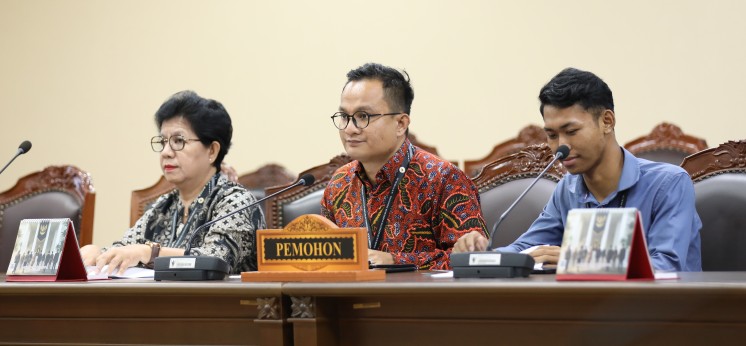
The Petitioners’ counsels presenting the petition at the preliminary hearing for Case No. 64/PUU-XXIV/2026 on the Basic Agrarian Law 1960, Friday (2/20/2026). Photo by MKRI/Ifa.
JAKARTA (MKRI) — Ariyanto Zalukhu, Desimeni Larosa, Christina W. Zega, Masnidarti Harefa, and Vendy Setiawan (Petitioners I-V) have petitioned the constitutionality of the Basic Agrarian Law No. 5 of 1960 (UUPA) to the Constitutional Court. The preliminary hearing for Case No. 64/PUU-XXIV/2026 on Friday, February 20, 2026 was presided over by Chief Justice Suhartoyo alongside Constitutional Justices Daniel Yusmic P. Foekh and M. Guntur Hamzah.
The Petitioners challenge Article 19 paragraph (1) of the Basic Agrarian Law, which stipulates: “In order to guarantee legal certainty, the Government shall conduct land registration throughout the territory of the Republic of Indonesia according to provisions laid by Government Regulation.”
Vendy Setiawan, representing the Petitioners, explained that Petitioner I is a member of a customary law community who controls, manages, and utilizes customary land as his living space, obtained and inherited for generations based on customary law recognized within his community. Such land has not been given a land title certificate. The absence of a certificate is not due to the absence of rights, but rather structural factors such as economic limitations, limited access to land registration services, minimal state assistance, and the continued operation of customary land tenure systems that have long been socially and historically recognized.
However, the Petitioners believe Article 19 paragraph (1) of the Basic Agrarian Law, which mandates land registration to obtain legal certainty, has placed the customary land controlled by Petitioner I in a vulnerable position. Normatively, unregistered land is positioned as land without legal certainty. Meanwhile, Petitioners II through IV are the lawful heirs of owners of customary land legally acquired by the Petitioners’ parents through sale and purchase deeds dated August 6, 1956; January 25, 1958; and October 7, 1969. Some of these deeds were executed before the enactment of the Law a quo and some after. The land has been physically managed for a very long period without registration or issuance of certificates. However, in 2023 and 2025, certain members of the Nias Regency DPRD (Regional Legislative Council) and civil servants at the Gunungsitoli City Office claimed to possess land title certificates over approximately ±5,000 m² of the Petitioners’ land and constructed buildings that factually overlap with land long controlled and managed by the Petitioners’ families.
As a direct consequence of the enforcement of the norm a quo, the Petitioners have suffered real and actual constitutional losses, including: loss of control and utilization of customary land that constitutes the families’ source of livelihood; deprivation of property rights and housing rights as guaranteed by Article 28H paragraph (4) of the 1945 Constitution; and loss of legal certainty and fair legal protection as guaranteed by Article 28D paragraph (1) of the 1945 Constitution, because certificates are positioned as absolute proof without room to prove pre-existing rights.
Petitioner V is an Indonesian citizen who once assisted administrative activities at a land office as a volunteer, and therefore was not equipped with legal authority, formal administrative responsibility, or institutional protection from the state. However, the absence of regulation regarding state responsibility in Article 19 of the Basic Agrarian Law has resulted in the burden of state administrative failures being unlawfully shifted to individual citizens, including Petitioner V. Thus, the institutional responsibility of the State has transformed into a personal burden on citizens without legal basis.
In their petitum, the Petitioners request the Court to: “Declare Article 19 paragraph (1) of Law No. 5 of 1960 concerning Basic Agrarian Principles (State Gazette of the Republic of Indonesia of 1960 No. 104, Supplement to State Gazette No. 2043) conditionally unconstitutional, insofar as the phrase ‘to ensure legal certainty by the Government’ is not interpreted as: ‘The Government’s obligation to conduct land registration to ensure legal certainty must be interpreted as an active obligation of the State to guarantee the material accuracy of physical and juridical data in land registration, to bear legal responsibility for every error and administrative defect arising from the implementation of land registration, and not to disregard the validity of rights that have historically and sociologically existed, including the rights of customary law communities as well as customary land and long-held land that have been physically controlled and inherited from generation to generation.’”
The Petitioners’ Evidence
Constitutional Justice M. Guntur Hamzah stated that the Petitioners need to submit evidence regarding the inherited land they claim as part of documents convincing the Court. This is to substantiate that the Petitioners indeed possess rights and that their constitutional rights have been violated due to the land status in question.
He further emphasized that Petitioners II through IV, as heirs, must prove their status, and Petitioner V, as a former worker at a land administration office, must also provide clear evidence. “All of it must be supported by evidence, not merely narrative in the petition,” he explained.
Meanwhile, Constitutional Justice Daniel Yusmic P. Foekh noted that issues concerning customary land are a national concern. Therefore, in establishing legal standing, the Petitioners must clarify and supplement a brief chronology regarding the claim of buildings constructed on the customary land.
“In terms of substance, the position of the Government in land affairs must also be strengthened. The state must indeed be present, but there are delineations of authority; this needs further clarification,” he stated.
Subsequently, Chief Justice Suhartoyo requested the Petitioners to submit evidence of the sale and purchase deeds demonstrating the legal linkage between the principals and the holders of land rights in the deeds presented in their petition. “Then re-examine whether it is truly this norm that creates legal uncertainty, or whether universally this norm produces such consequences,” he remarked.
Before adjourning the session, the chief justice announced that the Petitioners would have 14 days to revise the petition. The revised petition must have been received by the Court’s Registrar’s Office no later than 12:00 WIB on Thursday, March 5, 2026. The Court will the schedule the second session to hear the revisions to the petition.
Explore case No. 64/PUU-XXIV/2026 (in Indonesian).
Author : Sri Pujianti
Editor : N. Rosi
Translator : Yuniar Widiastuti (NL)
Disclaimer: The original version of the news is in Indonesian. In case of any differences between the English and the Indonesian versions, the Indonesian version will prevail.
Friday, February 20, 2026 | 10:19 WIB 126