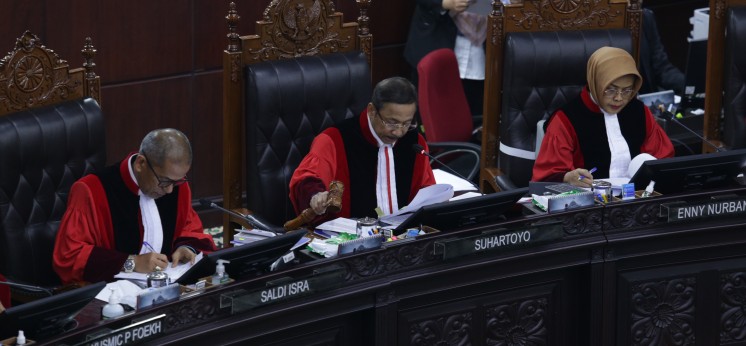
The Court holding the ruling hearing for Case No. 121/PUU-XXIV/2026 on the judicial review of Law No. 3 of 2020 on Mineral and Coal Mining, as last amended by Law No. 2 of 2025. Wednesday (6/17/2026). Photo by MKRI/Bay.
JAKARTA (MKRI) — The Constitutional Court rejected in its entirety the petition challenging Article 119(c) of Law No. 3 of 2020 on Mineral and Coal Mining (Mining Law). The petition in Case No. 121/PUU-XXIV/2026 was filed by Octolin H. Hutagalung and Arif Suherman. The ruling was delivered in the Plenary Courtroom of the Constitutional Court’s Building I on Wednesday, June 17, 2026.
Delivering the Court’s legal considerations, Constitutional Justice Adies Kadir explained that the revocation of a Mining Business Permit (IUP) or Special Mining Business Permit (IUPK) held by a company declared bankrupt is not automatic. A bankrupt debtor still has the opportunity to demonstrate good faith and pursue debt settlement through available legal mechanisms.
Where the debtor can prove efforts to reach a composition agreement or maintain the business as a going concern that benefits creditors, the Minister may consider not revoking the IUP or IUPK, or defer the revocation until the legal process is concluded. However, where the debtor fails to obtain a cassation ruling or a decision ratifying a composition agreement (homologation) within 12 months after the bankruptcy ruling, the permit holder may be subjected to an administrative sanction in the form of IUP or IUPK revocation by the Minister of Energy and Mineral Resources.
“The revocation of IUP or IUPK held by a company declared bankrupt cannot be considered contrary to bankruptcy law, in casu Law No. 37 of 2004. The going concern mechanism may still be applied, provided that the permit holder remains eligible to conduct mining operations in accordance with good mining practice as required by Article 65 of Law No. 3 of 2020,” Justice Adies said.
He added that Law No. 3 of 2020 and Law No. 37 of 2004 should not be set against one another in the context of bankruptcy proceedings involving mining companies.
Administrative Law Consequence
The Court further found that granting the Petitioners’ requested conditional interpretation would create legal uncertainty. The word “may” in Article 119(c), which gives the Minister discretion, would lose its meaning if the provision were interpreted to exclude bankrupt debtors whose businesses remain going concerns. Such an interpretation would transform the norm into a binding or imperative provision.
“Regarding the Petitioners’ argument on the revocation of IUP or IUPK held by a bankrupt debtor, the Court finds that it is an administrative law consequence. Legal mechanisms to challenge administrative acts or state administrative decisions are already available,” Justice Adies explained.
Minister’s Authority
The Court also addressed the Petitioners’ concern that companies whose permits are revoked would lose the opportunity to settle their debts, including tax obligations. According to the Court, this consequence need not occur. Once a company is no longer permitted to continue operating, its bankruptcy estate may be distributed by the curator to creditors according to their respective ranking, including preferred creditors such as the state for tax liabilities, workers for unpaid wages, and the curator for fees.
Nevertheless, the Court emphasized that although the Minister’s authority to revoke IUP or IUPK is discretionary, it must be exercised carefully and prudently when a bankrupt company is still permitted to continue operating as a going concern. Where necessary, the Minister should consider the supervisory judge’s oversight report before revoking the permit.
“A company that remains a going concern, although declared bankrupt, may still serve as a financial basis for improving the circumstances of parties affected by the bankruptcy ruling, particularly creditors, debtors, workers, and the state. Therefore, the Minister’s exercise of authority must also be directed toward realizing the principle of fair legal certainty,” Justice Adies said.
Also read:
Minister’s Revocation of Mining Permits Challenged
Petitioners Seek Clarification on Mining Permit Revocation
Previously, at the preliminary hearing, the Petitioners argued that Article 119(c) of Law No. 3 of 2020 violates Article 28D(1) of the 1945 Constitution because it fails to ensure legal certainty, guarantees, and protection for debtors holding IUP or IUPK that have been declared bankrupt but remain going concerns.
They argued that the provision is not aligned with Law No. 37 of 2004 on Bankruptcy and Suspension of Debt Payment Obligations, particularly Articles 179 through 182 on the continuation of a bankrupt debtor’s business.
Janses explained that once a debtor is declared bankrupt, the authority to control and manage its assets transfers to a curator under Article 24(1) of the Bankruptcy and Suspension of Debt Payment Obligations Law. A curator may seek permission from the supervisory judge to continue the debtor’s business operations through the going concern mechanism.
The Petitioners maintained that continuing a bankrupt debtor’s business could generate economic benefits, including state revenue from the mining sector and the settlement of tax obligations and other debts. Conversely, they argued that revoking the IUP or IUPK of a debtor whose business remains a going concern could harm creditors, workers, debtors, and the state.
Author: Utami Argawati
Editor: Lulu Anjarsari P.
PR: Raisa Ayuditha M.
Translator: Yuanna Sisilia
The Complete Decision: Decision No. 121/PUU-XXIV/2026
Disclaimer: The original version of the news is in Indonesian. In case of any differences between the English and the Indonesian versions, the Indonesian version will prevail.
Wednesday, June 17, 2026 | 16:36 WIB 6