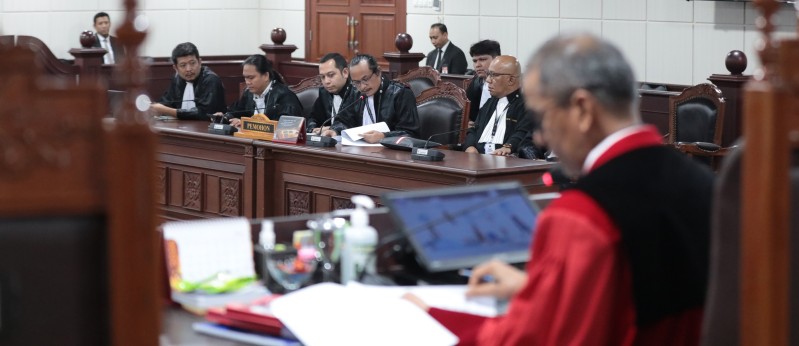
The Constitutional Court holding a hearing to examine the revised petition in the judicial review of the Mining Law, Wednesday (4/22/2026). Photo by MKRI/IlhamWM.
JAKARTA (MKRI) — The Constitutional Court (MK) held a petition revision hearing on Wednesday, April 22, 2026, for the judicial review of Article 119(c) of Law No. 3 of 2020 on Mineral and Coal Mining (Mining Law). The petition, registered as Case No. 121/PUU-XXIV/2026, was filed by Octolin H. Hutagalung and Arif Suherman, who challenge the minister’s authority to revoke Mining Business Permits (IUP) and Special Mining Business Permits (IUPK).
Represented by their legal counsel Janses Sihaloho, the Petitioners conveyed revisions as advised by the panel of justices during the preliminary hearing. The hearing was presided over by Deputy Chief Justice Saldi Isra, alongside Constitutional Justices Adies Kadir and Liliek P. Adi.
“We have refined our legal standing and clarified the constitutional basis for review. We also elaborate on Article 119(c), which provides two possible actions when a company is declared bankrupt: revocation or non-revocation. We request the Court to interpret that if there is a court ruling declaring the company as a going concern, then the only option is not to revoke the permits,” Janses stated before the panel.
In their revised petitum, the Petitioners request the Court to declare Article 119(c) of Law No. 3 of 2020, amending Law No. 4 of 2009 on Mineral and Coal Mining, as further amended by Law No. 2 of 2025, contrary to the 1945 Constitution and not legally binding insofar as it is not interpreted to mean “excluded for holders of IUP or IUPK who have been declared bankrupt but are allowed by the Commercial Court to continue their business (going concern).”
Also read: Minister’s Revocation of Mining Permits Challenged
Previously, in the preliminary hearing, the Petitioners argued that Article 119(c) of Law No. 3 of 2020 contradicts Article 28D(1) of the 1945 Constitution, as it fails to ensure legal certainty and protection, particularly for debtors holding IUP or IUPK who have been declared bankrupt but remain in a going concern condition. According to them, the provision creates legal uncertainty as it is not aligned with Law No. 37 of 2004 on Bankruptcy and Suspension of Debt Payment Obligations, particularly Articles 179 through 182 concerning the continuation of a bankrupt debtor’s business.
Janses further explained that under bankruptcy law, a debtor declared bankrupt loses the authority to manage and control their assets upon the issuance of the bankruptcy ruling. Such authority is transferred to a curator, as stipulated in Article 24(1) of the Bankruptcy and Suspension of Debt Payment Obligations Law. He added that one measure available to the curator to ensure debt repayment is to seek approval from the supervisory judge to continue the debtor’s business activities. This scheme, known as going concern, is considered capable of providing legal certainty for both creditors and debtors.
The Petitioners believe that maintaining the business continuity of a bankrupt debtor may generate broader economic benefits, including state revenue from the mining sector and the settlement of tax and other financial obligations. Conversely, revoking IUP or IUPK from a bankrupt debtor that remains a going concern would potentially harm various parties, including the state.
Author: Utami Argawati
Editor: Lulu Anjarsari P.
PR: Adriana A.Y.
Translator: Yuanna Sisilia
Disclaimer: The original version of the news is in Indonesian. In case of any differences between the English and the Indonesian versions, the Indonesian version will prevail.
Explore the Case: Case No.121/PUU-XXIV/2026 (in Bahasa Indonesia)
Wednesday, April 22, 2026 | 16:39 WIB 59