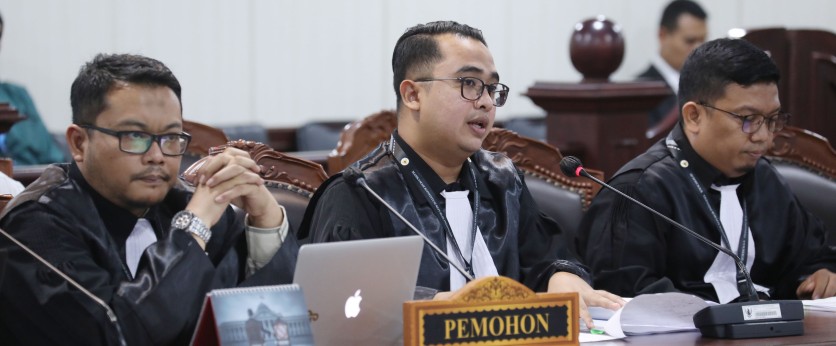
Agil Oktaryal and Dudy Agung Tresna, legal counsel to the Petitioners challenging Law No. 1 of 2022 on Financial Relations between the Central Government and Regional Governments, presenting the revised petition at a panel hearing. Wednesday (6/17/2026). Photo by MKRI/Panji.
JAKARTA (MKRI) — Regional Autonomy Watch (KPPOD) and the Indonesian Forum for Budget Transparency (FITRA) submitted revisions to their petition in Case No. 171/PUU-XXIV/2026 concerning the material judicial review of Law No. 1 of 2022 on Financial Relations between the Central Government and Regional Governments (HKPD Law) before the Constitutional Court (MK).
The Petitioners asserted that the petition challenges Article 107 paragraphs (2) and (4), Article 109 paragraph (1), and Article 146 paragraph (1) of the HKPD Law against Article 1 paragraph (3), Article 18 paragraph (5), Article 18A paragraph (2), Article 28C paragraph (2), and Article 28D paragraph (1) of the 1945 Constitution.
“At its core, the petition is not intended to call into question particular policies adopted by the central government. Rather, it challenges the normative design established by the lawmakers, as the provisions are alleged to contain arrangements that run counter to the constitutional principles enshrined in the 1945 Constitution,” said Agil Oktaryal, legal counsel to the Petitioners, in the Constitutional Court’s panel courtroom in Jakarta on Wednesday, June 17, 2026.
The Petitioners argued that the challenged provisions are closely linked to financial relations between the central and regional governments, which form an integral part of the regional autonomy regime guaranteed under Article 18 paragraph (5) and Article 18A paragraph (2) of the 1945 Constitution. Therefore, when lawmakers establish mechanisms for fiscal management, oversight, and the allocation of authority that may diminish regional autonomy, the issue is no longer merely how the provisions are implemented, but whether their normative design is consistent with the Constitution’s mandate for decentralization and a fair and harmonious fiscal balance between the central and regional governments.
“The main issue in the a quo petition is whether the challenged provisions were formulated in accordance with the principles of the rule of law, regional autonomy, a fair and harmonious fiscal balance between the central and regional governments, as well as legal certainty and citizens’ constitutional rights, as mandated by the 1945 Constitution,” Oktaryal said.
Also read: Petitioners Challenge HKPD Law over MBG Funding Policy and Regional Autonomy
At the preliminary hearing on Wednesday, June 3, 2026, the Petitioners argued that Article 107 paragraph (2) of the HKPD Law gives the central government legitimacy to prioritize national budgetary priorities over potentially more urgent local needs. They maintained that the implementation of flagship national programs, such as the Free Nutritious Meals (MBG) program, through mandatory adjustments to Regional Transfers (TKD), constitutes a tangible erosion of regional autonomy.
According to the Petitioners, this practice is unconstitutional because regional governments no longer exercise the broadest possible autonomy, but merely serve as distribution channels for central government priorities that draw upon regional financial resources.
The Petitioners further asserted that regional autonomy provides regional governments with the broadest possible scope to manage their own affairs and improve public services in order to accelerate community welfare. However, reductions in Regional Transfers have caused problems in the regions, particularly in infrastructure development and the payment of employee entitlements, including basic salaries and holiday allowances.
In their petitum, the Petitioners requested that the Court grant the petition in its entirety and declare Article 107 paragraphs (2) and (4), Article 109 paragraph (1), and Article 146 paragraph (1) of the HKPD Law conditionally unconstitutional and not legally binding insofar as they are not interpreted as requested by the Petitioners.
The Petitioners requested that Article 107 paragraph (2) of the HKPD Law be interpreted as follows:
“Regional Transfer policy as referred to in paragraph (1) shall refer to the National Medium-Term Development Plan and relevant statutory laws and regulations, be aligned with the Government Work Plan, and be set out in the Financial Note and draft State Budget for the following fiscal year, while ensuring a fair allocation of funding consistent with the regions’ actual needs.”
They also requested that Article 107 paragraph (4) be interpreted as follows:
“Regional Transfer policy as referred to in paragraph (3) shall first be discussed with the regional autonomy advisory council before the Financial Note and draft State Budget are submitted to the House of Representatives (DPR), and must involve all stakeholder groups focusing on the implementation of regional autonomy.”
The Petitioners further requested that Article 109 paragraph (1) be interpreted as follows:
“Regional Transfer policy as referred to in Article 107 paragraph (2) and the budget amount referred to in Article 108 paragraph (1) may be adjusted by taking account of national economic conditions, and must preserve regional fiscal capacity and financial stability through an appropriate mechanism.”
In addition, they requested that Article 146 paragraph (1) be interpreted as follows:
“Regional governments shall allocate personnel expenditure, excluding teacher allowances allocated through Regional Transfers, at no more than 30 percent of total expenditure under the Regional Revenue and Expenditure Budget (APBD), except for regions that objectively have special territorial characteristics, a large geographic area, and a substantial burden of basic public services, following consideration from a representative regional autonomy advisory council.”
Author: Mimi Kartika
Editor: N. Rosi
PR: Andhini SF
Translator: Yuanna Sisilia
Explore the Case: Case No. 171/PUU-XXIV/2026
Disclaimer: The original version of the news is in Indonesian. In case of any differences between the English and the Indonesian versions, the Indonesian version will prevail.
Wednesday, June 17, 2026 | 17:13 WIB 5