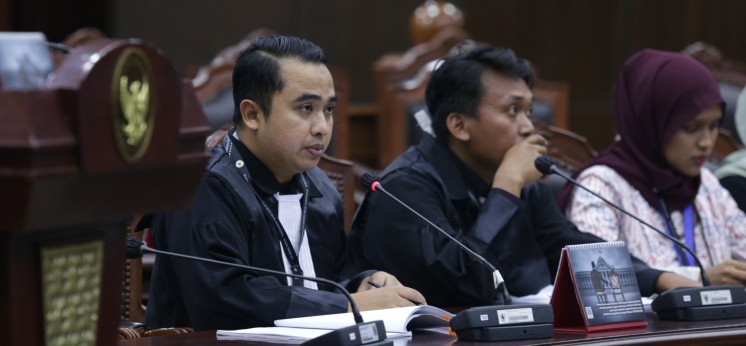
The Petitioners’ legal counsel presenting arguments at the preliminary hearing for Case No. 171/PUU-XXIV/2026 on the judicial review of Law No. 1 of 2022 on Financial Relations Between the Central Government and Regional Governments, Wednesday (6/3/2026). Photo by MKRI/Bayu.
JAKARTA (MKRI) — The Regional Autonomy Watch Committee (KPPOD) and the Indonesian Forum for Budget Transparency (FITRA) have petitioned the Constitutional Court to review Article 107 paragraph (2), paragraph (4), Article 109, and Article 146 of Law No. 1 of 2022 on Financial Relations Between the Central Government and Regional Governments (HKPD Law). They argue that Article 107 paragraph (2) grants the central government excessive authority to prioritize national budgetary programs over local needs that may be more pressing for regional communities.
In Petition No. 171/PUU-XXIV/2026, the Petitioners contend that the implementation of flagship national programs such as the Free Nutritious Meals (MBG) program through mandatory adjustments to Regional Transfers (TKD) constitutes a tangible erosion of regional autonomy. They maintain that this practice contravenes Article 18 paragraph (5) of the 1945 Constitution because regional governments no longer exercise the broad autonomy guaranteed by the Constitution, but instead function merely as channels for implementing central government priorities that draw upon regional financial resources.
“The implementation of flagship national programs such as the Free Nutritious Meals (MBG) program through mandatory TKD adjustments constitutes a clear erosion of regional autonomy,” said the Petitioners’ legal counsel, Agil Oktaryal, during the preliminary hearing on Wednesday, June 3, 2026, in the Constitutional Court’s courtroom in Jakarta.
The Petitioners explained that regional governments are responsible for optimizing local potential to improve the welfare of their respective communities. However, when financial resources are redirected or restricted to meet central government priorities, regional heads face obstacles in delivering on their political commitments and development agendas tailored to local needs, as available budgets have already been earmarked for centrally determined programs.
They further emphasized that regional autonomy is intended to grant local governments broad discretion to manage their own affairs and improve public services, thereby accelerating regional prosperity. Nevertheless, reductions in TKD allocations have, according to the Petitioners, created various challenges, particularly in infrastructure development and the fulfillment of employees’ rights, including basic salaries and holiday allowances, among other expenditures.
In their petitum, the Petitioners request that the Court grant the petition in its entirety and declare Article 107 paragraph (2), paragraph (4), Article 109, and Article 146 of the HKPD Law contrary to the 1945 Constitution and conditionally unconstitutional unless interpreted in accordance with the formulations proposed by the Petitioners.
They seek a reinterpretation of Article 107 paragraph (2) to read: “The TKD policy as referred to in paragraph (1) shall refer to the national medium-term development plan, while continuing to ensure fair funding allocations that correspond to the actual needs of regions and relevant statutory laws and regulations, remain aligned with the government work plan, and be incorporated into the financial memorandum and draft state budget for the following fiscal year.”
The Petitioners also request that Article 107 paragraph (4) be interpreted to require prior discussion of TKD policies through a regional autonomy advisory forum and with the participation of civil society organizations concerned with regional autonomy, thereby ensuring meaningful participation before the submission of the financial memorandum and draft state budget to the House of Representatives (DPR). They further seek provisions mandating the involvement of all stakeholders in regional governance and requiring that decisions on TKD policies be made in accordance with the principle of meaningful participation before the draft state budget is submitted.
Regarding Article 109, the Petitioners propose that it be interpreted as follows: “The TKD policy as referred to in Article 107 paragraph (2) and the budget allocation as referred to in Article 108 paragraph (1) may be adjusted by taking into account national economic conditions and must safeguard regional fiscal capacity and financial stability through a meaningful participation mechanism involving regional representatives to ensure fair and harmonious intergovernmental relations.”
They also seek a revised interpretation of Article 146 to read: “Regional governments shall allocate expenditure for regional personnel, excluding teacher allowances financed through TKD, at a maximum of 30 percent of total regional budget expenditure, except for regions that objectively possess special territorial characteristics, extensive geographic coverage, and substantial public service obligations, following consideration by a representative regional autonomy advisory forum.”
The petition was heard by a panel of constitutional justices chaired by Chief Justice Suhartoyo, alongside Constitutional Justices Daniel Yusmic P. Foekh and M. Guntur Hamzah. During the advisory session, Justice Guntur observed that while the petition had adequately outlined the legal issues involved, it had yet to sufficiently explain the constitutional issues arising from the alleged conflict between each challenged provision of the HKPD Law and the constitutional provisions invoked as the basis for review.
“You have cited five constitutional provisions as the basis of review, and these must be substantiated more convincingly. The justices need to clearly see the constitutional conflict between the challenged norms and the constitutional norms being invoked, rather than merely identifying legal problems within the law itself,” Justice Guntur remarked.
Explore the case: Case No. 171/PUU-XXIV/2026
Author: Mimi Kartika
Editor: N. Rosi
PR: Andhini SF
Translator: Yuanna Sisilia
Disclaimer: The original version of the news is in Indonesian. In case of any differences between the English and the Indonesian versions, the Indonesian version will prevail.
Wednesday, June 03, 2026 | 18:05 WIB 4