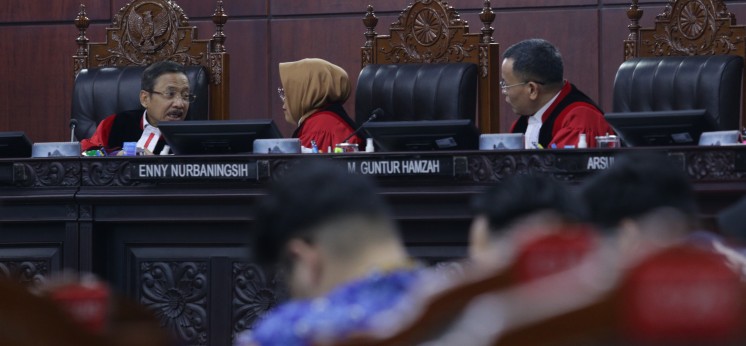
Decision Pronouncement Hearing of Case No. 139/PUU-XXIV/2026 on the material review of Law No. 8 of 2011 on the Amendment to Law No. 24 of 2003 on the Constitutional Court and Law No. 24 of 2003 on the Constitutional Court on Wednesday (17/6). Photo by MKRI/Bay.
Jakarta (MKRI) – The Constitutional Court (MK) cannot accept a petition submitted by Adam Imam Hamdana and Wianda Julita Maharani to review Article 41 paragraph (1) of Law No. 24 of 2003 on the Constitutional Court, and rejects a petition to review Law No. 8 of 2011 on the Amendment to Law No. 24 of 2003 on the Constitutional Court. These were Decision No. 139/PUU-XXIV/2026, pronounced on Wednesday, June 17, 2026, at the Plenary Courtroom, Jakarta.
In its legal considerations, as read out by Justice Liliek P Adi, the Court states that the resolution of a case depends on the characteristics and complexity of its issues. “Constitutional Justices need time to review the consistency and strength of the petition’s arguments, which need multidisciplinary studies because many laws regulate technical aspects in detail, for example, laws on economy, taxes, health, environment, technology, general elections, and so forth,” Justice Liliek stated.
However, the lack of a time limit does not mean that the Court does not work to expedite the handling of the cases. Statistically, the average time to handle judicial review cases has been decreasing year by year.
Based on these considerations, the Court declared that the petition for review of Article 41 paragraph (1) of Law No. 24 of 2003 before the Constitutional Court cannot be accepted. The Court also rejected the Petitioner’s remaining requests
Also read:
The Absence of Time Limit in Judicial Review Questioned
Students Revise Petition on Time Limit in Judicial Review Cases
During the preliminary hearing on Monday, April 27, 2026, students of the Sharia and Law Faculty of Universitas Islam Negeri Sayyid Ali Rahmatullah Tulungagung: Adam Imam Hamdana and Wianda Julita Maharani, questioned the absence of a time limit in the judicial review cases. They challenged Law No. 8 of 2011 on the Amendment to Law No. 24 of 2003 on the Constitutional Court and Law No. 24 of 2003 of the Constitutional Court.
Petitioners argued that the absence of a consistent time limit in the case hearing and handling has created legal uncertainty. Attending the hearing online, the Petitioners contended that the challenged provision also resulted in a lack of transparency before the Panel of Justices led by Deputy Chief Justice Saldi Isra. The Petitioners submitted a comparison of the schedules applied in the Constitutional Courts of several countries. Based on such arguments, the Petitioners requested that the Court provide a constitutional interpretation of the time limit on the examination hearing, which, in essence, states that, should the hearing be postponed, the Court should inform the Petitioners of the reason for the postponement.
In the petitum, the Petitioners request the Court to declare the phrase “Examination Hearing” in the Sixth Part of the Constitutional Court Law contradicts the 1945 Constitution of the Republic of Indonesia and conditionally has no legally binding power conditionally as long as it is not interpreted as “The examination hearing shall be conducted within a period of no later than 30 (thirty) working days as from the holding of the preliminary hearing, provided that, in exceptional circumstances, the Court may conduct the examination hearing beyond that time limit, after first notifying the Petitioner of the reasons for any postponement and/or rescheduling.”
The Petitioners also request the Court to declare the phrase “Decree” in Article 48A of the Constitutional Court Law contradicts the 1945 Constitution of the Republic of Indonesia and conditionally has no legally binding power as long as it is not interpreted as “A decree shall be issued by the Court within a period of no later than 60 (sixty) working days as from the date of the last hearing, provided that, in exceptional circumstances, the Court may issue such decree beyond that time limit after first notifying the Petitioner of the reasons for any postponement and/or rescheduling.”
In addition, they also ask the Court to declare the phrase “Decision” in Article 56 of the Constitutional Court Law contradicts the 1945 Constitution and conditionally has no legally binding power as long as it is not interpreted as “A decision shall be issued by the Court within a period of no later than 60 (sixty) working days as from the date of the last hearing, provided that, in exceptional circumstances, the Court may issue such decision beyond that time limit after first notifying the Petitioner of the reasons for any postponement and/or rescheduling.”
Case tracking: Petition No. 139/PUU-XXIV/2026 (in Indonesian)
Read in full: Decision No. 139/PUU-XXIV/2026 (in Indonesian)
Author: Ilham Wiryadi Muhammad.
Editor: N. Rosi.
PR: Raisa Ayuditha M.
Translator: Rizky Kurnia Chaesario
Disclaimer: The original version of the news is in Indonesian. In case of any differences between the English and the Indonesian versions, the Indonesian version will prevail.
Wednesday, June 17, 2026 | 20:45 WIB 7