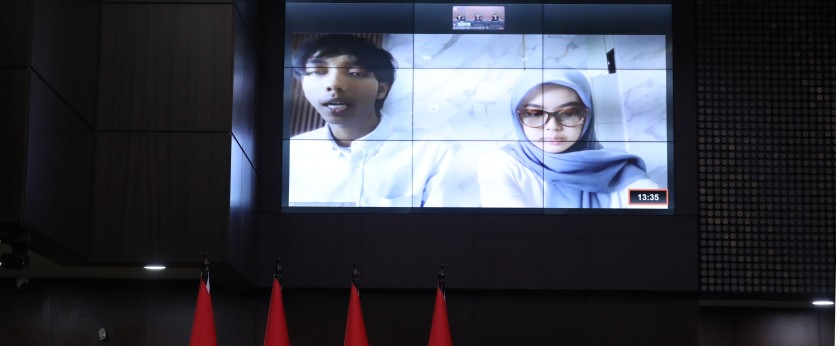
Petitioners Adam Imam and Wanda Junita attending the judicial review hearing on the Constitutional Court Law to deliver the main points of their petition online on Monday (27/4). Photo by MKRI/Panji.
Jakarta (MKRI) – The lack of any time limit for the Constitutional Court’s handling of petitions for judicial review has come under scrutiny. Petitioners of Case No. 139/PUU-XXIV/2026 comprise Adam Imam Hamdana and Wianda Julita Maharani, both students of the Sharia and Law Faculty of Universitas Islam Negeri Sayyid Ali Rahmatullah Tulungagung. They challenged Law No. 8 of 2011 on the Amendment to Law No. 24 of 2003 on the Constitutional Court and Law No. 24 of 2003 of the Constitutional Court. The first hearing of the case was held on Monday, April 27, 2026.
Petitioners argued that the absence of a consistent time limit in the case hearing and handling has created legal uncertainty. “It is as if the Petitioners were bound by uncertainty on their cases,” Adam stated. In addition, the lack of a time limit has also caused a delay in justice.
Attending the hearing online, the Petitioners contended that the challenged provision also resulted in a lack of transparency before the Panel of Justices led by Deputy Chief Justice Saldi Isra. The Petitioners submitted a comparison of the schedules applied in the Constitutional Courts of several countries. Based on such arguments, the Petitioners requested that the Court provide a constitutional interpretation of the time limit on the examination hearing, which, in essence, states that, should the hearing be postponed, the Court should inform the Petitioners of the reason for the postponement.
In the petitum, the Petitioners request the Court to declare the phrase “Examination Hearing” in the Sixth Part of the Constitutional Court Law contradicts the 1945 Constitution of the Republic of Indonesia and conditionally has no legally binding power conditionally as long as it is not interpreted as “The examination hearing shall be conducted within a period of no later than 30 (thirty) working days as from the holding of the preliminary hearing, provided that, in exceptional circumstances, the Court may conduct the examination hearing beyond that time limit, after first notifying the Petitioner of the reasons for any postponement and/or rescheduling.”
The Petitioners also request the Court to declare the phrase “Decree” in Article 48A of the Constitutional Court Law contradicts the 1945 Constitution of the Republic of Indonesia and conditionally has no legally binding power as long as it is not interpreted as “A decree shall be issued by the Court within a period of no later than 60 (sixty) working days as from the date of the last hearing, provided that, in exceptional circumstances, the Court may issue such decree beyond that time limit after first notifying the Petitioner of the reasons for any postponement and/or rescheduling.”
In addition, they also ask the Court to declare the phrase “Decision” in Article 56 of the Constitutional Court Law contradicts the 1945 Constitution and conditionally has no legally binding power as long as it is not interpreted as “A decision shall be issued by the Court within a period of no later than 60 (sixty) working days as from the date of the last hearing, provided that, in exceptional circumstances, the Court may issue such decision beyond that time limit after first notifying the Petitioner of the reasons for any postponement and/or rescheduling.
Justices’ Advice
Responding to the petition, Justice Adies Kadir asked the Petitioner to explain which article contains the phrase “hearing”. He also requested that the petitioner clearly state the article being challenged, as it has not been mentioned in their petition.
“The question is whether the article being challenged is Article 41 of Law 24/2003 or Article 41 of Law 8/2011, please clarify there,” Justice Adies said.
He further advised the Petitioners to clarify their legal standing and point out the constitutional rights under the 1945 Constitution that serve as the touchstone. Justice Adies stated that the Petitioners must explain the constitutional harm caused by the lack of a time limit in judicial review proceedings, as well as the contradiction between the challenged norms and the 1945 Constitution.
Justice Liliek P. Adi noted that the Petitioners must clarify the relationship between the lack of a time limit in judicial review proceedings and the lack of transparency. “You may add facts, cases, and data in the Constitutional Court decisions, in which, based on your knowledge and understanding, the time is uncertain and lengthy, so that it creates uncertainty and injustice,” Justice Liliek stated.
Deputy Chief Justice Saldi Isra requested the Petitioners to revise their petition by elaborating on the constitutional harm they suffer. “The legal standing is your basis. You had your internship, and because of that, you withdrew your petition to avoid a conflict of interest. It was not your intention, then you made it the basis to question the lack of a time limit in the judicial review proceedings in the Constitutional Court,” Deputy Chief Justice Saldi Isra said.
Deputy Chief Justice Saldi asked the Petitioners whether such a situation is sufficient to confer legal standing in this case, considering that the option you had was to cancel the internship or withdraw the petition, and you chose to withdraw the petition. Besides, there is no time limit in judicial review proceedings, unlike in other Court authorities. It depends on the character of the petition whether it needs to be heard in plenary session for further examination.
Deputy Chief Justice Saldi asked the Petitioners to explain the causal relationship between the challenged norm and the constitutional harm they experienced. “You withdrew the petition not because of the Court’s willingness to, but because you took the internship in the Constitutional Court,” he said. The Petitioners also advised reviewing the norm, as the law has been revised several times.
Case tracking: Petition No. 139/PUU-XXIV/2026
Author: Ilham Wiryadi Muhammad.
Editor: N. Rosi.
PR: Raisa Ayuditha M.
Translator: Rizky Kurnia Chaesario
Disclaimer: The original version of the news is in Indonesian. In case of any differences between the English and the Indonesian versions, the Indonesian version will prevail.
Monday, April 27, 2026 | 17:15 WIB 58