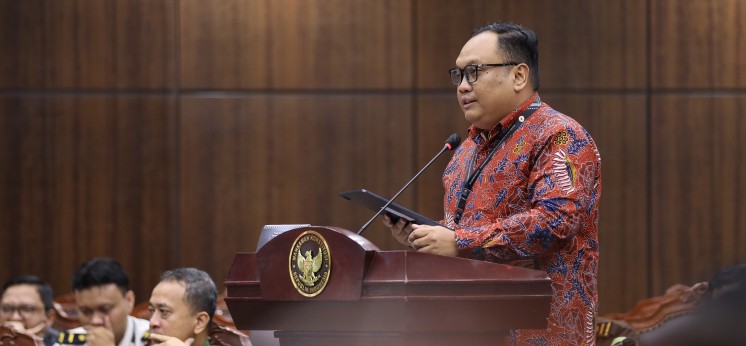
Airlangga University Faculty of Law criminal law expert Maradona testifying as an expert for the House of Representatives (DPR) at the follow-up hearing for the judicial review of Law No. 20 of 2025 on the Criminal Procedure Code, Thursday (5/21/2026) in the Constitutional Court courtroom. Photo by MKRI/Ifa.
JAKARTA (MKRI) — The Constitutional Court (MK) held a hearing for Petition No. 31/PUU-XXIV/2026 on the judicial review of Article 2 paragraph (2), Article 6 paragraph (2), Article 31, Article 32 paragraph (1), Article 79 paragraph (8), Article 93 paragraph (3), Article 99 paragraph (3), Article 277, Article 281, Article 282 paragraph (1), and Article 344 paragraph (3) of Law No. 20 of 2025 on the Criminal Procedure Code (KUHAP), with the agenda of hearing testimony from the House of Representatives’ experts on Thursday, May 21, 2026. The House presented Airlangga University Faculty of Law criminal law expert Maradona and Andalas University Faculty of Law Criminal Law Department lecturer Lucky Raspati.
In his testimony, Lucky explained that Article 2 paragraph (2) and Article 344 paragraph (3) of the 2025 KUHAP had properly implemented the principle of functional differentiation. According to Lucky, assigning the function of Community Counselors (PK) to the rehabilitation stage for inmates and convicts, or post-adjudication, is consistent with the philosophy of adult criminal procedure.
Lucky argued that PK’s involvement from the investigation stage, as practiced in the juvenile justice system, cannot automatically be applied to the general criminal justice system because the subjects are adults who are fully responsible for their actions. “This separation of roles actually prevents ethical dilemmas that could compromise the objectivity of social inquiry reports (Litmas) if PK were forced to be involved in the adversarial stage of investigation,” Lucky said.
Meanwhile, Maradona stated that this construction is a form of single point of accountability to ensure uniform human rights protection standards across Indonesia. Maradona emphasized that the Indonesian National Police’s position as the lead investigator has a strong constitutional basis in Article 30 paragraph (4) of the 1945 Constitution and represents continuity from a system that has been tested since the 1981 KUHAP.
Regarding the coordination of coercive measures under Article 93 paragraph (3) and Article 99 paragraph (3), the experts considered that the obligation for civil servant investigators (PPNS) to request an order from the National Police before making arrests or detentions is not a form of discriminatory subordination. This mechanism is seen as quality control and horizontal checks and balances to ensure that the deprivation of citizens’ liberty is carried out proportionally and meets security and health standards, considering that the National Police has more standardized detention facilities and interview rooms.
“The National Police functions to maintain coordination, procedural standards, and the integration of the investigation system, while PPNS carry out special investigative functions based on technical competence and mandates under sectoral laws. Therefore, the relationship between the lead investigator and PPNS should be understood as coordinative, not as hierarchical command,” Maradona said.
Responding to the judicial review of Article 31 and Article 32 paragraph (1) of KUHAP, Lucky argued that suspects’ right to legal assistance had been fully fulfilled through assistance by advocates. He said advocates are professionals specifically trained to provide legal defenses and safeguard due process of law, while PK’s competence lies more in social assessment and rehabilitation.
Furthermore, regarding the omission of PK from Article 277 on excerpts of decisions, Article 281 on courtroom layout, and Article 282 paragraph (1) on the position of the parties, the experts viewed such omission as rational. PK are not mentioned because they are not adversarial parties in adult criminal trials.
“Forcing PK to attend every trial would instead obscure the principle of functional differentiation and create confusion over roles,” Lucky said.
Lastly, regarding Article 79 paragraph (8) of KUHAP, the expert considered the optional involvement of PK in restorative justice to be appropriate. Lucky explained that requiring PK’s involvement in every restorative process, especially in simple cases, would create bureaucratization that would hinder the swift and efficient achievement of peace in accordance with the principle of simple and low-cost justice.
Based on all these explanations, the two experts concluded that the reviewed articles remain constitutional because they provide legal certainty, guarantee accountability, and create a balance between the effectiveness of law enforcement under the Crime Control Model and the protection of human rights under the Due Process Model.
Also read:
Activist, Advocate Question Limits to Role of Corrections Counselors
Petitioners Revise KUHAP Judicial Review Petition on the Role of Corrections Counselors
DPR and Government Request Postponement of KUHAP Judicial Review Hearing
Government: New Criminal Procedure Code Strengthens the Urgency of Community Counselors’ Role
Development of Correctional Centers and Community Counselors Considered Less Than Optimal
For information, Petition No. 31/PUU-XXIV/2026 was filed by activist Adhel Setiawan and advocate Komarudin. They challenge the provisions limiting the role of Community Counselors as well as the alleged discrimination and subordination of civil servant investigators. They are reviewing Article 2 paragraph (2), Article 6 paragraph (2), Article 31, Article 32 paragraph (1), Article 79 paragraph (8), Article 93 paragraph (3), Article 99 paragraph (3), Article 277, Article 281, Article 282 paragraph (1), and Article 344 paragraph (3) of KUHAP.
Adhel, who is also a former general chairperson of the Jakarta Branch of the Islamic Students Association (HMI) for the 2007–2008 period, a former member of HMI’s Executive Board, and a member of the Perkumpulan Jaringan Advokasi Hutan, said Article 2 paragraph (2) and Article 344 paragraph (3) of KUHAP limit Community Counselors’ role only to inmate rehabilitation. This is because Article 31 of KUHAP only mentions suspects’ right to an advocate without Community Counselors; Article 32 paragraph (1) of KUHAP only mentions legal assistance without Community Counselors; and Article 79 paragraph (8) of KUHAP regulates restorative justice without mentioning the role of Community Counselors at all.
He further argued that criminal proceedings would be reduced to a mere punishment machine, thereby violating Article 28D paragraph (1) of the 1945 Constitution of the Republic of Indonesia on fair legal certainty. In addition, he argued that this also violates Article 28H paragraph (1) and Article 34 paragraph (3) of the 1945 Constitution concerning the state’s responsibility to uphold social and humanitarian approaches.
Furthermore, Adhel stated that Article 6 paragraph (2) of KUHAP, which designates the Indonesian National Police (Polri) as the lead investigator; Article 93 paragraph (3) of KUHAP, which states that PPNS and certain investigators cannot make arrests except upon an order from National Police investigators; and Article 99 paragraph (3) of KUHAP, which states that PPNS and certain investigators cannot make detentions except upon an order from National Police investigators, constitute not coordination but discriminatory structural subordination. As a result, law enforcement in the environmental, forestry, taxation, immigration, fisheries, and other sectors becomes slow, loses momentum in red-handed arrests, and becomes ineffective.
The Petitioners believe that this directly contradicts Article 1 paragraph (3) of the 1945 Constitution on the rule of law; Article 27 paragraph (1) of the 1945 Constitution on equal standing before the law; Article 28D paragraph (1) of the 1945 Constitution on fair legal certainty; and Article 28I paragraph (2) on the prohibition of discrimination. They also argue that it contradicts Article 28G paragraph (1) and Article 28H paragraph (2) of the 1945 Constitution concerning the right to personal protection and security as well as equal treatment.
In their petitums, the Petitioners request the Court to declare the material content of Article 2 paragraph (2) and Article 344 paragraph (3) of KUHAP contrary to the 1945 Constitution and conditionally unconstitutional and not legally binding insofar as it is not interpreted to mean that Community Counselors carry out Community Counseling functions through social inquiry, assistance, guidance, and supervision within and outside judicial proceedings; to declare Article 31, Article 32 paragraph (1), Article 79 paragraph (8), Article 277, Article 281, and Article 282 paragraph (1) of KUHAP contrary to the 1945 Constitution and conditionally unconstitutional and not legally binding insofar as they are not interpreted to require the involvement of Community Counselors; to declare the phrase “investigation within the Indonesian National Police” in Article 2 paragraph (2) of KUHAP contrary to the 1945 Constitution and conditionally unconstitutional and not legally binding insofar as it is not interpreted as “the investigative function of investigators”; to declare the phrase “lead investigator” in Article 6 paragraph (2) of KUHAP contrary to the 1945 Constitution and not legally binding; and to declare the material content of Article 93 paragraph (3) and Article 99 paragraph (3) of KUHAP contrary to the 1945 Constitution and conditionally unconstitutional and not legally binding insofar as they are not interpreted to mean that civil servant investigators and certain investigators may make arrests and detentions.
Author: Mimi Kartika
Editor: N. Rosi
PR: Fauzan Febriyan
Translator: Siti Rosmalina Nurhayati
Explore the case: Petition No. 31/PUU-XXIV/2026
Disclaimer: The original version of the news is in Indonesian. In case of any differences between the English and the Indonesian versions, the Indonesian version will prevail.
Thursday, May 21, 2026 | 14:50 WIB 2