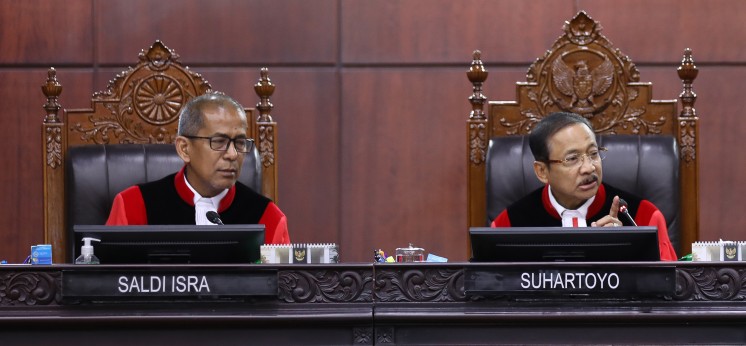
Chief Justice Suhartoyo and Deputy Chief Justice Saldi Isra chairing a judicial review hearing of Law No. 20 of 2025 on the Criminal Procedure Code (KUHAP) at the Constitutional Court courtroom (3/13/2026). Photo by MKRI/Ifa.
JAKARTA (MKRI) — The Constitutional Court (the Court) postponed the hearing for Petition No. 31/PUU-XXIV/2026 concerning the judicial review of Article 2 paragraph (2), Article 31, Article 32 paragraph (1), Article 79 paragraph (8), Article 277, Article 281, Article 282 paragraph (1), Article 344 paragraph (3), Article 6 paragraph (2), Article 93 paragraph (3), and Article 99 paragraph (3) of Law No. 20 of 2025 on the Criminal Procedure Code (KUHAP). The postponement followed requests from the House of Representatives (DPR) and the Government, both of which stated they were not yet ready to present their statements on Friday, March 13, 2026.
“The agenda for this morning’s hearing was to hear statements from the DPR and the President. However, both parties have requested a postponement as they are not yet prepared. The DPR may currently be in recess, while the Government may already be on holiday travel,” said Chief Justice Suhartoyo in the Court’s plenary courtroom in Jakarta.
Justice Suhartoyo further stated that the Court has not yet scheduled the next hearing, as it must adjust to other hearings and the upcoming long holidays of Day of Silence (Nyepi) and Eid al-Fitr. Information on the next hearing schedule will be communicated to the parties in due course.
“Therefore, we expect that at the next hearing, no further requests for postponement will be made,” Suhartoyo added.
Related Articles:
Activist, Advocate Question Limits to Role of Corrections Counselors
Petitioners Revise KUHAP Judicial Review Petition on the Role of Corrections Counselors
For context, the petition was filed by activist Adhel Setiawan and advocate Komarudin. They challenge provisions limiting the role of community advisors as well as what they consider discriminatory and subordinate treatment of civil servant investigators.
Adhel, a former Chair of the Jakarta Branch of the Islamic Students Association (HMI) for the 2007-2008 period, former member of the HMI Central Board, and member of the Forest Advocacy Network Association, argued that Article 2 paragraph (2) and Article 344 paragraph (3) of KUHAP restrict the role of community advisors solely to inmate rehabilitation. He noted that Article 31 of KUHAP only mentions the suspect’s right to legal counsel without reference to community advisors; Article 32 paragraph (1) only refers to legal assistance; and Article 79 paragraph (8) regulates restorative justice without mentioning the role of community advisors at all.
He further asserted that this framework reduces criminal proceedings to a mere punitive mechanism, thereby violating Article 28D paragraph (1) of the 1945 Constitution concerning the right to legal certainty. It also contravenes Article 28H paragraph (1) and Article 34 paragraph (3) of the Constitution regarding the state’s responsibility to adopt social and humanitarian approaches.
In addition, Setiawan argued that Article 6 paragraph (2) of KUHAP, which designates the Indonesian National Police (Polri) as the primary investigator; Article 93 paragraph (3), which stipulates that civil servant investigators (PPNS) and certain investigators cannot conduct arrests without orders from Polri investigators; and Article 99 paragraph (3), which similarly restricts detention powers, do not constitute coordination but rather discriminatory structural subordination. As a result, law enforcement in sectors such as environment, forestry, taxation, immigration, and fisheries becomes slow, loses the element of immediacy in arrests, and is rendered ineffective.
The Petitioners contend that these provisions directly conflict with Article 1 paragraph (3) of the 1945 Constitution on the rule of law; Article 27 paragraph (1) on equality before the law; Article 28D paragraph (1) on legal certainty; and Article 28I paragraph (2) on the prohibition of discrimination. They also argue that the provisions violate Article 28G paragraph (1) and Article 28H paragraph (2) concerning the right to personal security and equal treatment.
In their petitum, the Petitioners request the Court to declare that the substance of Article 2 paragraph (2) and Article 344 paragraph (3) of KUHAP is unconstitutional and conditionally not legally binding unless interpreted to mean that community advisors carry out community guidance functions through social research, assistance, supervision, and mentoring both within and outside judicial processes. They also request that Article 31, Article 32 paragraph (1), Article 79 paragraph (8), Article 277, Article 281, and Article 282 paragraph (1) be declared unconstitutional and conditionally not legally binding unless interpreted to require the involvement of community advisors.
Furthermore, they seek a ruling that the phrase “investigation under the Indonesian National Police” in Article 2 paragraph (2) of the Criminal Code (KUHP) is unconstitutional and conditionally not legally binding unless interpreted as “investigative functions by investigators.” They also challenge the phrase “primary investigator” in Article 6 paragraph (2) of the KUHP as unconstitutional and not legally binding. Lastly, they request that Article 93 paragraph (3) and Article 99 paragraph (3) of KUHAP be declared unconstitutional and conditionally not legally binding unless interpreted to allow civil servant investigators and certain investigators to carry out arrests and detention.
Author: Mimi Kartika
Editor: N. Rosi
Public Relations: Fauzan Febriyan
Translator: Siti Rosmalina Nurhayati (SRN)
Explore Case: Petition No. 31/PUU-XXIV/2026
Disclaimer : The original version of the news is in Indonesian. In case of any difference between the English and the Indonesian versions, the Indonesian version will prevail.
Friday, March 13, 2026 | 09:51 WIB 68