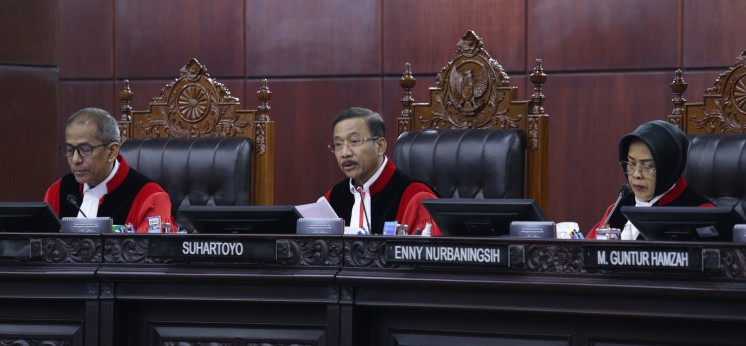
The ruling hearing for Case No. 109/PUU-XXIV/2026 on the material review of the Election Law, Tuesday (5/12/2026). Photo by MKRI/Bayu.
JAKARTA (MKRI) — The petition for the material review of Article 240 paragraph (1) letter a and Article 241 of Law No. 7 of 2017 on General Elections in Case No. 109/PUU-XXIV/2026 filed by M. Havidz Aima was ruled inadmissible. The decision was pronounced at a ruling hearing on Tuesday, May 12, 2026.
In its considerations, delivered by Deputy Chief Justice Saldi Isra, the Court held that the Petitioner had not explained his argument on the contrast between the norms petitioned for review and the 1945 Constitution. In addition, the petitums contain two different requests, making them obscure.
“Accordingly, there exists inconsistency between the arguments presented in the posita and the petitums, [which disregards] Article 68 letter a of Constitutional Court Regulation No. 7 of 2025. In addition, petitums two and three constitute unusual formulations because they improperly combine two different norms. Such combination of two distinct norms in fact demonstrates that the petitums are vague or obscure, particularly since petitums two and three seek two different and mutually contradictory matters without any logical or rational alternative,” stated the Deputy Chief Justice while reading out the Court’s legal considerations in Decision No. 109/PUU-XXIV/2026.
Also read:
Petitioner Questions Party Nomination of House Members
Petitioner Revises Grounds for Challenging Election Law
In the petition, he challenged the requirement that prospective candidates for the House may only be nominated by political parties participating in the election. He argued this norm effectively makes political parties the sole gateway for DPR candidacy.
The Petitioner argued that, in practice, this mechanism places the nomination process entirely within the internal domain of political parties. As a result, citizens who are not part of party structures have no opportunity to run directly as candidates for the House.
Furthermore, he contended that this condition could potentially restrict citizen participation in governance and national political representation. He argued that many citizens possess integrity, experience, and contributions to the nation but are unable to participate in political contestation due to the requirement to go through political parties.
He also linked his argument to the principle of popular sovereignty as stipulated in Article 1 paragraph (2) of the 1945 Constitution. In a constitutional democracy, the exercise of popular sovereignty through elections should provide the broadest possible space for participation, both as voters and as candidates.
In addition, the Petitioner highlighted the difference in nomination mechanisms between members of the DPR and the Regional Representatives Council (DPD). For the DPD, candidacy may be pursued through independent pathway, whereas for the DPR it is limited to political party nomination. According to the Petitioner, this demonstrates that Indonesia’s constitutional system already recognizes a model of individual representation.
Read Decision No. 109/PUU-XXIV/2026 (in Indonesian).
Author : Ilham W.M.
Editor : Lulu Anjarsari P.
PR : Adriana A. Y.
Translator : Yuniar Widiastuti (NL)
Disclaimer: The original version of the news is in Indonesian. In case of any differences between the English and the Indonesian versions, the Indonesian version will prevail.
Tuesday, May 12, 2026 | 18:36 WIB 72