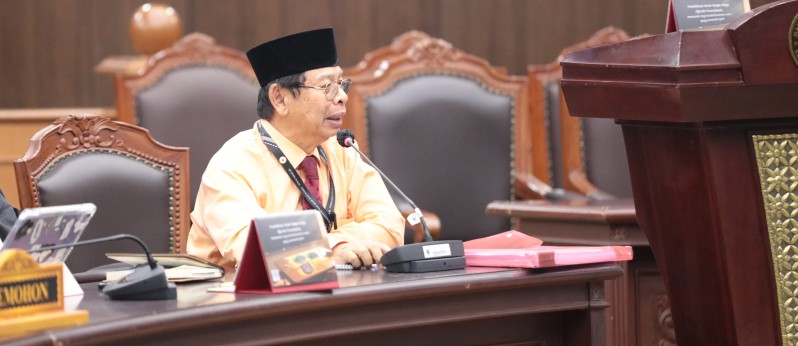
M. Havidz Aima presenting his petition against the Election Law at the preliminary hearing, Thursday (4/2/2026). Photo by MKRI/Ilham W. M.
JAKARTA (MKRI) — The Constitutional Court held a preliminary hearing to examine a petition for judicial review of Law No. 7 of 2017 on General Elections, registered as Case No. 109/PUU-XXIV/2026. The hearing was chaired by Constitutional Justice Enny Nurbaningsih.
The petition was filed by M. Havidz Aima, who challenges the constitutionality of Article 240 paragraph (1) letter a and Article 241 of the Election Law.
At the hearing, he explained that the Constitution of the Republic of Indonesia affirms that sovereignty resides in the hands of the people and is exercised in accordance with the Constitution, as stipulated in Article 1 paragraph (2) of the 1945 Constitution. In a constitutional democracy, general elections serve as the primary means for the people to exercise their sovereignty through the election of representatives to legislative bodies.
However, under Indonesia’s electoral legal framework, candidacy for members of the House of Representatives (DPR) is restricted to nominations through political parties, as regulated in Article 240 paragraph (1) letter a and Article 241 of the Election Law.
“These provisions raise a constitutional issue regarding the extent to which space for citizen participation in the process of political representation can be expanded within Indonesia’s democratic system,” he stated.
In his petition, he challenges the requirement that prospective candidates for the House may only be nominated by political parties participating in the election. He believes this norm effectively makes political parties the sole gateway for DPR candidacy.
The Petitioner argues that, in practice, this mechanism places the nomination process entirely within the internal domain of political parties. As a result, citizens who are not part of party structures have no opportunity to run directly as candidates for the House.
Furthermore, he contends that this condition could potentially restrict citizen participation in governance and national political representation. He argues that many citizens possess integrity, experience, and contributions to the nation but are unable to participate in political contestation due to the requirement to go through political parties.
He also links his argument to the principle of popular sovereignty as stipulated in Article 1 paragraph (2) of the 1945 Constitution. In a constitutional democracy, the exercise of popular sovereignty through elections should provide the broadest possible space for participation, both as voters and as candidates.
In addition, the Petitioner highlights the difference in nomination mechanisms between members of the DPR and the Regional Representatives Council (DPD). For the DPD, candidacy may be pursued through independent pathway, whereas for the DPR it is limited to political party nomination. According to the Petitioner, this demonstrates that Indonesia’s constitutional system already recognizes a model of individual representation.
He further argues that the provisions a quo potentially contradict Article 28D paragraph (3) of the 1945 Constitution, which guarantees every citizen the right to equal opportunity in government. This right, he contends, includes not only the right to vote but also the right to be elected.
In his petitums, the Petitioner requests the Court to declare Article 240 paragraph (1) letter a and Article 241 of the Election Law unconstitutional insofar as they are interpreted to mean that candidacy for DPR members may only be conducted through political parties. He also asks the Court to provide a constitutional interpretation that opens the possibility for citizens to run as DPR candidates outside the political party mechanism.
Responding to the petition, Constitutional Justice M. Guntur Hamzah advised the Petitioner to follow the requirements set out in Constitutional Court Regulation No. 7 of 2025 and to refer to past petitions available on the Court’s official website. He also requested the Petitioner to clearly explain the constitutional harm he has suffered.
The panel of constitutional justices gave the Petitioner 14 days to revise the petition. The revised the petition must have been received by the Court no later than 12:00 WIB on Wednesday, April 15, 2026.
Explore case No. 109/PUU-XXIV/2026 (in Indonesian).
Author : Utami Argawati
Editor : Lulu Anjarsari P.
PR : Adriana A. Y.
Translator : Yuniar Widiastuti (NL)
Disclaimer: The original version of the news is in Indonesian. In case of any differences between the English and the Indonesian versions, the Indonesian version will prevail.
Thursday, April 02, 2026 | 16:13 WIB 117