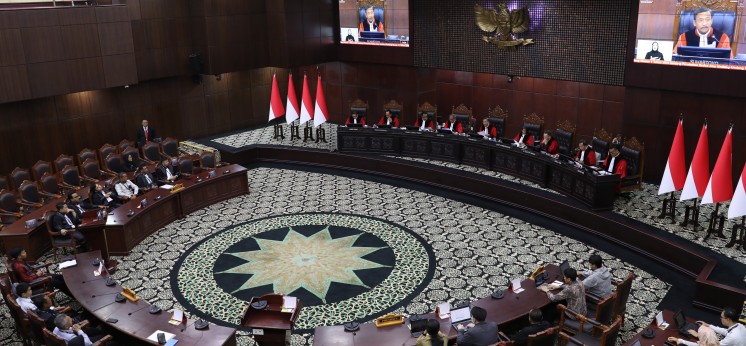
The Constitutional Court holding a ruling hearing for the judicial review of Law No. 2 of 2004 on Industrial Relations Dispute Settlement on Tuesday (5/12/2026) at the Constitutional Court courtroom. Photo by MKRI/Ifa.
JAKARTA (MKRI) — The Constitutional Court (MK) rejected in its entirety the petition filed by Muhamad Khaetami concerning the judicial review of Article 15 in conjunction with Article 1 paragraph (12) of Law No. 2 of 2004 on Industrial Relations Dispute Settlement (PPHI Law). The ruling for Case No. 125/PUU-XXIV/2026 was delivered in a plenary hearing at the Court on Tuesday, May 12, 2026.
Delivering the Court’s legal considerations, Constitutional Justice Arsul Sani explained that the regulation of time limits in dispute settlement through mediation, as stipulated in the challenged provisions, was intended to provide fair legal certainty for disputing parties. Such fair legal certainty, he said, is guaranteed under Article 28D paragraph (1) of the 1945 Constitution. The time limit arrangement also aims to ensure that industrial relations disputes are resolved promptly, accurately, and fairly.
“The definitive regulation of time limits in dispute settlement through mediation is intended to provide fair legal certainty for disputing parties as guaranteed under Article 28D paragraph (1) of the 1945 Constitution,” Arsul stated while reading out the Court’s legal considerations. Therefore, the Petitioner’s argument claiming that the ambiguity of the challenged provisions had caused prolonged industrial relations dispute settlement through mediation was deemed unfounded.
The Court also addressed the phrase “obliged to provide written recommendations,” which the Petitioner argued lacked clear legal consequences. According to the Court, granting the Petitioner’s request would create juridical issues by altering the construction of various provisions within the PPHI Law, making the law no longer comprehensible as an integral whole. Moreover, the obligation of mediators to issue written recommendations had previously been affirmed by the Court in Decision No. 68/PUU-XII/2015, pronounced in a public plenary hearing on September 29, 2015.
The Court further viewed that the issues raised by the Petitioner pertained to the implementation of the norms rather than their constitutionality. “Regarding the Petitioner’s argument concerning the lengthy period taken by mediators to issue written recommendations and the mistaken understanding in issuing mediation reports that are still followed by written recommendations, the Court is of the opinion that such matters concern not the constitutionality of the norms, but rather the implementation of the norms,” Arsul remarked.
Also read:
Petitioner Challenges Ambiguity in PPHI Law Mediation Provisions
Petitioner Revises Petition on Mediation Provisions in PPHI Law
Previously, during the preliminary hearing held on Monday, April 14, 2026, Khaetami questioned the legal uncertainty regarding whether the calculation of the 30-working-day limit began when the dispute was reported or when the case was delegated to the mediator. He also argued that the PPHI Law did not clearly define the term “working days,” resulting in confusion in its implementation.
“The formulation of the a quo provisions lacks legal certainty, is ambiguous, and inefficient. The enforcement of the a quo provisions has resulted in legal uncertainty and legal ineffectiveness,” he argued during the hearing.
The Petitioner also recounted his own experience in undergoing the dispute settlement process. He reported the dispute on April 24, 2025, but only received the first clarification summons on May 14, 2025. Following several stages of clarification, mediation was finally conducted on June 24, 2025, approximately two months after the report had been filed. He further revealed that the mediator’s written recommendation was only issued around 60 days after the mediation process. According to the Petitioner, such delays were inconsistent with the provisions of the PPHI Law and potentially detrimental to workers.
In his petitum, the Petitioner requested the Court to declare Article 15 of the PPHI Law conditionally constitutional insofar as the 30-working-day limit is interpreted as commencing from the receipt of the dispute report by the relevant institution. He also requested the Court to declare the phrase concerning the obligation to provide written recommendations in Article 1 paragraph (12) of the PPHI Law conditionally unconstitutional unless interpreted in accordance with his petition.
Author: Ilham Wiryadi Muhammad
Editor: N. Rosi
PR: Adriana
Translator: Yuanna Sisilia
Disclaimer: The original version of the news is in Indonesian. In case of any differences between the English and the Indonesian versions, the Indonesian version will prevail.
The Complete Decision: Decision No. 125/PUU-XXIV/2026 (in Bahasa Indonesia)
Tuesday, May 12, 2026 | 20:32 WIB 85