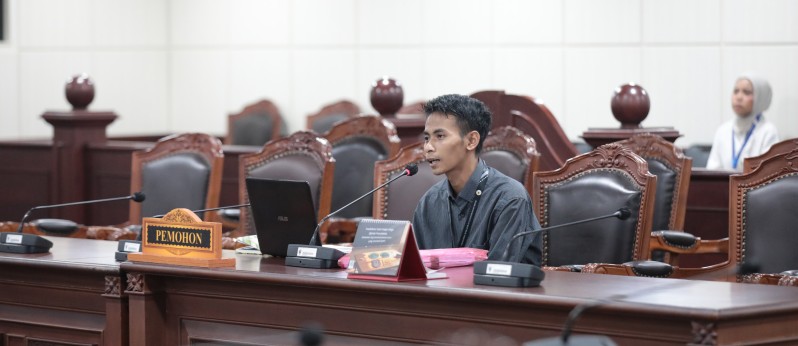
Muhamad Khaetami, Petitioner for the judicial review of the Law on the Settlement of Industrial Relations Disputes, presenting his arguments before the panel of Constitutional Justices during a preliminary hearing, Monday (4/13/2026), examining the petition. Photo by MKRI/IlhamWM.
JAKARTA (MKRI) — The Constitutional Court (MK) held a preliminary hearing for the judicial review of Article 15 in conjunction with Article 1 paragraph (12) of Law No. 2 of 2004 on the Settlement of Industrial Relations Disputes (PPHI Law) against the 1945 Constitution on Monday (April 14, 2026). The hearing was chaired by Constitutional Justice Enny Nurbaningsih, accompanied by Constitutional Justices Arsul Sani and Liliek Prisbawono Adi.
The petition, registered as Case No. 125/PUU-XXIV/2026, was filed by Muhamad Khaetami, who challenges the constitutionality of Article 15 of the PPHI Law for allegedly failing to provide legal certainty. According to Khaetami (the Petitioner), the provision is ambiguous, open to multiple interpretations, and inconsistent with the actual practice of resolving industrial relations disputes.
Appearing without legal counsel, the Petitioner elaborated on the uncertainty regarding whether the 30-day period should be calculated from the time the dispute is reported or from the time it is referred to a mediator. He further pointed out that the PPHI Law does not clearly define the term “working days,” thereby creating confusion in its implementation.
“The formulation of the a quo article lacks legal certainty, is ambiguous, and inefficient. Its enforcement has resulted in uncertainty and ineffectiveness of the law,” he argued.
The Petitioner also recounted his personal experience in the dispute resolution process. He reported the dispute on April 24, 2025, but only received the first summons for clarification on May 14, 2025. Following several rounds of clarification, mediation was held on June 24, 2025, approximately 2 months after the initial report was filed.
Moreover, he revealed that the mediator's written recommendation was issued only about 60 days after the mediation. This delay, he contended, contradicts the provisions of the PPHI Law and may potentially disadvantage workers.
The Petitioner asserted that such normative ambiguity contravenes fundamental principles of procedural law, namely lex certa, lex scripta, and lex stricta. He also argued that the situation may infringe upon the right to legal certainty as guaranteed under Article 28D paragraph (1) of the 1945 Constitution.
In addition, he criticized the role of the manpower office (Disnaker), which he deemed merely procedural in the mediation process and lacked effective authority to ensure optimal dispute resolution.
In his petitum, the Petitioner requested the Court to declare Article 15 of the PPHI Law conditionally constitutional, provided that the 30-working-day limit is interpreted as commencing from the receipt of the dispute report by the relevant authority. He further requested that the phrase concerning the obligation to issue a written recommendation in Article 1 paragraph (12) of the PPHI Law be declared conditionally unconstitutional unless interpreted in accordance with his request.
Causal Relationship
Responding to the petition, Constitutional Justice Arsul Sani advised the Petitioner to refine his legal standing. “Although the formulation is already quite sound, what remains unclear is the constitutional impairment and the causal relationship between the alleged losses and the provisions being challenged,” Arsul remarked.
The panel of justices granted the Petitioner 14 days to revise the petition. The revised petition must be submitted to the Court no later than Monday, April 27, 2026, at 12:00 PM WIB.
Author: Utami Argawati
Editor: N. Rosi
PR: Nana
Translator: Yuanna Sisilia
Disclaimer: The original version of the news is in Indonesian. In case of any differences between the English and the Indonesian versions, the Indonesian version will prevail.
Monday, April 13, 2026 | 18:24 WIB 46