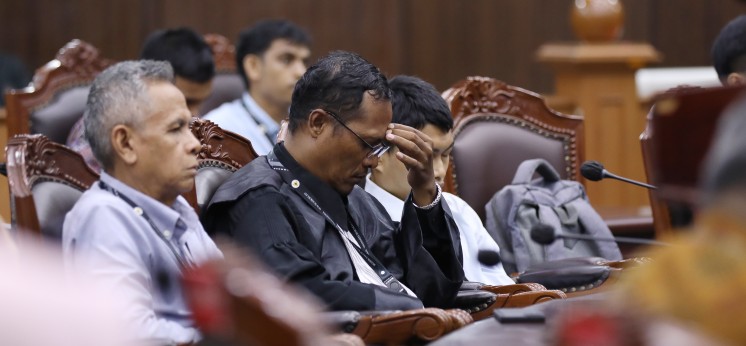
The Petitioner’s counsels listening to the Court’s verdict for the material review of Law No. 2 of 2004 on Industrial Relations Dispute Settlement (PPHI) for case No. 60/PUU-XXIV/2026, Tuesday (5/12/2026). Photo by MKRI/Ifa.
JAKARTA (MKRI) — The Constitutional Court rejected Petition No. 60/PUU-XXIV/2026 on the material review of Article 81 of Law No. 2 of 2004 concerning Industrial Relations Dispute Settlement (PPHI Law). The Court emphasized that the jurisdiction of the industrial relations court authorized to examine and adjudicate industrial relations dispute (PHI) claim is regulated narrowly based on the area where the worker/laborer performs his or her work, rather than on the domicile or residence of the defendant as applies under general civil procedural law.
“Article 81 of Law No. 2 of 2004 specifically regulates the relative jurisdiction of the industrial relations court, which is likewise justified under Article 57 of Law No. 2 of 2004,” stated Constitutional Justice Enny Nurbaningsih while delivering the Court’s legal considerations in Decision No. 60/PUU-XXIV/2026 on Tuesday, May 12, 2026.
With regard to the Petitioner’s argument questioning the phrase “the place where the worker/laborer works” in Article 81 of Law No. 2 of 2004, the Court related such issue to the characteristics of companies implementing multi-location business models, whereby companies may maintain branch offices or representative offices in other locations, or apply flexible worker placement systems allowing workers/laborers to be assigned either to the parent company/head office or to branch/representative offices, including circumstances in which workers/laborers are assigned to client companies under outsourcing arrangements. Under such conditions, the workplace of a worker is no longer fixed to a single location.
Concerning this matter, the Court considered it important to emphasize, within the bounds of reasonable legal reasoning, that “the place where the worker/laborer works” refers to the location where the worker/laborer carries out operational work activities at the place to which the worker/laborer is assigned. Where a company has branch offices such that workers/laborers may be assigned thereto, PHI claims may still be directed against the board of directors domiciled at the headquarters or legal domicile of the company as the party authorized and fully responsible for the management of the corporation and representing the corporation both inside and outside the court pursuant to the company’s articles of association.
Electronic Court System
The same applies to workers/laborers assigned to client companies under outsourcing systems. Although claims are directed against the outsourcing company as the employer maintaining the employment relationship with outsourced workers pursuant to Article 18 paragraph (1) of Government Regulation No. 35 of 2021 concerning Fixed-Term Employment Agreements, Outsourcing, Working Hours and Rest Periods, and Termination of Employment, the PHI claim must still be filed before the industrial relations court within the jurisdiction where the outsourced worker carries out operational work activities.
With respect to circumstances in which the worker’s/laborer’s domicile differs from the place where he/she works, as argued by the Petitioner who received termination of employment in a location different from his workplace, the Court emphasized that the Petitioner may still pursue legal remedies by filing a PHI claim before the industrial relations court within the jurisdiction where the Petitioner worked through the use of electronic judicial system services (e-court).
Such services are now no longer limited merely to administrative processes, namely registration (e-filing), payment of court fees, and summons (e-summon), but also encompass court proceedings (e-litigation) and delivery of copies of judgments (e-salinan). Such mechanisms may not only prevent the loss of the Petitioner’s right to be heard during proceedings and prevent inequality of position and the denial of substantive access to justice for the Petitioner, but also accord with the principle of access to courts and justice.
Through such litigation mechanisms, irrespective of the Petitioner’s concrete case, his right to file a claim before the industrial relations court within the jurisdiction of “the place where the worker/laborer works,” in order to obtain equal convenience, opportunity, and benefit to achieve equality and justice as guaranteed under Article 28D paragraph (1) and Article 28H paragraph (2) of the 1945 Constitution, may be effectively exercised.
Also read:
Bandung Resident Questions Jurisdiction Issue in Industrial Relations Dispute Law
Bandung Resident Revises Petition on Jurisdiction Issue in Industrial Relations Dispute Law
Dodi Saputra, a resident of Bandung, West Java Province, submitted the petition because he intended to challenge his unilateral termination of employment, yet under Article 81 of the PPHI Law, he must file the lawsuit with the district court having jurisdiction over his workplace in Papua. He worked at PT G4S Security Solution Services as a security officer through a recruitment process at the company’s office in Jakarta. The Petitioner was then assigned by the company to various companies, locations, and regions. Most recently, he was deployed to PT Freeport Indonesia in Timika, Central Papua Province.
While the Petitioner was on leave, he received a summons letter from the company in Jakarta, instructing him to appear at the company’s office in Bandung, West Java Province, which he complied. He was handed a termination letter without a proper bipartite process, without examination, without adequate explanation. He argued that the dismissal to have been carried out unilaterally, without valid grounds, without a staged dispute resolution process, without deliberation, and without compensation in accordance with statutory provisions.
Following the termination, he immediately submitted a written objection but was unable to claim his rights—such as wages during the process, severance pay, or reinstatement—resulting in direct economic and psychological losses. This is because any claim must be filed with the Manpower Office in Mimika Regency or Central Papua Province and, ultimately, with the Industrial Relations Court at the Jayapura District Court in Papua Province.
The Petitioner acknowledged that the relative competence of the industrial relations court is designed to facilitate workers. Nevertheless, limiting the scope solely to the phrase “covers the workplace of the worker/laborer” is no longer compatible with current, more dynamic conditions, where workers may be summoned outside their work region solely to be dismissed—particularly in cross-regional companies such as outsourcing or labor service providers. This limitation, he argued, harms his constitutional rights because it is discriminatory, fails to ensure equality and convenience before the law, and restricts his opportunity to obtain justice in employment relations.
This requirement stems from Article 81 of the PPHI Law, which provides: “A petition of industrial relations dispute shall be filed with the Industrial Relations Court at the District Court whose jurisdiction covers the workplace of the worker/laborer.” The Petitioner acknowledged that this provision was intended as an exception to the general principle of civil procedural law in order to ease the burden on workers. However, in practice, the norm is an obstacle when a dismissal is deliberately carried out outside the worker’s area of employment.
In the petitums, the Petitioner appealed to the Court to declare the phrase “covers the workplace of the worker/laborer” in Article 81 of the PPHI Law unconstitutional and not legally binding if not interpreted as “covers the worker’s/laborer’s place of residence.”
Read Decision No. 60/PUU-XXIV/2026 (in Indonesian).
Author : Mimi Kartika
Editor : N. Rosi.
Translator : Yuniar Widiastuti (NL)
Disclaimer: The original version of the news is in Indonesian. In case of any differences between the English and the Indonesian versions, the Indonesian version will prevail.
Tuesday, May 12, 2026 | 19:08 WIB 59