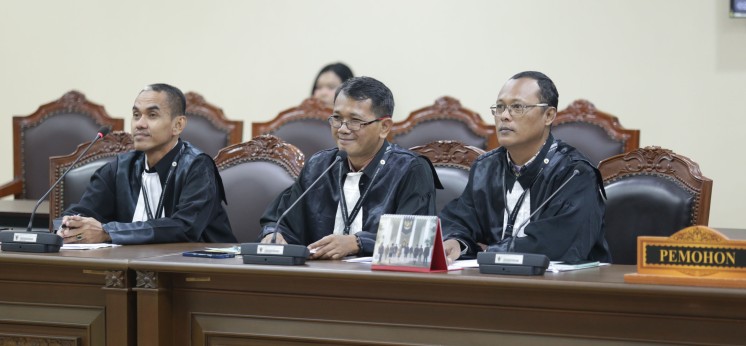
The Petitioner’s counsels at the preliminary hearing for the judicial review of Law No. 2 of 2004 on Industrial Relations Dispute Settlement (PPHI) for case No. 60/PUU-XXIV/2026, Friday (2/13/2026). Photo by MKRI/Bayu.
JAKARTA (MKRI) — Dodi Saputra, a private employee residing in Bandung, West Java Province, has filed a petition for the judicial review of Article 81 of Law No. 2 of 2004 concerning Industrial Relations Dispute Settlement (PPHI Law) before the Constitutional Court. He submitted the petition because he intends to challenge his unilateral termination of employment, yet under Article 81 of the PPHI Law, he must file the lawsuit with the district court having jurisdiction over his workplace in Papua.
“The Petitioner no longer has or has lost his regular income, so he is experiencing financial and economic hardship for traveling or returning to Timika, Central Papua, to pursue settlement of the dismissal dispute, whether through the Manpower Office in Mimika Regency or the Manpower Office of Central Papua Province, including filing an industrial relations dispute lawsuit with the Industrial Relations Court at the Jayapura District Court, Papua,” said the Petitioner’s counsel, Ata, at the preliminary hearing for Case No. 60/PUU-XXIV/2026 on Friday, February 13, 2026 in the Constitutional Court.
Ata explained that the Petitioner worked at PT G4S Security Solution Services as a security officer through a recruitment process at the company’s office in Jakarta. The Petitioner was then assigned by the company to various companies, locations, and regions. Most recently, he was deployed to PT Freeport Indonesia in Timika, Central Papua Province.
While the Petitioner was on leave, he received a summons letter from the company in Jakarta via WhatsApp. He was instructed to appear at the company’s office in Bandung, West Java Province, and he complied.
However, instead of receiving clarification, the Petitioner was handed a termination letter without a proper bipartite process, without examination, and without adequate explanation. He believes the dismissal to have been carried out unilaterally, without valid grounds, without a staged dispute resolution process, without deliberation, and without compensation in accordance with statutory provisions.
Following the termination, he immediately submitted a written objection but was unable to claim his rights—such as wages during the process, severance pay, or reinstatement—resulting in direct economic and psychological losses. This is because any claim must be filed with the Manpower Office in Mimika Regency or Central Papua Province and, ultimately, with the Industrial Relations Court at the Jayapura District Court in Papua Province.
This requirement stems from Article 81 of the PPHI Law, which provides: “A petition of industrial relations dispute shall be filed with the Industrial Relations Court at the District Court whose jurisdiction covers the workplace of the worker/laborer.” The Petitioner understands that this provision was intended as an exception to the general principle of civil procedural law in order to ease the burden on workers. However, in practice, the norm becomes an obstacle when a dismissal is deliberately carried out outside the worker’s area of employment.
The Petitioner acknowledges that the relative competence of the industrial relations court is designed to facilitate workers. Nevertheless, limiting the scope solely to the phrase “covers the workplace of the worker/laborer” is no longer compatible with current, more dynamic conditions, where workers may be summoned outside their work region solely to be dismissed—particularly in cross-regional companies such as outsourcing or labor service providers. This limitation, he argued, harms his constitutional rights because it is discriminatory, fails to ensure equality and convenience before the law, and restricts his opportunity to obtain justice in employment relations.
“Based on the Petitioner’s experience, the company appears to have deliberately manipulated the location of the dismissal to complicate access to judicial remedies, something not anticipated by the provision. Thus, the phrase contradicts the true design of the PPHI Law, which aims to provide dispute resolution that is quick, simple, and low-cost,” said another legal counsel for the Petitioner, Solikin.
The Petitioner submitted both primary and subsidiary petitums. In his primary petitum, he requested the Court to declare the phrase “covers the workplace of the worker/laborer” in Article 81 of the PPHI Law unconstitutional and without binding legal force insofar as it is not also interpreted to mean “covers the place where the worker/laborer resides,” and to declare the norm conditionally unconstitutional, becoming constitutional only insofar as it is interpreted to mean “whose jurisdiction covers the worker/laborer’s place of residence.”
In his subsidiary petitum, the Petitioner requested the Court to declare that the phrase “covers the workplace of the worker/laborer” in Article 81 of Law No. 2 of 2004 is ambiguous, fails to guarantee fair legal certainty, and does not provide protection and convenience as intended by Article 28D paragraph (1) and Article 28H paragraph (2) of the 1945 Constitution, while maintaining that Article 81 shall remain legally binding insofar as it is interpreted in accordance with the constitutional interpretation provided by the Constitutional Court in its ruling.
The petition was examined by a panel chaired by Constitutional Justice Enny Nurbaningsih, accompanied by Constitutional Justices Anwar Usman and Arsul Sani. Justice Arsul highlighted the primary and subsidiary petitums, noting that such terminology is not commonly recognized in constitutional review proceedings before the Constitutional Court.
“In fact, the terms primary petitums or subsidiary or secondary petitums are not formally recognized here. But is it prohibited to have alternative petitums? No, alternative petitions are allowed. The petitums should simply be formulated as a request, and if you wish to include what is intended as subsidiary or even further subsidiary petitums, they can be connected using the word ‘or’,” Justice Arsul explained.
Before adjourning the session, Justice Enny announced that the Petitioner would have 14 days to revise the petition only once. The softcopy and hardcopy of the petition must have been received by the Court no later than 12:00 WIB on Thursday, February 26, 2026.
Explore Case No. 60/PUU-XXIV/2026 (in Indonesian).
Author : Mimi Kartika
Editor : N. Rosi.
Translator : Yuniar Widiastuti (NL)
Disclaimer: The original version of the news is in Indonesian. In case of any differences between the English and the Indonesian versions, the Indonesian version will prevail.
Friday, February 13, 2026 | 14:57 WIB 71