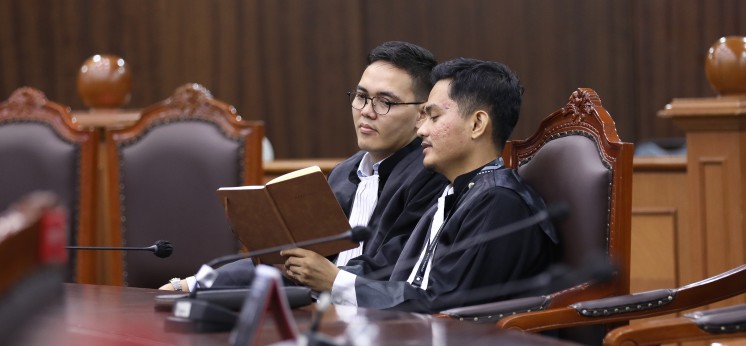
Counsel for the petitioners attends the Constitutional Court hearing for the ruling on the judicial review of Law No. 50 of 2009 on Religious Courts, Tuesday (12/05), at the Constitutional Court courtroom in Jakarta. Photo: MKRI Public Relations/Ifa.
JAKARTA, MKRI– The Constitutional Court (Mahkamah Konstitusi/MK) has rejected a judicial review petition challenging provisions of the Religious Courts Law concerning the filing of joint marital property claims.
The ruling was delivered in Decision No. 113/PUU-XXIV/2026 during a judgment hearing on Tuesday (12 May 2026), with Constitutional Justice M. Guntur Hamzah reading the Court’s legal considerations.
Addressing the petitioners’ argument that the phrase “joint property” in Article 86 paragraph (1) of the Religious Courts Law lacked clear limitations regarding the filing of joint-property lawsuits, the Court held that mechanisms for resolving disputes over marital assets had already been sufficiently regulated under existing laws and procedural frameworks, including through litigation before the courts.
“Based on Article 37 of the Marriage Law, the distribution of joint property is left to the parties to determine according to the legal system applicable to them,” Guntur stated while reading the ruling in the petition filed by Marlinda and Zaina Arline.
“In cases where the parties choose the jurisdiction of the religious courts, the applicable procedural law is the civil procedural law used in the general courts, except where specifically regulated under the Religious Courts Law,” he continued.
Court Warns Against Restricting Constitutional Rights
The petitioners had requested the Court to limit joint-property lawsuits to a single filing only. However, the Court found that such a restriction could itself create legal uncertainty and narrow the scope of the challenged provision.
“According to the Court, such a limitation could potentially create legal uncertainty because it would narrow the essence of Article 86 paragraph (1) of the Religious Courts Law,” Guntur explained.
He noted that the provision does not solely regulate procedures for filing claims over joint property, but also governs claims relating to child custody, child support, and spousal maintenance. Imposing a one-time filing restriction, the Court said, could improperly limit litigants’ ability to pursue legal remedies.
The Court further emphasized that the issues raised by the petitioners concerned constitutional efforts to protect private rights, and that courts should not restrict the exercise of those constitutional rights.
Accordingly, the Court unanimously rejected the petition in its entirety.
“The petition of the petitioners is rejected in its entirety,” Guntur declared while reading the ruling.
Also read:
Absence of Limits on Joint-Property Lawsuits Challenged
Petitioners Refine Case in Constitutional Challenge to Religious Courts Law
Previously, the petitioners argued that the absence of clear limitations allows for multiple claims to be filed over the same object and between the same parties. Such a situation, they contend, creates legal uncertainty and potential injustice for litigants. Even parties who have obtained a final and binding judgment may still face the risk of subsequent lawsuits, undermining legal certainty and security over property rights.
They further warned that, without clear restrictions, parties may exploit the system by filing repetitive claims to delay proceedings. This could hinder other parties from exercising or transferring their rights over disputed property. In their view, such conditions are inconsistent with the constitutional principle of legal certainty as guaranteed by the 1945 Constitution.
Accordingly, the petitioners argue that limitations on filing joint property claims are necessary to uphold the principles of simple, speedy, and low-cost justice, while preventing protracted litigation.
The petitioners also stressed that imposing such limitations would not restrict access to justice. The legal system, they noted, already provides a tiered framework of remedies, from first-instance courts to judicial review before the Supreme Court. In cases where new evidence (novum) emerges, a petition for judicial review constitutes the appropriate legal avenue, rather than initiating a new lawsuit.
Author : Utami Argawati
Editor : Lulu Anjarsari P.
Public Relations: Adriana A.Y.
Translator : SO
Disclaimer: The original version of the news is in Indonesian. In case of any differences between the English and the Indonesian versions, the Indonesian version will prevail.
Tuesday, May 12, 2026 | 19:07 WIB 1