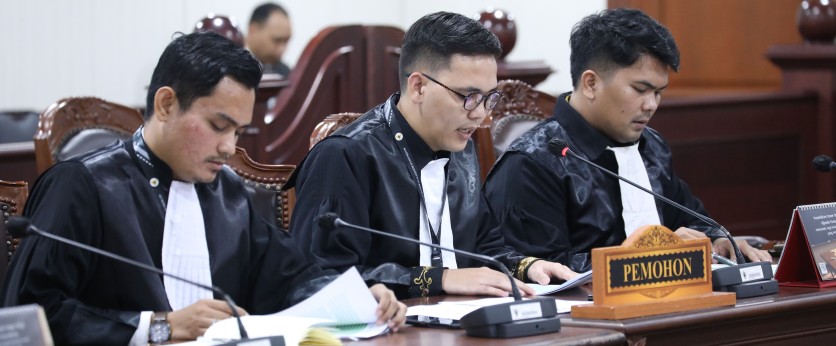
Petitioners’ legal counsel delivering the main points of the petition for judicial review of Law No. 50 of 2009 on Religious Courts during the preliminary hearing on Tuesday (7/4). Photo by MKRI/Panji.
Jakarta (MKRI) - The Constitutional Court (MK) held a preliminary hearing on Tuesday, April 7, 2026, in a case challenging Law No. 7 of 1989 on Religious Courts. The session, chaired by Chief Justice Suhartoyo with Justices Daniel Yusmic P. Foekh and M. Guntur Hamzah, examined Petition No. 113/PUU-XXIV/2026 filed by Zaina Arline and Marlinda. With their legal counsel, Lintar Fauzi, the Petitioners questioned Article 86, paragraph (1), of the Religious Courts Law, which they say fails to clearly limit the number of times joint-property lawsuits may be filed.
The Petitioners argue that the absence of such a limit opens the door to multiple lawsuits over the same joint property between the same parties, creating legal uncertainty and unfairness for litigants. Parties who have already secured a final and binding judgment remain under the shadow of fresh suits, leaving them feeling insecure about their ownership.
“Article 86 paragraph (1) of the Religious Courts Law does not clearly regulate any restriction on filing joint‑property claims, so it can lead to multiple lawsuits over the same joint property. If such a situation is allowed, within reasonable bounds of logic, it will harm the other party to the case, who is also a justice seeker,” Lintar told the Court.
They further contend that without limits, some parties may repeatedly file suits simply to delay final resolution, hampering others' ability to use or transfer their rights to disputed assets.
In their view, this contravenes the principle of fair legal certainty guaranteed by the 1945 Constitution and runs counter to the ideals of simple, swift, and low‑cost justice by allowing proceedings to drag on indefinitely.
The Petitioners maintain that introducing limits would not block access to justice because the legal system already provides tiered remedies, from first instance through appeal and cassation to judicial review at the Supreme Court. Where new evidence (novum) emerges, they argue, the appropriate route is judicial review rather than filing a new lawsuit.
In their petitum, the Petitioners ask the Court to declare the phrase “joint property” in Article 86 paragraph (1) of the Religious Courts Law conditionally unconstitutional and without binding force unless interpreted to mean that a joint‑property lawsuit may only be filed once after a final and binding judgment. They also seek a provisional order directing the Court to prioritize the examination of the case and issue a ruling that guarantees legal certainty and fairness for justice seekers in joint property disputes.
The Panel offered several suggestions for revising the petition. Justice Daniel Yusmic P. Foekh observed that the Petitioners’ explanation of their constitutional losses needed to be streamlined and clarified. He noted that this section was even longer than the section setting out the grounds of the petition and advised that concrete case details be attached and summarised briefly so the alleged harm is clearly visible.
Justice Daniel also urged the Petitioners to strengthen their arguments specifically on the phrase “joint property” under review and to spell out how each Petitioner’s losses differ, including their legal relationships to the property.
At the close of the session, the Panel gave the Petitioners until Tuesday, April 21, 2026, at 12.00 Western Indonesian Time to submit a revised petition.
Author: Utami Argawati
Editor: Lulu Anjarsari P.
PR: Adriana A.Y.
Translator: Rizky Kurnia Chaesario
Disclaimer: The original version of the news is in Indonesian. In case of any differences between the English and the Indonesian versions, the Indonesian version will prevail.
Tuesday, April 07, 2026 | 15:50 WIB 84