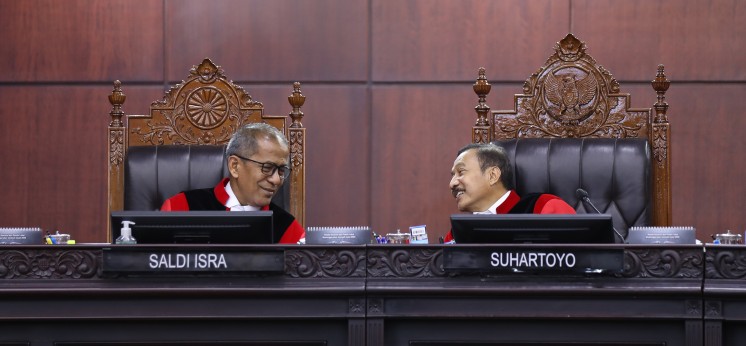
Chief Justice Suhartoyo and Deputy Chief Justice Saldi Isra chairing the ruling hearing for the judicial review of Law No. 3 of 2022 on the State Capital, Tuesday (5/12/2026). Photo by MKRI/Ifa.
JAKARTA (MKRI) — The Constitutional Court (MK) rejected in its entirety the petition for judicial review of Law No. 3 of 2022 on the State Capital, as amended by Law No. 21 of 2023 (State Capital Law/IKN Law). The pronouncement of Decision No. 71/PUU-XXIV/2026 was delivered on Tuesday, May 12, 2026, in a plenary hearing chaired by Chief Justice Suhartoyo at the Constitutional Court’s Plenary Courtroom.
Delivering the Court’s legal considerations, Constitutional Justice Adies Kadir explained that the Petitioner argued that Article 2 paragraph (1) of Law No. 2 of 2024 was inconsistent with Article 39 paragraph (1) of Law No. 3 of 2022, thereby creating a constitutional vacuum concerning the status of the state capital. According to the Petitioner, such a condition could affect the legality of governmental actions, including the issuance of state administrative decisions, governance activities, and public administration.
In response to the argument, the Court held that Article 2 paragraph (1) of Law No. 2 of 2024 must be interpreted in conjunction with Article 73 of the same law. Adies stated that the term “shall come into effect” in Article 73 refers to the enforceability and binding force of the norms governing the relocation of the state capital once the President issues a Presidential Decree on the transfer of the capital of the Unitary State of the Republic of Indonesia (NKRI) from the Special Capital Region of Jakarta Province to Nusantara Capital City.
Regarding the timing of the relocation, the Court referred to the legal considerations in Constitutional Court Decision No. 38/PUU-XXIV/2026, which stipulate that the relocation of the capital city depends on the issuance of the Presidential Decree concerning the transfer of the capital from Jakarta to Nusantara. Therefore, pursuant to Article 87 of Law No. 12 of 2011 on Lawmaking, statutory laws and regulations come into effect and obtain binding force upon promulgation, unless otherwise specified in the relevant legislation.
“In other words, in the context of the a quo petition, the timing of the relocation of the state capital to Nusantara depends on the issuance and enactment of the Presidential Decree concerned. Therefore, based on the foregoing legal considerations and in relation to the Petitioner’s petitum, the Court is of the opinion that without the interpretation sought by the Petitioner regarding Article 39 paragraph (1) of Law No. 2 of 2024, the status, functions, and role of the state capital shall remain in the Special Capital Region of Jakarta Province until the Presidential Decree on the relocation of the capital of the Unitary State of the Republic of Indonesia from the Special Capital Region of Jakarta Province to Nusantara Capital City is issued. Accordingly, the Petitioner’s argument asserting that Article 39 paragraph (1) of Law No. 3 of 2022 contradicts Article 1 paragraph (3) and Article 28D paragraph (1) of the 1945 Constitution is legally unfounded,” Adies stated.
Also read:
Petitioner Highlights Constitutional Uncertainty over State Capital Status
Constitutional Vacuum over Capital City Status Questioned
Previously, the Petitioner, Zulkifli, argued that the challenged provisions render a Presidential Decree a constitutive requirement for transferring the status of the state capital. Subsequently, in 2024, Law No. 2 of 2024 on the Special Region of Jakarta (DKJ Law) was enacted, which normatively removes Jakarta’s status as the state capital. However, to date, the Presidential Decree mandated by Articles 39 and 41 of the IKN Law has not been issued.
The concurrent applicability of the IKN Law and the DKJ Law, both of equal legal standing, has resulted in a manifest horizontal disharmony. On the one hand, Jakarta is no longer designated as the capital in normative terms; on the other hand, Nusantara has not yet acquired constitutive legitimacy as the state capital. This condition, therefore, gives rise to what the Petitioner described as a structural and fundamental vacuum in the constitutional status of the state capital.
According to the Petitioner, such a constitutional vacuum is not merely attributable to policy implementation issues or presidential inaction. Rather, it stems directly from the normative design of the a quo provisions, which lack safeguard clauses, transitional provisions, and assurances for the continuity of the capital’s status during the transition period. From the standpoint of the rule of law, the state capital constitutes a fundamental element of the constitutional structure and, as such, cannot be left in a condition of ambiguity, multiple interpretations, or legal uncertainty.
Author: Sri Pujianti
Editor: Lulu Anjarsari P.
PR: Raisa Ayuditha M.
Translator: Yuanna Sisilia
Disclaimer: The original version of the news is in Indonesian. In case of any differences between the English and the Indonesian versions, the Indonesian version will prevail.
The Complete Decision: Decision No. 71/PUU-XXIV/2026 (in Bahasa Indonesia)
Tuesday, May 12, 2026 | 16:11 WIB 356