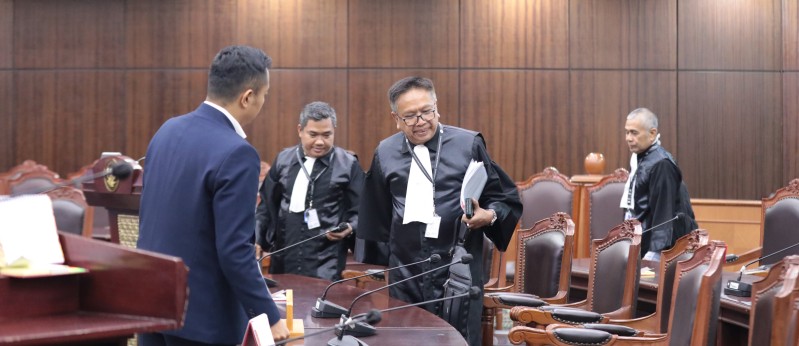
The Petitioner’s legal counsel for the judicial review of the State Capital Law entering the courtroom, Wednesday (3/11/2026), to attend a petition revision hearing. Photo by MKRI/IlhamWM.
JAKARTA (MKRI) — The Constitutional Court (MK) once again held a judicial review hearing of Law No. 3 of 2022 on the State Capital, as amended by Law No. 21 of 2023 (State Capital Law). The second hearing, to examine the revisions to the petition filed by Zulkifli, a medical doctor, took place in the plenary courtroom on Wednesday, March 11, 2026.
Purnomo, the Petitioner’s legal counsel, stated that in Case No. 71/PUU-XXIV/2026, the Petitioner had revised the provisions under review. Initially, the petition challenged Article 39 and Article 41 of the State Capital Law. In the revised petition, however, the Petitioner narrows the constitutional review to Article 39, paragraph (1), of the law, using Article 1, paragraph (3), of the 1945 Constitution as the benchmark for constitutionality.
“[We request the Court to] declare Article 39 paragraph (1) of Law No. 3 of 2022 on the State Capital, as amended by Law No. 21 of 2023, unconstitutional and not legally binding insofar as it is not interpreted as follows: ‘As long as no Presidential Decree on the relocation of the State Capital has been issued, Jakarta shall remain the State Capital of the Republic of Indonesia to ensure legal certainty and the continuity of the constitutional structure,’” Hadi stated while reading the revised petitum before a panel chaired by Deputy Chief Justice Saldi Isra, alongside Constitutional Justices Ridwan Mansyur and Adies Kadir.
Previously, Hadi Purnomo, who also serves as legal counsel, elaborated that the relevant provisions effectively make a Presidential Decree the constitutive requirement for transferring the status of the state capital. Subsequently, in 2024, Law No. 2 of 2024 on the Special Region of Jakarta (DKJ Law) was enacted, which normatively removes Jakarta’s status as the state capital. However, to date, the Presidential Decree mandated by Articles 39 and 41 of the State Capital Law has not been issued.
The concurrent applicability of the State Capital Law and the DKJ Law, both of equal legal standing, has resulted in a manifest horizontal disharmony. On the one hand, Jakarta is no longer designated as the capital in normative terms; on the other hand, Nusantara has not yet acquired constitutive legitimacy as the state capital. This condition, therefore, gives rise to a structural and fundamental vacuum in the constitutional status of the state capital.
According to the Petitioner, such a constitutional vacuum is not merely attributable to policy implementation issues or presidential inaction. Rather, it stems directly from the normative design of the a quo provisions, which lack a safeguard clause, transitional provisions, and assurances for the continuity of the capital’s status during the transitional period. From the standpoint of the rule of law, the state capital constitutes a fundamental element of the constitutional structure and, as such, cannot be left in a condition of ambiguity, multiple interpretations, or legal uncertainty.
The Petitioner further argued that this ambiguity and constitutional vacuum contravene Article 1 paragraph (3) of the 1945 Constitution, as the principle of the rule of law necessitates certainty, order, and continuity of legal norms, particularly with respect to the state’s fundamental elements.
Author: Sri Pujianti
Editor: Lulu Anjarsari P.
PR: Raisa A.M
Translator: Yuanna Sisilia
Disclaimer: The original version of the news is in Indonesian. In case of any differences between the English and the Indonesian versions, the Indonesian version will prevail.
Wednesday, March 11, 2026 | 14:28 WIB 135