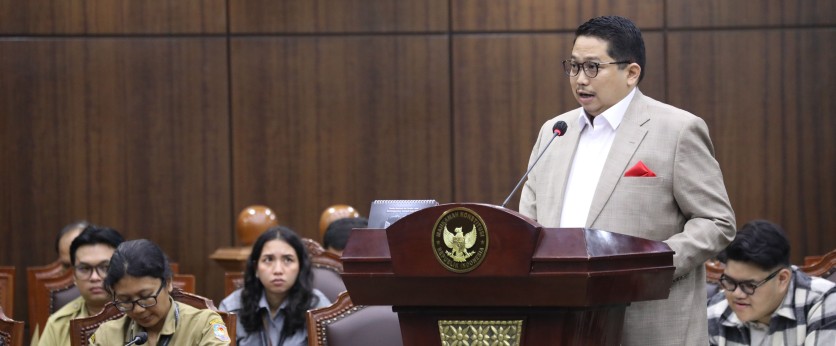
Muhammad Rullyandi, a Constitutional Law Expert and lecturer at the Faculty of Law, Universitas Jayabaya, appeared as an expert witness for the Government during a Constitutional Court hearing on the judicial review of Law No. 24 of 2007 on Disaster Management, Monday (11 May 2026). Photo: MKRI Public Relations/Panji.
JAKARTA, MKRI – The government defended the President’s broad discretionary authority in determining national disaster status during a Constitutional Court hearing reviewing Law No. 24 of 2007 on Disaster Management on Monday (11 May 2026).
Appearing as an expert witness for the President in Petition No. 261/PUU-XXIII/2025, constitutional law scholar Muhammad Rullyandi argued that the Disaster Management Law places disaster designation within the executive’s administrative authority, granting the President wide discretion to assess priorities and determine appropriate responses during emergencies.
“The determination of whether a disaster constitutes a national or regional disaster is an operational matter in the field, involving both objectively and subjectively measurable considerations, and that falls within the government’s domain of authority,” Rullyandi told the Court during a plenary hearing at the Constitutional Court building in Jakarta.
The Universitas Jayabaya law lecturer stated that the President’s authority in disaster management is not merely administrative in nature, but also forms part of the constitutional mandate to protect citizens.
Rullyandi argued that the Disaster Management Law has already been elaborated through various implementing regulations, including Government Regulation No. 21 of 2008 on Disaster Management Implementation, Government Regulation No. 22 of 2008 on Disaster Funding and Assistance Management, Government Regulation No. 23 of 2008 on the Participation of International and Foreign Non-Governmental Institutions in Disaster Management, as well as Presidential Regulation No. 1 of 2019 on the National Disaster Management Agency (BNPB).
He further cited Law No. 30 of 2014 on Government Administration as providing sufficient legal certainty in disaster governance through the five indicators set out in Article 7 paragraph (2) of the Disaster Management Law: the number of victims, property losses, infrastructure damage, affected geographical scope, and socio-economic impact.
According to Rullyandi, these indicators establish the government’s constitutional obligation to respond to disasters in a non-discriminatory manner while ensuring state protection and recovery efforts for affected citizens. He also pointed to previous presidential decisions declaring disasters in Flores, Aceh, and during the COVID-19 pandemic as examples of the lawful exercise of executive discretion.
Rullyandi maintained that the government’s handling of the 2025 floods and landslides in Aceh, North Sumatra, and West Sumatra reflected a legitimate exercise of executive discretion. Although the disasters were not formally designated as national disasters, he argued that the government had treated them as a national priority requiring coordinated intervention.
He said disaster response agencies—including BNPB, regional disaster management agencies (BPBD), BASARNAS, the Indonesian Red Cross (PMI), sectoral ministries, and local governments—had carried out evacuation and recovery efforts in a systematic and measurable manner under presidential direction.
Based on this framework, Rullyandi concluded that Article 7 paragraphs (2) and (3), as well as Article 84 of the Disaster Management Law, do not contain any legal vacuum or conflict with the 1945 Constitution. Referring to legal philosopher Lon L. Fuller’s theory in The Morality of Law, he argued that the provisions challenged by the petitioners do not exhibit the characteristics of failed legislation.
Also read:
Five Lawyers Challenge Provisions on the Determination of National Disaster Status
Sumatra Flood Victims Join Constitutional Challenge Over National Disaster Status Provisions
Government-Parliament Seek Postponement in Disaster Management Law Review
Government Explains Presidential Discretion in Declaring National Disaster Status
House: Indicators for Declaring National and Regional Disaster Status Are Exhaustive
Presidential Discretion in Declaring National Disasters Considered to Lack Legal Certainty
For information, the Petitioners in this case include Elydya Kristina Simanullang (Petitioner I), Doris Manggalang Raja Sagala (Petitioner II), Jonswaris Sinaga (Petitioner III), Robinar V.K. Panggabean (Petitioner IV), Amudin Laia (Petitioner V), Roy Sitompul (Petitioner VI), and Christian Adrianus Sihite (Petitioner VII).
The judicial review stems from the floods and landslides in Aceh, North Sumatra, and West Sumatra that were not declared a national disaster. As of December 15, 2025, the disasters had resulted in 1,016 fatalities and displaced approximately 850,000 people. Despite the scale of the catastrophe, the Government did not designate the events as a national disaster.
Proposals to declare the floods and landslides as a national disaster were reportedly supported by nearly all factions in the DPR, as well as several regional heads. Some local leaders acknowledged that their regions no longer possessed sufficient capacity to manage the disaster’s impact.
Instead of declaring a national disaster, the Government referred to the situation as a “national priority.” According to the Petitioners, however, the term “national priority” is not recognized under the Disaster Management Law, which regulates only national and regional disaster status. They argue that labeling the disaster as a “national priority” resembles a development project classification that does not directly focus on victims—particularly given the more than one thousand recorded deaths, with the possibility of further increases.
Article 7 paragraphs (2) and (3) of the Disaster Management Law provide:
“Paragraph (2): The determination of the status and level of national and regional disasters as referred to in paragraph (1) letter c shall include indicators comprising:
a) number of victims; b) property losses; c) damage to infrastructure and facilities; d) the geographic scope of the affected area; and e) the resulting socio-economic impact.
Paragraph (3): Further provisions regarding the determination of disaster status and level as referred to in paragraph (2) shall be regulated by Presidential Regulation.”
In their petition, the Petitioners request the Court to declare Article 7 paragraph (2) unconstitutional and without binding legal force insofar as it is not interpreted to mean: “The determination of the status and level of national and regional disasters as referred to in paragraph (1) letter c shall include indicators, among others: a. number of victims; b. property losses; c. damage to infrastructure and facilities; d. the geographic scope of the affected area; and e. the resulting socio-economic impact.”
They further request the Court to declare Article 7 paragraph (3) unconstitutional and without binding legal force insofar as it is not interpreted to mean: “Further provisions regarding the determination of disaster status and level as referred to in paragraph (2) shall be regulated by Government Regulation.”
Explore case No. 261/PUU-XXIII/2025 (in Indonesian).
Author : Mimi Kartika
Editor : N. Rosi
Public Relations: Andhini S.F
Translator : SO
Disclaimer: The original version of the news is in Indonesian. In case of any differences between the English and the Indonesian versions, the Indonesian version will prevail.
Monday, May 11, 2026 | 13:28 WIB 35