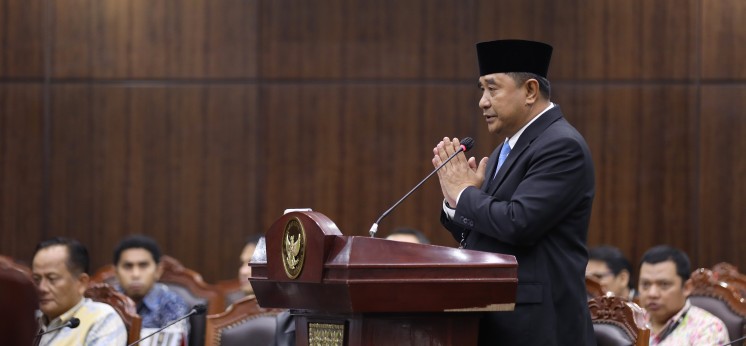
Bahtiar, Expert Staff to the Minister for Government Affairs at the Ministry of Home Affairs, represented the Government in presenting its statement at the hearing on the judicial review of Law Number 24 of 2007 on Disaster Management, Thursday (February 26), in the Constitutional Court courtroom. Photo by Public Relations/Ifa.
JAKARTA, MKRI – The President/Government, represented by Bahtiar, Expert Staff to the Minister for Government Affairs at the Ministry of Home Affairs, refuted the Petitioners’ claim in Case Number 261/PUU-XXIII/2025 that the President exercised broad and unfettered discretion in declining to designate the floods and landslides in Aceh, North Sumatra, and West Sumatra as a national disaster.
Bahtiar delivered the Government’s statement during the judicial review hearing of Article 7 paragraphs (2) and (3) of Law Number 24 of 2007 on Disaster Management (Disaster Management Law), which was held on Thursday (February 26, 2026) with the agenda of hearing the statements of the House of Representatives (DPR) and the President before the Constitutional Court of the Republic of Indonesia (MK).
“It is incorrect to assert that the determination of disaster status lies entirely within the realm of subjectivity without legal parameters,” Bahtiar stated before the Plenary Court of the Constitutional Court in Jakarta.
He explained that discretionary authority (freies ermessen) arises as a mechanism to address abnormal and unforeseen conditions not fully anticipated by statutory regulations. According to Bahtiar, the President’s discretion in determining disaster status remains framed by strict legal norms and is cumulatively bound by objective indicators stipulated in Article 7 paragraph (2) of the Disaster Management Law.
Bahtiar further outlined that the indicators for determining disaster status and level under Law No. 24/2007 are appropriate and comprehensive. For disaster status, the criteria include: (1) the occurrence of a natural or non-natural disaster threatening the public; (2) fatalities; (3) property losses; (4) damage to infrastructure and facilities; and (5) resulting socio-economic impacts.
For determining the disaster level, the criteria include: (1) the geographic scope of the affected area; (2) the inadequacy of available resources to respond effectively; (3) the paralysis of local governmental institutions and related entities in carrying out disaster response; (4) the potential for subsequent disasters; and (5) projections and assumptions indicating a prolonged recovery period.
Every exercise of discretion, he stressed, must adhere to the General Principles of Good Governance (AUPB), be based on objective considerations, undertaken in good faith, and remain subject to administrative and political oversight. In disaster management, Bahtiar added, the immediate response to save human lives must take precedence over purely administrative concerns.
The Government also rejected the Petitioners’ argument that disaster status determinations are highly susceptible to politicization due to the absence of a Presidential Regulation. Such a claim, the Government argued, is legally unfounded. Disaster management decisions are influenced not only by political considerations but also by economic factors (including fiscal impact and investment stability), administrative concerns, governmental stability, and the dynamics of central–regional relations.
Moreover, the procedures for determining disaster status are clearly regulated in Law No. 24/2007 and Government Regulation No. 21 of 2008 on the Implementation of Disaster Management.
Regarding the delegation of regulatory authority to a Presidential Regulation (Perpres) under Article 7 paragraph (3), which the Petitioners challenge, the Government maintained that such delegation is appropriate. A Presidential Regulation, it argued, offers greater flexibility than a Government Regulation and enables a faster response to urgent policy needs, particularly in the technical and operational assessment of disaster conditions.
The Government also emphasized that although the Presidential Regulation mandated by Article 7 paragraph (3) has not yet been issued, this has not significantly hindered disaster response efforts. It reported deploying 90,109 personnel along with various primary defense equipment (alutsista) to address the disasters in Aceh, North Sumatra, and West Sumatra through the establishment of a task force pursuant to Presidential Decree No. 1 of 2026.
At the conclusion of the hearing, the Government requested the Court to declare that the Petitioners lack legal standing and to dismiss the petition in its entirety. The Government argued that Article 7 paragraphs (2) and (3), as well as Article 84 of Law No. 24/2007, do not contravene the 1945 Constitution, as they provide an adequate normative framework for the state in addressing extraordinary circumstances.
Meanwhile, during the same session, the DPR indicated that it was not yet prepared to deliver its statement.
Background of the Case
The Petitioners in this case include Elydya Kristina Simanullang (Petitioner I), Doris Manggalang Raja Sagala (Petitioner II), Jonswaris Sinaga (Petitioner III), Robinar V.K. Panggabean (Petitioner IV), Amudin Laia (Petitioner V), Roy Sitompul (Petitioner VI), and Christian Adrianus Sihite (Petitioner VII).
The judicial review stems from the floods and landslides in Aceh, North Sumatra, and West Sumatra that were not declared a national disaster. As of December 15, 2025, the disasters had resulted in 1,016 fatalities and displaced approximately 850,000 people. Despite the scale of the catastrophe, the Government did not designate the events as a national disaster.
Proposals to declare the floods and landslides as a national disaster were reportedly supported by nearly all factions in the DPR, as well as several regional heads. Some local leaders acknowledged that their regions no longer possessed sufficient capacity to manage the disaster’s impact.
Instead of declaring a national disaster, the Government referred to the situation as a “national priority.” According to the Petitioners, however, the term “national priority” is not recognized under the Disaster Management Law, which regulates only national and regional disaster status. They argue that labeling the disaster as a “national priority” resembles a development project classification that does not directly focus on victims, particularly given the more than one thousand recorded deaths, with the possibility of further increases.
Also read:
Five Lawyers Challenge Provisions on the Determination of National Disaster Status
Sumatra Flood Victims Join Constitutional Challenge Over National Disaster Status Provisions
Article 7 paragraphs (2) and (3) of the Disaster Management Law provide:
“Paragraph (2): The determination of the status and level of national and regional disasters as referred to in paragraph (1) letter c shall include indicators comprising:
a) number of victims; b) property losses; c) damage to infrastructure and facilities; d) the geographic scope of the affected area; and e) the resulting socio-economic impact.
Paragraph (3): Further provisions regarding the determination of disaster status and level as referred to in paragraph (2) shall be regulated by Presidential Regulation.”
In their petition, the Petitioners request the Court to declare Article 7 paragraph (2) unconstitutional and without binding legal force insofar as it is not interpreted to mean: “The determination of the status and level of national and regional disasters as referred to in paragraph (1) letter c shall include indicators, among others: a. number of victims; b. property losses; c. damage to infrastructure and facilities; d. the geographic scope of the affected area; and e. the resulting socio-economic impact.”
They further request the Court to declare Article 7 paragraph (3) unconstitutional and without binding legal force insofar as it is not interpreted to mean: “Further provisions regarding the determination of disaster status and level as referred to in paragraph (2) shall be regulated by Government Regulation.”
Explore case No. 261/PUU-XXIII/2025 (in Indonesian).
Author : Mimi Kartika
Editor : Lulu Anjarsari P.
Public Relations: Andhini S.F
Translator : SO
Disclaimer: The original version of the news is in Indonesian. In case of any differences between the English and the Indonesian versions, the Indonesian version will prevail
Thursday, February 26, 2026 | 12:42 WIB 209