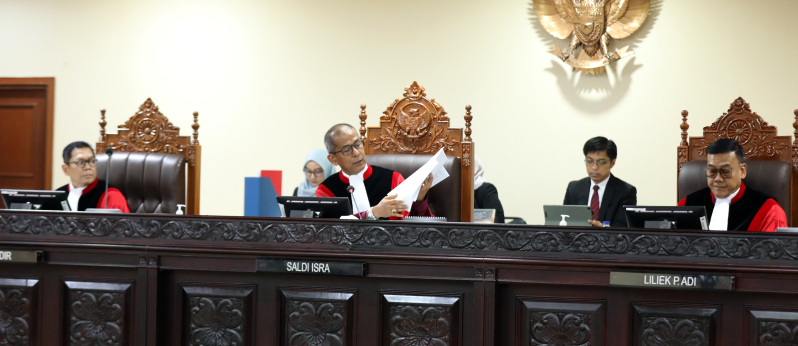
Deputy Chief Justice Saldi Isra, alongside Constitutional Justices Adies Kadir and Liliek P. Adi, during the panel hearing for Case No. 154/PUU-XXIV/2026, Thursday (5/7/2026). Photo by MKRI/Fauzan
JAKARTA (MKRI) — Nine advocates filed a petition for the judicial review of Article 1 point 22 and Article 151 paragraph (2) letter b of Law No. 20 of 2025 on the Criminal Procedure Code (KUHAP) against the 1945 Constitution to the Constitutional Court (MK). The Petitioners are Ratih Mutiara Louk Fanggi (Petitioner I), Titi Tantri (Petitioner II), Kusnaini (Petitioner III), Suparman (Petitioner IV), Satria Zulfikar Rasyd (Petitioner V), Hakiki Ramadhani (Petitioner VI), Ricki Insan Putra (Petitioner VII), Irwan (Petitioner VIII), and Tri Wahyu Budi Santoso (Petitioner IX).
The preliminary hearing for Case No. 154/PUU-XXIV/2026 took place on Thursday (5/7/2026) in the Court’s panel courtroom. At the outset of the hearing, the panel chaired by Deputy Chief Justice Saldi Isra alongside Constitutional Justices Adies Kadir and Liliek P. Adi questioned the striking similarity between the Petitioners’ submission and another petition previously filed before the Court, namely Case No. 119/PUU-XXIV/2026.
“Previously, we discovered that the grounds of your petition are exactly identical to another petition. Please explain this! You are all young advocates. Did you take a petition that had previously been submitted to the Constitutional Court? We found that this petition is precisely the same as Case No. 119/PUU-XXIV/2026 filed by Syamsul Jahidin. We cannot allow this to continue repeatedly. We await your decision,” Saldi stated.
Responding to the panel’s remarks, Ratih Mutiara Louk Fanggi, representing the Petitioners, asserted that her side had absolutely no knowledge of the contents of Case No. 119/PUU-XXIV/2026. She explained that the Petitioners initially intended to elaborate their petition further by presenting new evidence distinct from previous petitions submitted to the Court. However, after considering the circumstances highlighted by the constitutional justices, the Petitioners eventually agreed to withdraw their petition.
“We intended to proceed with this petition and submit concrete evidence concerning the degradation and overlap of the a quo norms. However, considering the circumstances, we have decided to withdraw this petition,” Titi Tantri emphasized.
In their petition, the Petitioners argued that Article 1 point 22 and Article 151 paragraph (2) letter b of the KUHAP contradict Article 27 paragraph (1) and Article 28D paragraphs (1) and (2) of the 1945 Constitution. As advocates, the Petitioners claimed that the enactment of those provisions potentially impairs their constitutional rights for several reasons. They argued that the provisions obscure the boundaries of the advocate profession, which has been strictly regulated under the Advocates Law. In particular, the phrase “and/or persons who may provide legal services both inside and outside the court as part of community service in providing pro bono legal assistance based on statutory laws and regulations” potentially enables individuals lacking qualifications under the Advocates Law to claim the status of “advocate.” They further contended that the provisions have created legal uncertainty regarding parties authorized to provide legal services within litigation proceedings.
Additionally, the Petitioners argued that the a quo provisions have triggered normative disharmony and legal conflict by defining “Advocate” and “Legal Aid” under two separate and independent legal regimes. Law No. 18 of 2003 regulates, as lex specialis, the definition, requirements, appointment, oath-taking, rights, obligations, code of ethics, supervision, and dismissal of advocates, while Law No. 16 of 2011 governs the provision of free legal aid to underprivileged communities through legal aid institutions under a mechanism distinct from the regulation of the advocate profession.
Also read:
Petition Challenging Expansion of Advocate Definition in Criminal Procedure Code Withdrawn
Questioning Advocates Expanded Definition Without Clear Qualification Standards
Author: Sri Pujianti
Editor: N. Rosi
Translator: Yuanna Sisilia
Disclaimer: The original version of the news is in Indonesian. In case of any differences between the English and the Indonesian versions, the Indonesian version will prevail.
Thursday, May 07, 2026 | 15:00 WIB 32