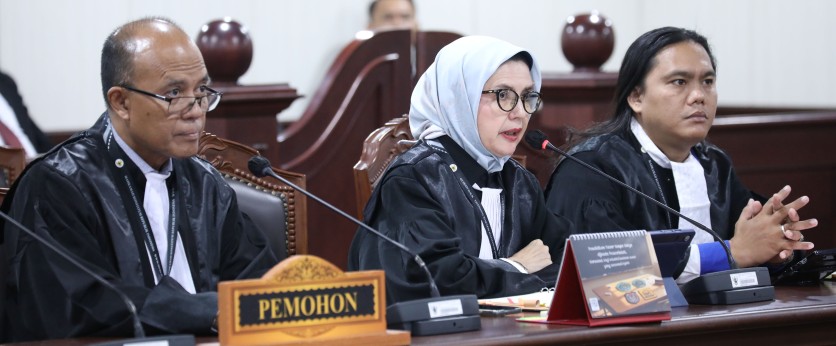
Legal counsel for the petitioners in the judicial review of the Law on the Criminal Procedure Code (KUHAP) presented the main points of their petition during a hearing held in the Constitutional Court’s panel courtroom on Thursday (April 9, 2026). Photo: Public Relations/Panji.
JAKARTA, MKRI — Henoch Thomas, together with ten other advocates, has filed a constitutional review petition challenging several provisions of Law No. 20 of 2025 on the Criminal Procedure Code (KUHAP) before the Constitutional Court. The contested provisions include Article 1 point 22, Article 31, Article 31(1), Article 31(2), and Article 151(2)(b).
The preliminary hearing of Petition No. 119/PUU-XXIV/2026 was presided over by Constitutional Justice Enny Nurbaningsih at the Court’s Panel Chamber on Thursday (April 9, 2026).
Article 1 point 22 defines an advocate as: “a person who provides legal services both inside and outside the court, who meets the requirements stipulated by the law governing advocates, and/or a person who may provide legal services both inside and outside the court as part of community service in delivering pro bono legal aid in accordance with statutory regulations.”
The Petitioners take issue with the inclusion of non-advocates within this definition. They argue that the provision dilutes the professional status of advocates as established under Law No. 18 of 2003 on Advocates.
One of the Petitioners, Syamsul Jahidin, appearing virtually, argued that the challenged provisions violate Articles 27(1), 28D(1), and 28D(2) of the 1945 Constitution. The Petitioners contend that Article 151(2) in particular has caused actual constitutional harm by undermining legal certainty. According to them, the provision shifts and reduces the legal standing of advocates who have been formally appointed and sworn in under the Advocates Law, while simultaneously creating unequal treatment between advocates and non-advocates.
They further argue that the provision could hinder independent practitioners operating through law offices from providing legal services in criminal litigation. In their view, equating licensed advocates with individuals who have not undergone equivalent professional qualification processes amounts to a degradation of professional dignity and contradicts constitutional guarantees of dignity and equality.
The Petitioners also emphasize that, under the principle of due process of law, a fair criminal justice system requires legal assistance to be provided by competent professionals. They cite Constitutional Court Decision No. 006/PUU-III/2005, which underscores the importance of qualification standards in the exercise of constitutional rights, including the right to legal counsel.
Accordingly, the expansion of the advocate definition without clear qualification standards, they argue, risks undermining due process, as suspects or defendants may be assisted by individuals lacking adequate competence—thereby jeopardizing the effective protection of their constitutional rights.
“Declaring Article 1 point 22, specifically the phrase ‘and/or a person who may provide legal services both inside and outside the court as part of community service in delivering pro bono legal aid in accordance with statutory regulations’ of Law No. 20 of 2025 on the Criminal Procedure Code, conditionally unconstitutional and without binding legal force unless interpreted to mean: ‘An advocate is a person who provides legal services both inside and outside the court who meets the requirements stipulated by the law governing advocates,’” stated Cecep Sumarno, counsel for the Petitioners, in reading one of the petitum requests.
Constitutional Harm and Legal Standing
During the advisory session, Constitutional Justice Arsul Sani encouraged the Petitioners to streamline their arguments regarding constitutional harm. “Our task is to assess whether the arguments presented by the Petitioners or their counsel are rational,” he noted.
Justice M. Guntur Hamzah acknowledged the Petitioners’ experience as seasoned litigators but emphasized that the central issue lies in establishing their legal standing.
“For this petition, the issue of legal standing needs to be elaborated further. The fact that legal standing may have been granted in previous cases does not automatically apply here. This is the challenge for both the principal and counsel to address,” he said.
Justice Enny Nurbaningsih also observed that the petition resembles similar prior cases and stressed the importance of clearly articulating constitutional harm. She advised the Petitioners to refer to Constitutional Court Decision No. 50/PUU-XXII/2024 for guidance.
At the conclusion of the hearing, the Court granted the Petitioners 14 days to revise their application. The revised petition must be submitted no later than Wednesday, April 22, 2026, at 12:00 WIB. A subsequent hearing will be scheduled to examine the revised arguments.
Explore the Case: Petition No. 119/PUU-XXIV/2026
Author : Sri Pujianti
Editor : N. Rosi
Public Relations: Fauzan F.
Translator : SO
Disclaimer: The original version of the news is in Indonesian. In case of any differences between the English and the Indonesian versions, the Indonesian version will prevail.
Thursday, April 09, 2026 | 18:00 WIB 53