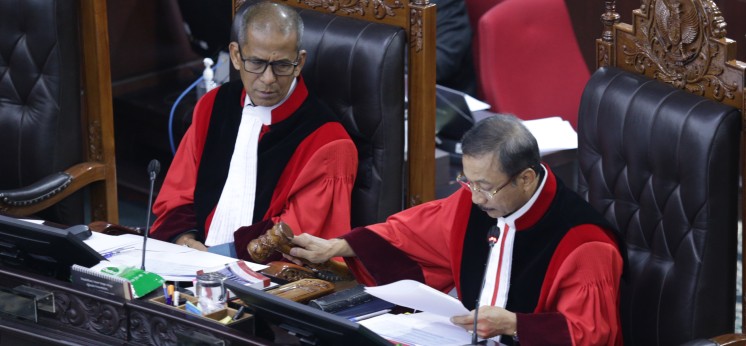
The Court delivers the ruling on the withdrawal of Petition Number 129/PUU-XXIV/2026 concerning the judicial review of Law Number 30 of 2004 on Notary Office as amended by Law Number 2 of 2014, Wednesday (04/29/2026), at the Plenary Courtroom of the Constitutional Court. Photo by MKRI/Bay.
JAKARTA, (MKRI) – The Constitutional Court (the Court) has granted the request for withdrawal of the petition for judicial review of Article 13 of Law Number 30 of 2004 on Notary Office, as amended by Law Number 2 of 2014 concerning Amendments to Law Number 30 of 2004 on Notary Office. This was declared by the Court in the pronouncement of Determination Number 129/PUU-XXIV/2026, presided over by Chief Justice Suhartoyo on Wednesday (04/29/2026) at the Plenary Courtroom of the Court in Jakarta.
In reading the determination, Suhartoyo stated that the Court had received a letter of withdrawal for Petition Number 129/PUU-XXIV/2026 submitted by a number of advocates, with the reasons outlined in the letter. Subsequently, the Justices’ Deliberation Meeting (RPH) held on April 15, 16, 21, and 22, 2026 concluded that the withdrawal was legally justified and that the Petitioners may not refile the a quo petition. The RPH also instructed the Registrar of the Court to record the withdrawal in the e-BRPK system and to return the case documents to the Petitioners.
“Declaring: granting the withdrawal of the Petitioners’ petition,” stated Suhartoyo in reading the determination.
Read also:
Petitioners Absent, Withdrawal of Notary Law Review Petition Not Confirmed
As additional information, the petition was filed by three notaries—Askanah, Jane Margaretha Handayani, and Wakiyo—along with a notary assistant, Syamsul Jahidin. The Petitioners challenged the constitutionality of a phrase in Article 13 of the Notary Office Law, arguing that the provision on criminal sanctions for notaries creates legal uncertainty and potentially infringes upon their constitutional rights.
In their petition, the Petitioners explained that the supervisory mechanism for notaries is primarily conducted by the Notary Supervisory Council under the authority of the Minister of Law and Human Rights. Notaries suspected of committing criminal acts must undergo the full legal process, including investigation by the police, prosecution by the public prosecutor, trial proceedings, and execution of the court’s decision.
The Petitioners also highlighted the regulation of administrative sanctions under Law Number 2 of 2014. Notaries sentenced to imprisonment based on a court decision may be subject to dishonorable dismissal as stipulated in Articles 12 and 13. However, differences exist between the two provisions.
Article 12 regulates dishonorable dismissal by the Minister upon the recommendation of the Central Supervisory Council, while Article 13 allows for direct dismissal. In practice, notaries sentenced to five years or more of imprisonment may be immediately dismissed dishonorably, whereas those sentenced to less than five years may still have the possibility of reinstatement.
According to the Petitioners, this condition demonstrates the absence of legal certainty in the regulation of sanctions and may undermine the dignity of the notary profession as public officials. Furthermore, the lack of regulation concerning sanctions for notaries facing imprisonment of less than five years is considered to create opportunities for abuse of authority, including the potential for extortion by supervisory authorities against notaries involved in criminal cases.
On that basis, the Petitioners requested the Court to declare the contested phrase contrary to the 1945 Constitution of the Republic of Indonesia (UUD 1945) and to have no binding legal force. (*)
Author : Ilham Wiryadi Muhammad
Editor : N. Rosi.
PR : Fauzan
Translator : Agusweka PS.
Disclaimer: The original version of the news is in Indonesian. In case of any differences between the English and the Indonesian versions, the Indonesian version prevails.
Full Decision: Number 129/PUU-XXIV/2026
Wednesday, April 29, 2026 | 17:13 WIB 182