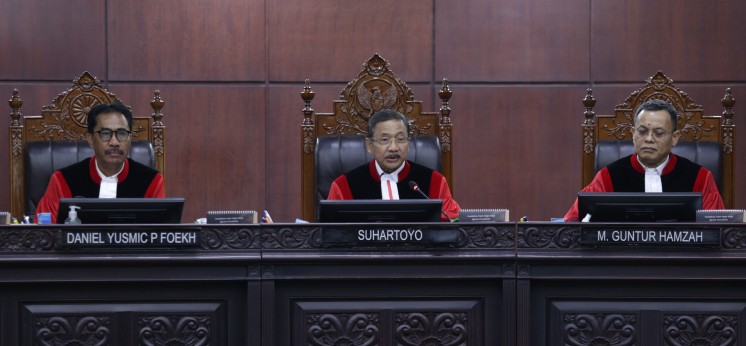
The hearing to confirm the withdrawal of Petition Number 129/PUU-XXIV/2026 concerning the judicial review of Law Number 30 of 2004 on the Position of Notary, as amended by Law Number 2 of 2014, Friday (04/17/2026). Photo by MKRI/Bay.
JAKARTA, (MKRI) – The Constitutional Court held a hearing for Petition Number 129/PUU-XXIV/2026 on Friday (04/17/2026) at the Plenary Courtroom in Jakarta. The petition was filed by three notaries—Askanah, Jane Margaretha Handayani, Wakiyo—and a notary assistant, Syamsul Jahidin.
The hearing was chaired by Chief Justice Suhartoyo, accompanied by Constitutional Justice Daniel Yusmic P. Foekh and Constitutional Justice M. Guntur Hamzah. The session was scheduled to confirm the withdrawal of the petition concerning the judicial review of Law Number 30 of 2004 on Notary Office. However, the Panel of Justices was unable to confirm the withdrawal as the Petitioners failed to appear.
During the hearing, Chief Justice Suhartoyo stated that court officers had duly summoned the Petitioners to attend the session for confirmation of the withdrawal. However, until the designated time, there was no confirmation of their attendance with acceptable reasons.
“The petition for Number 129 cannot be confirmed and will be reported to the Justices’ Deliberation Meeting (RPH),” Suhartoyo stated.
For context, the Petitioners challenged the constitutionality of a phrase in Article 13 of the Notary Law. They argued that the provision on criminal sanctions against notaries creates legal uncertainty and has the potential to infringe upon their constitutional rights.
In their petition, the Petitioners explained that supervision of notaries is generally carried out by the Notary Supervisory Council under the authority of the Minister of Law and Human Rights. Notaries suspected of committing criminal acts must undergo legal processes, including investigation by the police, prosecution by the public prosecutor, trial proceedings, and enforcement of court decisions.
The Petitioners also highlighted the regulation of administrative sanctions under Law Number 2 of 2014. Notaries sentenced to imprisonment based on a court decision may be subject to dishonorable dismissal as stipulated in Articles 12 and 13. However, there are differences in regulation between these provisions.
Article 12 provides for dismissal by the Minister upon recommendation of the Central Supervisory Council, while Article 13 allows for direct dismissal. In practice, notaries sentenced to imprisonment of five years or more may be directly dismissed dishonorably, whereas those sentenced to less than five years may still have the possibility of reinstatement.
According to the Petitioners, this condition reflects a lack of legal certainty in the regulation of sanctions and may undermine the dignity of the notary profession as a public office. Furthermore, the absence of clear norms regarding sanctions for notaries facing sentences of less than five years creates opportunities for abuse of authority. This, they argued, opens the possibility for misuse by supervisory bodies to extort notaries involved in criminal cases.
On that basis, the Petitioners requested the Court to declare the phrase unconstitutional and without binding legal force under the 1945 Constitution of the Republic of Indonesia. (*)
Author : Utami Argawati
Editor : N. Rosi
PR : Fauzan
Translator : Agusweka PS.
Disclaimer: The original version of the news is in Indonesian. In case of any differences between the English and the Indonesian versions, the Indonesian version prevails.
Case Track: Number 129/PUU-XXIV/2026
Friday, April 17, 2026 | 13:25 WIB 42