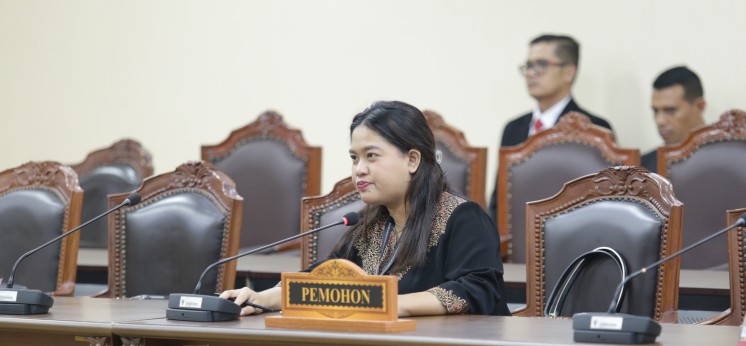
The Petitioner during the Hearing on the Revision of Petition for Case Number 126/PUU-XXIV/2026 concerning the Judicial Review of Law Number 18 of 2003 on Advocates, Monday (4/27/2026). Public Relations/Bay.
JAKARTA (MKRI) – Zico Leonard Djagardo Simanjuntak, petitioner for the judicial review of Article 12 paragraph (1) and Article 28 paragraph (1) of Law Number 18 of 2003 on Advocates (Advocates Law), submitted revisions to Petition Number 126/PUU-XXIV/2026. The revisions were conveyed by his legal counsel, Priskila Oktaviani, during the preliminary hearing with the agenda of examining the revised petition on Monday, April 27, 2026, at the Constitutional Court (MK) in Jakarta.
Before the panel of constitutional justices chaired by Chief Justice Suhartoyo, Priskila explained that several revisions had been made to the petition, including the addition of the Elucidation of Article 28 paragraph (1) of the Advocates Law. The Petitioner also added evidence in the form of the Petitioner’s Advocate Identity Card (KTA). In the posita, or legal arguments section, the revised petition further explained that the petition is not ne bis in idem, accompanied by comparative arguments regarding advocate supervision practices in various countries.
“To strengthen the argument that the a quo petition is not ne bis in idem and at the same time demonstrate the constitutional urgency of this petition, the Petitioner refers to comparative legal practices in various countries which show a tendency toward a non-fragmented and functionally centralized advocate professional supervision system,” Priskila stated.
Another revision concerned the Elucidation of Article 28 paragraph (1) of the Advocates Law, which merely states that the provision is “self-explanatory,” a formulation that according to the Petitioner does not provide adequate legal certainty. Priskila explained that the Petitioner’s intention is not simply to allow only one advocate organization in Indonesia, but specifically that only the Indonesian Advocates Association (PERADI) should be authorized to exercise the exclusive functions granted by the Advocates Law, while supervision of advocates should be carried out by a national honor council composed of representatives from various advocate groups.
“Regardless of their membership in any advocate organization, they must remain subject to a single National Advocate Honor Council established by PERADI. In addition, members of this honor council may only come from advocate circles,” Priskila stated.
Read also:
Multi-Organization Advocate System Deemed Detrimental to Justice Seekers
As additional information, Case No. 126/PUU-XXIV/2026 challenging the constitutionality of Article 12 paragraph (1) and Article 28 paragraph (1) of the Advocates Law was filed by Zico Leonard Djagardo Simanjuntak. Article 12 paragraph (1) stipulates that advocates are supervised by an Advocates Organization. Meanwhile, Article 28 paragraph (1) designates the Advocates Organization as the sole, independent, and free professional body.
In the preliminary hearing held on Monday, April 13, 2026. The Petitioner through his legal counsel, Gusti Putu Agung Cinta Arya Diningrat argued that the norms contained in these provisions create legal uncertainty, resulting in the absence of uniform standards of legal protection for the public. He asserted that such conditions contravene the principle of equality before the law as guaranteed under Article 27 paragraph (1) of the 1945 Constitution.
“The emergence of a multi-organization system creates two classes of justice seekers. First, those who use legal services from organizations with strict ethical standards, and second, those who rely on organizations with weak ethical enforcement. This distinction arises solely from the ambiguity of the law itself, not from the choice of citizens,” Gusti stated during the hearing.
Furthermore, the Petitioner highlighted that the Court, in Decision No. 014/PUU-IV/2006, had previously affirmed the Indonesian Advocates Association (PERADI) as the sole advocates’ organization. Nevertheless, issues remain regarding the authority to determine the legitimacy of such an organization.
The Petitioner argued that advocates, as independent law enforcers, should not be subject to intervention by the government or other law enforcement institutions. Therefore, clear statutory regulation is necessary to determine the legitimacy of advocate organizations in order to ensure legal certainty.
Therefore, the Petitioner requested the Court to declare Article 12 paragraph (1) of the Advocates Law contrary to the 1945 Constitution of the Republic of Indonesia and conditionally unconstitutional insofar as it is not interpreted as “Supervision of advocates shall only be carried out by a single National Advocate Honor Council whose members consist of representatives from various advocate groups.” The Petitioner also requested the Court to declare the phrase “Advocate Organization” in Article 28 paragraph (1) of the Advocates Law contrary to the 1945 Constitution and conditionally unconstitutional insofar as it is not interpreted as “the Indonesian Advocates Association (PERADI).” Furthermore, the Petitioner requested the Court to declare the Elucidation of Article 28 paragraph (1) of the Advocates Law contrary to the 1945 Constitution and conditionally unconstitutional insofar as it is not interpreted as: “The Indonesian Advocates Association (PERADI) referred to is the one registered with the ministry administering governmental affairs in the legal sector. In the event of a dispute regarding such registration status, its resolution shall be conducted through the competent court in accordance with prevailing laws and regulations.”
Author : Ilham WIryadi Muhammad.
Editor : N. Rosi.
Translator : Vale / Siti Rosmalina Nurhayati
Explore Case No. 126/PUU-XXIV/2026 (in Indonesian).
Disclaimer: The original version of the news is in Indonesian. In case of any differences between the English and the Indonesian versions, the Indonesian version will prevail.
Monday, April 27, 2026 | 17:53 WIB 4