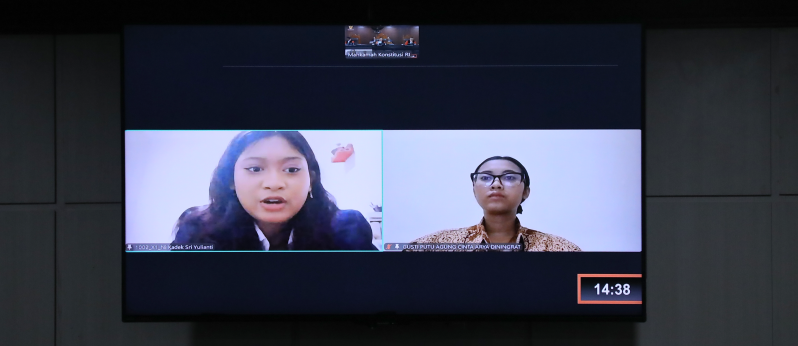
Ni Kadek Sri Yulianti and Gusti Putu Agung Cinta Arya Diningrat, as the Petitioner’s legal counsels, presenting the principal arguments of the petition during the preliminary hearing for Case No. 126/PUU-XXIV/2026. Photo by MKRI/Fauzan.
JAKARTA (MKRI) — On Monday, April 13, 2026, the Constitutional Court (MK) held a preliminary hearing for the judicial review of Law No. 18 of 2003 on Advocates against the 1945 Constitution. The hearing for Case No. 126/PUU-XXIV/2026 was chaired by Chief Justice Suhartoyo, accompanied by Constitutional Justices Daniel Yusmic P. Foekh and Justice M. Guntur Hamzah.
The petition was filed by Zico Leonard Djagardo Simanjuntak, challenging the constitutionality of Article 12 paragraph (1) and Article 28 paragraph (1) of the Advocates Law. Article 12 paragraph (1) stipulates that advocates are supervised by an Advocates Organization. Meanwhile, Article 28 paragraph (1) designates the Advocates Organization as the sole, independent, and free professional body.
During the hearing, the Petitioner’s legal counsel, Gusti Putu Agung Cinta Arya Diningrat, argued that the norms contained in these provisions create legal uncertainty, resulting in the absence of uniform standards of legal protection for the public. He asserted that such conditions contravene the principle of equality before the law as guaranteed under Article 27 paragraph (1) of the 1945 Constitution.
“The emergence of a multi-organization system creates two classes of justice seekers. First, those who use legal services from organizations with strict ethical standards, and second, those who rely on organizations with weak ethical enforcement. This distinction arises solely from the ambiguity of the law itself, not from the choice of citizens,” Gusti stated during the hearing.
The Petitioner also referred to expert testimony by Zainal Arifin Mochtar, who emphasized that the existence of multiple advocate organizations has the potential to harm the public. According to the expert, such a system may disadvantage justice seekers because advocates are not affiliated with a single governing body, thereby rendering ethical enforcement mechanisms unclear when violations occur.
Furthermore, the Petitioner highlighted that the Court, in Decision No. 014/PUU-IV/2006, had previously affirmed the Indonesian Advocates Association (PERADI) as the sole advocates’ organization. Nevertheless, issues remain regarding the authority to determine the legitimacy of such an organization.
The Petitioner argued that advocates, as independent law enforcers, should not be subject to intervention by the government or other law enforcement institutions. Therefore, clear statutory regulation is necessary to determine the legitimacy of advocate organizations in order to ensure legal certainty.
During the hearing, the panel of constitutional justices provided several recommendations to the Petitioner. Justice Foekh advised the Petitioner to strengthen the posita, or legal reasoning of the petition.
“Develop a stronger legal argument, possibly by employing doctrines or comparative principles, to convince the Court that what was previously considered clear in the elucidation of Article 28 paragraph (1) requires reinterpretation,” Justice Foekh explained.
The panel granted the Petitioner 14 days to revise the petition. The revised petition must be submitted to the Court no later than Monday, April 27, 2026, at 12:00 WIB.
Author: Utami Argawati
Editor: N. Rosi
Public Relations: Adriana AY
Translator: Siti Rosmalina Nurhayati
Track the case: Case No. 126/PUU-XXIV/2026
Disclaimer: The original version of the news is in Indonesian. In case of any differences between the English and the Indonesian versions, the Indonesian version will prevail
Monday, April 13, 2026 | 20:20 WIB 45