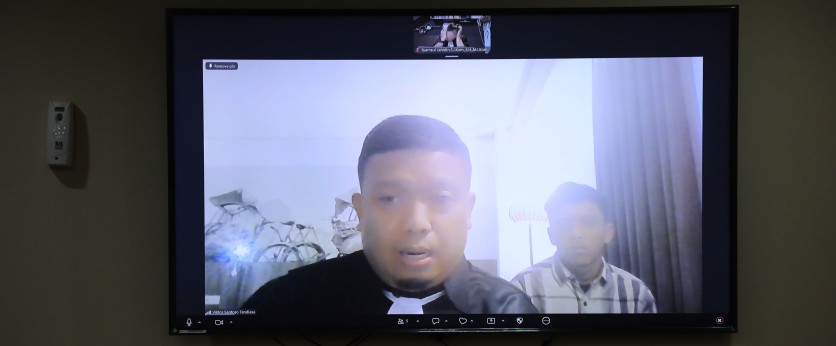
Viktor Santoso Tandiasa, legal counsel to the Petitioner in the judicial review of the State Civil Apparatus (ASN) Law, presenting the revised petition at the petition revision hearing, Wednesday (4/22/2026). Photo by MKRI/Panji.
JAKARTA (MKRI) — The Constitutional Court (MK) held a follow-up hearing for the judicial review of Article 21 paragraph (1) of Law No. 20 of 2023 on the State Civil Apparatus (ASN Law) on Wednesday, April 22, 2026. The petition for Case No. 122/PUU-XXIV/2026 was filed by Kusdiana, a retiree of the Ministry of Foreign Affairs.
Presided over by Constitutional Justice Enny Nurbaningsih in the panel courtroom, the hearing was held to hear the main points of the revised petition. During the hearing, the Petitioner’s legal counsel, Viktor Santoso Tandiasa, explained that the Petitioner had refined his legal standing by elaborating efforts to demonstrate the Government’s lack of good faith in following up on the Court’s directions. Based on these grounds, the Petitioner proceeded with the petition.
The Petitioner also revised the petitum. “To declare that Article 21 paragraph (1) of the ASN Law is contrary to the 1945 Constitution and conditionally unconstitutional insofar as it is not interpreted to mean: ‘State civil apparatus employees who are entitled to material recognition and rewards, in this case in the form of basic salary, include civil servants and retired civil servants who did not receive domestic basic salary during their assignment to Indonesian overseas missions,’” Viktor stated.
Article 21, paragraph (1) of the ASN Law stipulates that “state civil apparatus employees are entitled to material and/or non-material recognition and rewards.” The Petitioner argues that this provision is conditionally inconsistent with Article 1 paragraph (3), Article 28D paragraphs (1) and (2), Article 28H paragraph (4), and Article 28I paragraph (4) of the 1945 Constitution.
Also Read: Foreign Ministry Retiree Questions Suspension of Basic Salary
Previously, at the preliminary hearing on Thursday (April 9, 2026), Viktor explained that from 1950 until December 31, 2012, the Ministry of Foreign Affairs had practiced the suspension of basic salary payments for civil servants assigned to overseas postings, providing instead a foreign service allowance whose amount varied depending on the country of assignment.
“Therefore, Article 21 paragraph (1) of the ASN Law opens a loophole for the loss of civil servants’ fundamental right to basic salary through the merging or removal of income components, in this case the basic salary, as has occurred from 1961 to January 1, 2013,” Viktor asserted.
The Petitioner further argued that the interpretation of Article 21 paragraph (1) of the ASN Law should be retroactively remedial. This means the provision should be applied retrospectively not to punish, but to restore the proprietary rights to basic salary for civil servants assigned to Indonesian overseas missions whose rights had been effectively taken due to flawed administrative policies.
Author: Sri Pujianti
Editor: N. Rosi
PR: Andhini SF
Translator: Yuanna Sisilia
Disclaimer: The original version of the news is in Indonesian. In case of any differences between the English and the Indonesian versions, the Indonesian version will prevail.
Explore the Case: Case No. 122/PUU-XXIV/2026 (in Bahasa Indonesia)
Wednesday, April 22, 2026 | 18:48 WIB 40