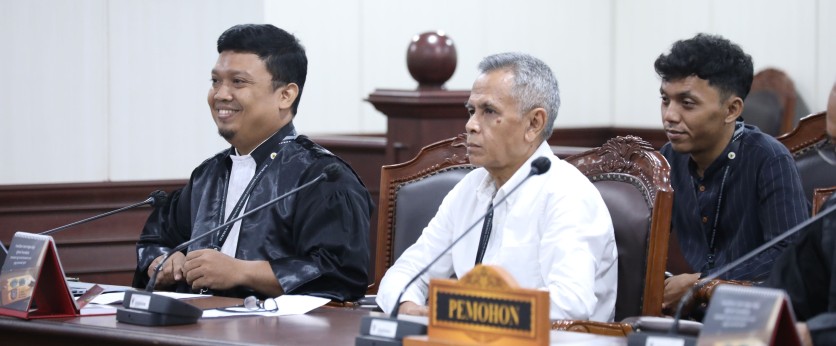
Petitioner Kusdiana, accompanied by his legal counsel Viktor Santoso Tandiasa, attending a judicial review hearing of Law No. 20 of 2023 on State Civil Apparatus (ASN Law), Thursday (4/9/2026) in the Constitutional Court’s panel courtroom. Photo by MKRI/Panji.
JAKARTA (MKRI) — A retiree of the Ministry of Foreign Affairs (MOFA), Kusdiana, has filed a petition for a material judicial review of Article 21 paragraph (1) of Law No. 20 of 2023 on State Civil Apparatus (ASN Law) against the 1945 Constitution to the Constitutional Court. The preliminary hearing for Case No. 122/PUU-XXIV/2026 was presided over by Constitutional Justice Enny Nurbaningsih in the Court’s panel courtroom on Thursday, April 9, 2026.
Article 21 paragraph (1) of the ASN Law stipulates that “state civil apparatus employees are entitled to rewards and recognition in the form of material and/or nonmaterial benefits.” According to Kusdiana (the Petitioner), this provision is conditionally unconstitutional as it contravenes Article 1 paragraph (3), Article 28D paragraphs (1) and (2), Article 28H paragraph (4), and Article 28I paragraph (4) of the 1945 Constitution.
The Petitioner’s legal counsel, Viktor Santoso Tandiasa, explained that from 1950 until December 31, 2012, a long-standing practice within the Ministry of Foreign Affairs effectively suspended the payment of basic salaries to civil servants assigned to overseas missions. Instead, they were granted overseas living allowances, the amounts of which varied depending on the country of assignment.
“Consequently, Article 21 paragraph (1) of the ASN Law opens a loophole for the erosion of civil servants’ fundamental right to a basic salary through the amalgamation or elimination of income components, in this case, the basic salary, practices that persisted from 1961 until January 1, 2013,” Viktor asserted.
In a state governed by the rule of law, such a situation should not occur unless the provision is construed to include civil servants and retired civil servants of the Ministry of Foreign Affairs who had not received domestic basic salaries during their overseas assignments prior to January 1, 2013. Otherwise, the norm fails to fulfill its function in safeguarding human rights, thereby reflecting a disregard for the fundamental principle that the state must ensure fair legal protection and certainty for all citizens.
The Petitioner further argued that it is inequitable for civil servants assigned abroad, carrying out official state duties, to suffer a diminution of rights by losing their basic salary compared to their counterparts stationed domestically. Therefore, he maintained that it is legally justified for the a quo provision to be declared conditionally unconstitutional under Article 28D paragraph (1) of the 1945 Constitution.
Moreover, the Petitioner contended that the interpretation of Article 21 paragraph (1) of the ASN Law must adopt a retroactive remedial approach. In essence, the provision should apply retrospectively not to impose sanctions, but to restore proprietary rights, namely, the basic salary, of civil servants previously assigned abroad whose entitlements were effectively “deprived” due to flawed administrative policies. Constitutionally protected property rights, he emphasized, cannot be extinguished merely by regulatory changes or the passage of time if the deprivation occurred through unlawful procedures.
Accordingly, the Petitioner argued that the failure to pay basic salaries to civil servants assigned abroad before January 1, 2013 constitutes a continuing constitutional violation. The provision in question thus presents a pivotal opportunity for the Court to reaffirm that civil servants’ entitlement to their basic salary is absolute and transcends temporal limitations.
Based on these arguments, the Petitioner requested the Court to declare Article 21 paragraph (1) of the ASN Law unconstitutional and not legally binding insofar as it is not interpreted to include civil servants of the Ministry of Foreign Affairs who did not receive domestic basic salaries during their overseas assignments prior to January 1, 2013.
Constitutional Losses
During the panel hearing, Constitutional Justice Arsul Sani advised the Petitioner to further refine the alleged constitutional losses. “Regarding the subject matter, it is stated that the claim is hindered by statutory limitation periods under previously tested laws. However, since this petition seeks an interpretation, this aspect must be clarified,” Arsul remarked.
Meanwhile, Constitutional Justice M. Guntur Hamzah highlighted the Petitioner’s legal standing. He suggested that the Petitioner should present documentation of appointment and termination of assignments to substantiate the factual basis of the claim.
“From the posita perspective, revisit Constitutional Court Decision No. 184/PUU-XXII/2024. The Court emphasized that such matters should be considered a form of state recognition and presence, taking fiscal capacity into account. Now, explain why the Court should intervene again, given that a previous decision has already addressed similar concerns,” Guntur stated.
Constitutional Justice Enny Nurbaningsih added that the petition appears to stem from a sense of grievance that must be framed within the framework of constitutional reasoning. “The Petitioner is a retired civil servant, yet the provision under review concerns active civil servants. Consider the broader implications, there are ten paragraphs within the a quo article, many of which are interrelated,” Enny explained.
At the conclusion of the hearing, Enny granted the Petitioner 14 days to revise the petition. The revised submission must be filed with the Registrar’s Office of the Constitutional Court by Wednesday, April 22, 2026, at 12:00 p.m. WIB. The Court will then hold a subsequent hearing to examine the revisions.
Author: Sri Pujianti
Editor: N. Rosi
PR: Andhini SF
Translator: Yuanna Sisilia
Disclaimer: The original version of the news is in Indonesian. In case of any differences between the English and the Indonesian versions, the Indonesian version will prevail.
Thursday, April 09, 2026 | 18:28 WIB 45