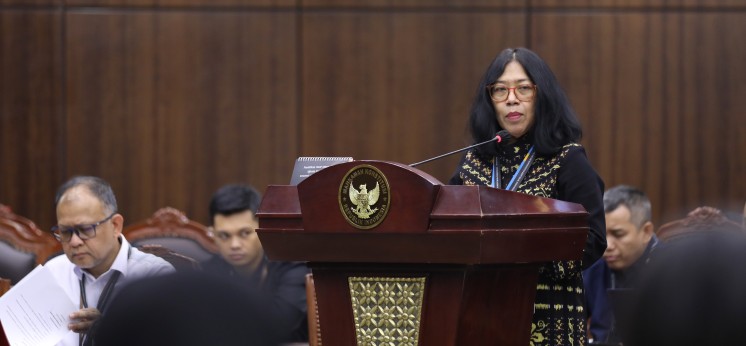
The Government, represented by Nur Syarifah from the Inspectorate General of the Ministry of Higher Education, delivers its statement during the continued hearing on the judicial review of Law Number 14 of 2005 on Teachers and Lecturers, Tuesday (04/21/2026) at the Constitutional Court courtroom. Photo by MKRI/Ifa.
JAKARTA, (MKRI) – The Constitutional Court held a continued hearing on the judicial review of Law Number 14 of 2005 on Teachers and Lecturers on Tuesday (04/21/2026) at the Plenary Courtroom. Petition Number 24/PUU-XXIV/2026 was filed by I Ketut Astawa and Reytman Aruan, permanent lecturers at the Faculty of Law, Universitas Singaperbangsa Karawang.
The Petitioners challenge the constitutionality of Article 54 paragraph (1) of the Teachers and Lecturers Law, which governs the provision of functional allowances for lecturers appointed by the Government. They argue that the provision lacks clear standards, principles, and benchmarks, potentially leading to legal uncertainty.
During the hearing, which was scheduled to hear the Government’s statement, Nur Syarifah, Acting Inspector General of the Ministry of Higher Education, Science, and Technology, emphasized that assessing the welfare of civil servant (ASN) lecturers cannot be done partially.
“An objective assessment of welfare must be viewed comprehensively through the cumulative principle of all income components received as a unified whole (take-home pay),” Syarifah stated before the Panel of Constitutional Justices.
According to the Government, using functional allowances as the sole indicator of welfare is a flawed approach, as it may obscure the objective condition of lecturers’ overall income. The Government also highlighted that ASN lecturers have access to various legitimate additional sources of income, such as research grants, royalties, and publication incentives.
Furthermore, the Government explained that the ASN income system is designed with multiple components, each serving distinct purposes and functions. This system forms part of the state’s strategy to strengthen professional human resource governance and support organizational effectiveness.
“Since the reform era, financial rewards for ASN have shifted toward a merit-based principle that prioritizes individual performance as a driver of productivity,” Syarifah said. She added that the Government applies the Factor Evaluation System (FES) to ensure fairness, namely equal pay for work with equal levels of responsibility.
The Government also stressed that providing fair compensation based on job weight serves as a preventive measure against corrupt behavior, while also recognizing employee professionalism.
Within the current remuneration structure, performance allowances constitute the largest component compared to base salary and positional allowances. The base salary functions as a basic guarantee, while positional allowances—including functional allowances for lecturers—are relatively static and serve as the initial recognition of a position.
In contrast, performance allowances are dynamic, as they are adjusted based on the achievement of key performance indicators (KPIs) at both institutional and individual levels.
“The Government has consciously shifted the strengthening of welfare toward dynamic performance allowances, ensuring that improvements in the welfare of ASN lecturers are directly proportional to productivity and tangible contributions,” Syarifah stated.
The Government concluded that the adequacy of ASN lecturers’ income is the result of the integration of various dynamic and measurable components. Therefore, lecturer welfare cannot be assessed solely based on a single type of functional allowance.
Read also:
Two Lecturers Challenge Provision on Functional Allowances
Two Lecturers Revise Petition Challenging Functional Allowance Provision
DPR: Provisions on Lecturers’ Functional Allowances Meet Established Standards
For additional context, during the Preliminary Examination Hearing held on Monday (01/26/2026), the Petitioners claimed that their constitutional rights were impaired by the enactment of Article 54 paragraph (1) of the Teachers and Lecturers Law. They argued that the provision fails to provide recognition, guarantees, protection, and fair legal certainty as guaranteed under Article 28D paragraph (1) of the 1945 Constitution of the Republic of Indonesia, as well as the right to a decent standard of living under Article 28H paragraph (1).
The Petitioners further argued that Article 54 paragraph (1) does not explicitly mandate further regulation of functional allowances. However, in practice, the Government issued Presidential Regulation Number 65 of 2007 on Lecturer Allowances, which sets the amount of functional allowances at approximately Rp1.5 million for professors, Rp900,000 for associate professors, Rp700,000 for lecturers, and Rp375,000 for assistant lecturers.
According to the Petitioners, this condition shows that the amount of functional allowances depends entirely on Government policy. This demonstrates that Article 54 paragraph (1) does not provide an adequate constitutional mandate to ensure the fair and sustainable fulfillment of their welfare rights.
They further contended that the issue does not merely stem from the Presidential Regulation, but from the absence of principles, standards, and benchmarks within Article 54 paragraph (1) itself. As a result, the Government has broad discretion in determining allowance amounts without considering the evolving cost of living and lecturers’ workload. This situation is considered detrimental, particularly for ASN lecturers at the lecturer rank, as it fails to provide fair legal certainty regarding welfare fulfillment.
Additionally, the Petitioners raised concerns over fairness, noting that lecturers are required to meet various requirements under Minister of Higher Education, Science, and Technology Regulation Number 52 of 2025 on Lecturer Profession, Career, and Income, while clear standards and benchmarks for functional allowances are not explicitly regulated at the statutory level.
Author : Utami Argawati
Editor : N. Rosi
PR : Raisa Ayuditha M.
Translator : Agusweka PS.
Disclaimer: The original version of the news is in Indonesian. In case of any differences between the English and the Indonesian versions, the Indonesian version prevails.
Case Track: Number 24/PUU-XXIV/2026
Tuesday, April 21, 2026 | 13:34 WIB 212