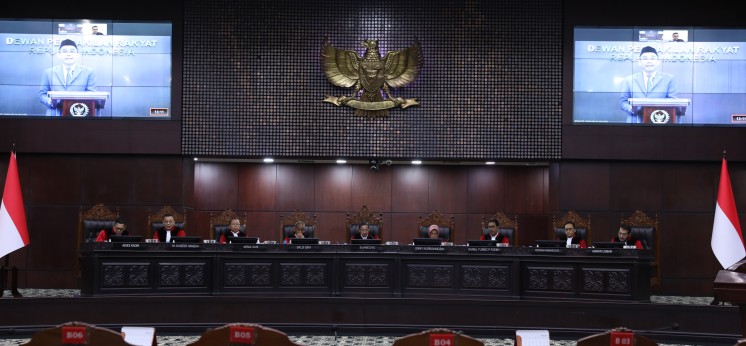
The Constitutional Court held a follow-up hearing on the judicial review of Law Number 14 of 2005 concerning Teachers and Lecturers, with the agenda of hearing statements from the House of Representatives and the President, on Thursday (02/26/2026) at the Courtroom. Photo by MKRI/Ifa.
JAKARTA, (MKRI) – The Constitutional Court held another hearing on the judicial review of Law Number 14 of 2005 on Teachers and Lecturers on Thursday (02/26/2026) at the Plenary Courtroom. Petition Number 24/PUU-XXIV/2026 was filed by I Ketut Astawa and Reytman Aruan, permanent lecturers at the Faculty of Law, Universitas Singaperbangsa Karawang.
The Petitioners are challenging the constitutionality of Article 54 paragraph (1) of the Teachers and Lecturers Law, which states, “The Government shall provide functional allowances as referred to in Article 52 paragraph (1) to lecturers appointed by the Government.”
According to the Petitioners, the provision does not clearly regulate the standards, principles, and benchmarks for granting lecturers’ functional allowances, thereby potentially creating legal uncertainty.
The hearing agenda was to hear the statement of the House of Representatives (DPR).
During the hearing, the DPR—represented by Commission III member Rudianto Lallo—stated that discussions regarding lecturers’ income had been comprehensively conducted during the Working Committee meeting of Commission X of the DPR together with the government on November 23, 2005.
In that meeting, he explained, the discussion specifically addressed adequate and proper income above the standard of living. The professional allowance is granted once lecturers obtain their educator certification, while the amount of functional allowances is provided in accordance with increases in academic rank. Under this structure, lecturers’ income is considered more secure and above basic living needs.
The DPR also explained that the regulation of functional allowances under Article 54 paragraph (1) of the Teachers and Lecturers Law refers to Article 52 paragraph (1) and Article 51 paragraph (1) letter a of the same law. The elucidation of Article 52 paragraph (1) provides limitations regarding the components of lecturers’ income, namely basic salary, professional allowance, and special allowance.
“Essentially, the regulation of lecturers’ functional allowances under Article 54 paragraph (1) of the Teachers and Lecturers Law refers to Article 52 paragraph (1) and Article 51 paragraph (1) letter a of the same law. The elucidation of Article 52 paragraph (1) provides a clear definition of each component of lecturers’ income, namely basic salary, professional allowance, and special allowance,” he stated.
Based on this structure, the DPR argued that the provisions of the Teachers and Lecturers Law have provided clear normative standards regarding the right to income above basic living needs as well as guarantees of lecturers’ welfare, including clothing, food, housing, healthcare, and old-age security.
Read also:
Two Lecturers Challenge Provision on Functional Allowances
Two Lecturers Revise Petition Challenging Functional Allowance Provision
During the Preliminary Examination hearing held at the Court on Monday (01/26/2026), the Petitioners argued that their constitutional rights had been impaired by the enforcement of Article 54 paragraph (1) of the Teachers and Lecturers Law. The provision is considered to fail to provide recognition, guarantees, protection, and fair legal certainty as guaranteed under Article 28D paragraph (1) of the 1945 Constitution of the Republic of Indonesia (UUD 1945), as well as the right to a prosperous life as stipulated in Article 28H paragraph (1) of the 1945 Constitution of the Republic of Indonesia (UUD 1945).
The Petitioners argued that Article 54 paragraph (1) does not explicitly mandate further regulation regarding functional allowances. However, in practice, the government issued Presidential Regulation Number 65 of 2007 on Lecturer Allowances, which sets the amount of functional allowances at Rp1.5 million for professors, approximately Rp900 thousand for associate professors, Rp700 thousand for lecturers, and Rp375 thousand for assistant lecturers.
According to the Petitioners, this condition demonstrates that the amount of lecturers’ functional allowances depends entirely on government policy. This, they argued, proves that Article 54 paragraph (1) does not provide an adequate constitutional mandate to ensure the fair and sustainable fulfillment of lecturers’ welfare rights.
The Petitioners further argued that the issue does not solely stem from the Presidential Regulation, but rather from the absence of principles, standards, and benchmarks of welfare within Article 54 paragraph (1). As a result, the Government has broad discretion in determining the amount of allowances without considering evolving standards of a decent living and lecturers’ workloads. This condition is considered detrimental to civil servant lecturers, particularly those holding the functional position of lecturer, as they do not obtain fair legal certainty regarding the fulfillment of their welfare rights.
In addition, the Petitioners questioned the fairness for lecturers who are required to fulfill various requirements as stipulated in Minister of Higher Education, Science, and Technology Regulation Number 52 of 2025 on the Profession, Career, and Income of Lecturers, while the standards and benchmarks for functional allowances have not been clearly regulated in the law.
Author : Utami Argawati
Editor : N. Rosi.
PR : Raisa Ayuditha M.
Translator : Agusweka PS.
Disclaimer: The original version of the news is in Indonesian. In case of any differences between the English and the Indonesian versions, the Indonesian version prevails.
Explore the Case: Number 24/PUU-XXIV/2026
Thursday, February 26, 2026 | 14:48 WIB 49