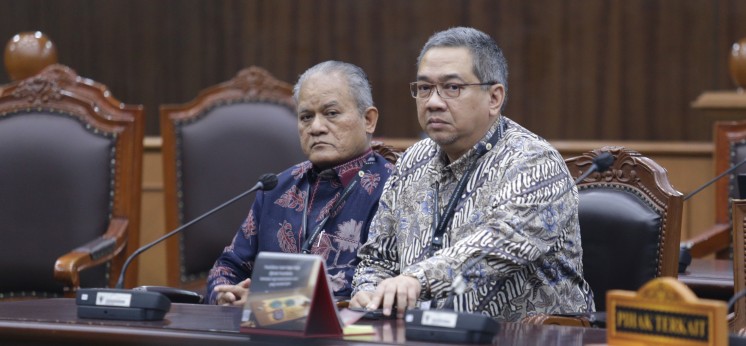
Related Party from the Consolidation of Pharmaceutical Companies delivering a testimony on the material review of Law No. 65 of 2024 on the Third Amendment to Law No. 13 of 2016 on Patent on Tuesday (21/4/2026). Photo by MKRI/Bay.
Jakarta (MKRI) – The Constitutional Court (MK) held a further material review hearing of Article 4 and the phrase “interested parties” in Article 70 paragraph (1) of Law No. 65 of 2024 on Patents (Patent Law) on Tuesday, April 21, 2026, at the Plenary Room. Petition No. 255/PUU-XXIII/2025 was submitted by several civil society organizations and patient communities: Indonesian Dialysis Patient Community Association, the Indonesian Drug Abuse Victims Association (PKNI), the Indonesian Pulmonary Hypertension Foundation (YHPI), the Indonesian Care Foundation, the Indonesian Positive Women's Association (IPPI), and the Indonesian Association for Global Justice, as well as four individuals.
The hearing was scheduled to hear testimony from a Related Party, the Coalition of Indonesian Pharmaceutical Companies (GPFI), represented by Secretary General Andreas Bayu Aji. GPFI argued that the regulation in Article 4 letter (f) of the Patent Law needs to be placed proportionally by clearly distinguishing between innovations that deserve patent protection and those that do not.
Bayu explained that the new uses or indications of existing products should still be eligible for patent protection. In his view, discovering a new indication is not achieved easily but through a long process of research and development, including complex clinical trials that require substantial investment.
“Granting a patent for a new indication is a form of reward for the innovation and investment,” he said.
He added that granting a patent for new uses does not immediately prevent other parties from producing the same medicines, as long as they do not claim the new uses. Therefore, it can maintain the balance between innovation protection and market access.
However, the GPFI asserted that not all compound modifications deserve patent protection. A new form of a compound that does not exhibit any significant benefits improvement and does not have chemical structure differences should not be eligible for a patent.
He added that innovation practices in the form of minor changes without real therapeutic benefit may become a tool for “patent evergreening,” which lengthens the monopoly period without any substantial innovation. This condition may harm society’s access to affordable medicine.
Further, the GPFI highlighted the phrase “interested parties” in Article 70 paragraph (1) of the Patent Law. Bayu argued that the party allowed to file an appeal against a patent objection should be limited to avoid ambiguity in the legal process. “If the interested parties have no relevance in the related industry, it may obstruct the appeal process. The public can still file objections through mechanisms already provided, including through the commercial court as stipulated in Article 70 paragraph (3),” Bayu explained.
Also read:
Also read:
Coalition for Patient Rights Advocacy for Access to Medicines Challenges Patent Law
Petitioners Revise Petition to Challenge Patent Law Concerning Access to Medicines
Patent Protection Rules Do Not Only Protect Inventors
Govt: Patent Law Framework Ensures Legal Certainty and Drives Drug Innovation
Review of Patent Law Highlights Evergreening and Patients’ Access to Medicines
During the preliminary hearing on Wednesday, December 17, 2025, the Petitioners argued that the removal of Article 4 letter f of Law No. 13 of 2016 on Patents through the Patent Law had eliminated legal protection for the public. The deleted provision previously excluded new uses of existing products and new forms of old compounds that did not provide a meaningful improvement in the properties of patentable objects.
According to the Petitioners, this change contradicts Article 28D paragraph (1) of the 1945 Constitution, which guarantees fair legal certainty, and Article 28H paragraph (1) of the 1945 Constitution, which guarantees the right to health. They further argued that Article 4, letter f, of the Patent Law protects the public and provides legal certainty by preventing low-quality patent applications that are intended solely to secure monopolies for a handful of large corporations. Low-quality patent applications certainly have the potential to violate the constitutional rights of the public, including the Petitioners, to guaranteed protection and legal certainty regarding the requirements for inventions that can be patented, particularly in the field of pharmaceuticals/medicines. (*)
Case tracking: Petition No. 255/PUU-XXIII/2025 (in Indonesian)
Author: Utami Argawati
Editor: Lulu Anjarsari P.
PR: Raisa Ayuditha Marsaulina
Translator: Rizky Kurnia Chaesario
Disclaimer: The original version of the news is in Indonesian. In case of any differences between the English and the Indonesian versions, the Indonesian version will prevail.
Tuesday, April 21, 2026 | 14:32 WIB 58