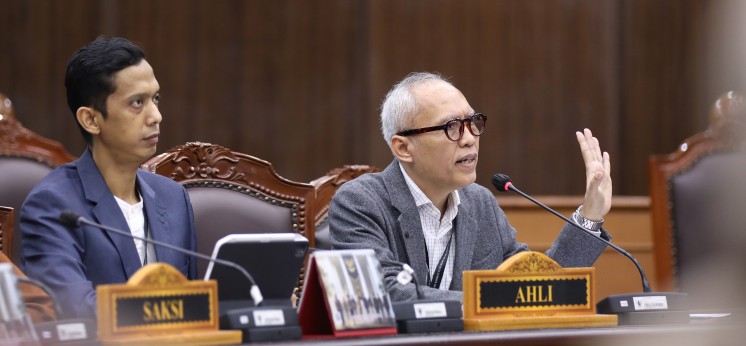
Experts brought by Petitioners, Tomi Suryo and Aditya Wardhana, delivering their testimony during the judicial review hearing of Law Mo. 65 of 2024 on Patent on Tuesday (24/02) at the Courtroom. Photo by MKRI/Ifa.
Jakarta (MKRI) - The Constitutional Court held a follow‑up hearing on the judicial review of Article 4 and the phrase “interested parties” in Article 70 paragraph (1) of Law No. 65 of 2024 on Patents on Tuesday, February 24, 2026. Case No. 255/PUU-XXIII/2025 was filed by several civil society organizations and patient communities, collectively known as the Coalition for Patient Rights Advocacy for Access to Medicines. The petitioners comprise the Indonesian Dialysis Patient Community Association (as Petitioner I), the Indonesian Drug Abuse Victims Association (PKNI) (as Petitioner II), the Indonesian Pulmonary Hypertension Foundation (YHPI) (as Petitioner III), the Indonesian Care Foundation (as Petitioner IV), the Indonesian Positive Women's Association (IPPI) (as Petitioner V), the Indonesian Association for Global Justice (as Petitioner VI), Patrick Johanes Laurens Nangka (as Petitioner VII), Irwandy Widjaja (as Petitioner VIII), Lusiana Aprilawati (as Petitioner IX), and Paran Sarimita Winarni (as Petitioner X).
Petitioners’ expert, Tomi Suryo Utomo, a professor at Universitas Janabadra’s Faculty of Law, told the Court that the history of pharmaceutical patent protection has never required countries to protect all types of pharmaceutical claims in absolute terms. He said global standards were introduced through the Agreement on Trade‑Related Aspects of Intellectual Property Rights (TRIPS), but the treaty does not simply mandate patent expansion.
He pointed to Articles 7 and 8 of TRIPS, which state that intellectual property protection must support social and economic welfare and allow countries to adopt measures to protect public health. “Protection for second medical use is not an international obligation. States may recognize or reject it as a matter of national policy,” he said.
Tomi explained that second medical use (SMU) refers to a new therapeutic use of an already known active substance. From the perspective of pharmaceutical companies or patent holders, SMU is seen as a follow-on innovation worthy of protection, but from a public health standpoint, the policy risks extending market exclusivity and delaying the entry of generics.
He said this phenomenon is often associated with evergreening strategies, where companies seek to prolong patent protection by claiming new therapeutic indications for the same medicine. Strong protection for such new indications can hinder generic entry, keep prices high despite unchanged chemical composition, and extend market dominance through brand loyalty and exclusive data claims.
Tomi also criticized the lack of a clear definition of “interested parties” in Article 70 of the Patent Law, warning that this ambiguity could weaken public oversight mechanisms. He argued that reviewing Article 4 letter f and Article 70 of the 2024 Patent Law has a strong constitutional basis to restore the previous norms found in Law No. 13 of 2016 and to spell out who qualifies as an “interested party.” Such steps, he said, align with the balance built into TRIPS and the constitutional mandate to ensure equitable access to health care.
Patent system and social contract
Another expert, Aditya Wardhana, chair of the IAC board, said the patent system is fundamentally a tool to encourage innovation for the public good. The state grants time-limited monopoly rights in exchange for concrete contributions to knowledge and technology.
“Patents are essentially a social contract. Temporary exclusivity is exchanged for benefits to society. But in practice, especially in the pharmaceutical sector, this system is often used to maintain monopolies through evergreening strategies,” he said.
According to Aditya, this is done by filing additional patents on new formulations, combinations, dosage forms, salt forms, and second medical use claims. These modifications, which he said often add little technical value, can extend market exclusivity beyond the standard 20‑year patent term.
Testimony from patients
The panel also heard from two witnesses. The first, Risa Oktaviana, is a pulmonary hypertension patient with a history of congenital heart disease (atrial septal defect) who was only diagnosed in 2017 after experiencing a heart attack.
She was diagnosed with pulmonary hypertension in 2020, a condition that has caused progressive shortness of breath, severe fatigue, chest pain, and limited daily activities. She initially received treatment at Pasar Minggu General Hospital before being referred to Harapan Kita National Heart and Vascular Center.
Although her treatment is covered by the national health insurance scheme (BPJS Kesehatan), Risa said the dose of Sildenafil she needs often exceeds the amount listed in the National Formulary, forcing her to buy extra medication out of pocket. She has taken Sildenafil 75 mg three times a day, compounded from 100 mg tablets that cost around Rp21,000 each and rose to about Rp34,500 in 2024.
Financial constraints frequently led her to buy fewer pills than prescribed, and at one point, she stopped treatment altogether for nearly two years. As a result, in June 2025, she required intensive care unit treatment with oxygen saturation levels of 86–89 percent and developed cardiomegaly (an enlarged heart).
She is now being treated at the University of Indonesia Hospital with a combination of Sildenafil 20 mg and Beraprost 20 mg, both covered by BPJS. Risa stressed that pulmonary hypertension patients need lifelong daily medication and that without treatment their condition can rapidly deteriorate and become fatal.
“I hope more affordable medicines will be available so patients like me can continue treatment,” she told the Court.
The second witness, Farahdiba Zalika Fatah, recounted that since starting treatment for multidrug-resistant (MDR) and extensively drug-resistant (XDR) tuberculosis, she has been enrolled in the national TB program, which fully subsidizes her medicines. Even so, she learned from nurses and treatment supporters that the cost of MDR and XDR TB drugs can reach tens of millions of rupiah.
Curious, she sought information on Bedaquiline, one of her medications, and discovered that its cost is around Rp20,000 per day. She believes this high price explains why patients are required to sign a commitment letter to complete treatment and agree to reimburse the state if they abandon therapy.
Farahdiba admitted that she stopped treatment for one month because she felt unproductive and powerless due to side effects from the anti-TB drugs, compounded by having to take a three-year leave from university. Time, money, and energy that should have gone toward finishing her degree had to be diverted to treatment, which led her to deliberately pause therapy before eventually resuming it on medical advice.
She also described facing stigma and discrimination during treatment. A former classmate called to ask her not to sit together anymore, and she feared her health status would be exposed on campus. During practical sessions involving TB bacteria, some peers even joked that people with TB “should just die,” and she continues to hear TB patients described as burdensome and shameful.
Also read:
Coalition for Patient Rights Advocacy for Access to Medicines Challenges Patent Law
Petitioners Revise Petition to Challenge Patent Law Concerning Access to Medicines
Patent Protection Rules Do Not Only Protect Inventors
Govt: Patent Law Framework Ensures Legal Certainty and Drives Drug Innovation
During the preliminary hearing on Wednesday, December 17, 2025, the Petitioners argued that the removal of Article 4 letter f of Law No. 13 of 2016 on Patents through the Patent Law had eliminated legal protection for the public. The deleted provision previously excluded new uses of existing products and new forms of old compounds that did not provide a meaningful improvement in the properties of patentable objects.
According to the Petitioners, this change contradicts Article 28D paragraph (1) of the 1945 Constitution, which guarantees fair legal certainty, and Article 28H paragraph (1) of the 1945 Constitution, which guarantees the right to health. They further argued that Article 4, letter f, of the Patent Law protects the public and provides legal certainty by preventing low-quality patent applications that are intended solely to secure monopolies for a handful of large corporations. Low-quality patent applications certainly have the potential to violate the constitutional rights of the public, including the Petitioners, to guaranteed protection and legal certainty regarding the requirements for inventions that can be patented, particularly in the field of pharmaceuticals/medicines. (*)
Case tracking: Petition No. 255/PUU-XXIII/2025 (in Indonesian)
Author: Utami Argawati
Editor: Lulu Anjarsari P.
PR: Raisa Ayuditha Marsaulina
Translator: Rizky Kurnia Chaesario
Disclaimer: The original version of the news is in Indonesian. In case of any differences between the English and the Indonesian versions, the Indonesian version will prevail.
Tuesday, February 24, 2026 | 15:02 WIB 158