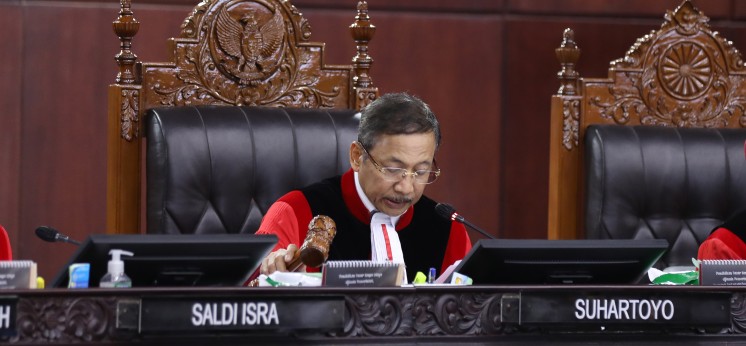
Chief Justice Suhartoyo, delivering the verdict of Law No. 12 of 2012 on Higher Education, Thursday (April 16, 2026), in the Courtroom. Photo by MKRI/Ifa.
JAKARTA, MKRI – The Court has declared Petition No. 76/PUU-XXIV/2026, concerning the Article 7 paragraph (4) of Law No. 12 of 2012 on Higher Education (the Higher Education Law), inadmissible. The Petitioners failed to submit valid evidence, namely evidence affixed with the required stamp duty.
“Evidence marked as Exhibits P1 through P5, upon the Court’s careful examination, was not affixed with sufficient stamp duty as required for admissible evidence,” stated Constitutional Justice Arsul Sani while reading out the legal considerations of Decision No. 76/PUU-XXIV/2026 on Thursday (April 16, 2026) in the Plenary Courtroom, Jakarta.
Pursuant to Article 12 paragraph (3) of Constitutional Court Regulation No. 7 of 2025, the submission of evidence duly affixed with sufficient stamp duty constitutes an essential requirement in assessing the fulfillment of the formal admissibility of a petition. Accordingly, the Court did not validate the Petitioners’ evidence.
Also read:
Students Challenge the Separation of Religious Higher Education from the National Education System
Students Revise Petition on the Separation of Religious Higher Education Management
The petition was filed by five students, namely Yohanes Brilian Jemadur, Defrin Fortinius Ziliwu, Leo Agung Lagu, Yonatan Syahlendra, and Frans Edward Silalahi. They filed a judicial review of Article 7 paragraph (4) of the Higher Education Law, challenging the separation of the management of religious higher education from the national higher education system, which, in practice, has often resulted in various structural limitations.
As a consequence, higher education is not administered under a fully integrated governance system. The Petitioners argued that this dualism concerns not only administrative aspects but also affects policy standards, institutional capacity, and resource support in the provision of higher education.
In other words, differences in supervising ministries have implications for disparities in higher education policymaking, the management of academic resources, and the capacity for institutional development. This condition indicates that the quality of higher education is ultimately determined not only by the internal capacity of higher education institutions but also by the institutional structure and state policies governing the administration of higher education.
For reference, Article 7 paragraph (4) of the Higher Education Law stipulates: “In the administration of religious higher education, responsibilities, duties, and authorities shall be exercised by the minister administering governmental affairs in the field of religion.” However, in their petition, the Petitioners requested the Court to declare Article 7 paragraph (4) of the Higher Education Law contrary to the 1945 Constitution of the Republic of Indonesia, particularly Article 28C paragraph (1), Article 28D paragraph (1), Article 28I paragraph (2), Article 31 paragraph (1), and Article 31 paragraph (3), and therefore lacking binding legal force, as well as to affirm that the administration and management of higher education constitute part of a single national education system within one national education policy framework as mandated by Article 31 paragraph (3) of the 1945 Constitution.
Author : Mimi Kartika
Editor : Lulu Anjarsari P.
PR : Andhini S. F.
Translator : Nies Lindy
Decision No. 76/PUU-XXIV/2026 (in Indonesian)
Disclaimer: The original version of the news is in Indonesian. In case of any differences between the English and the Indonesian versions, the Indonesian version will prevail.
Thursday, April 16, 2026 | 15:31 WIB 33