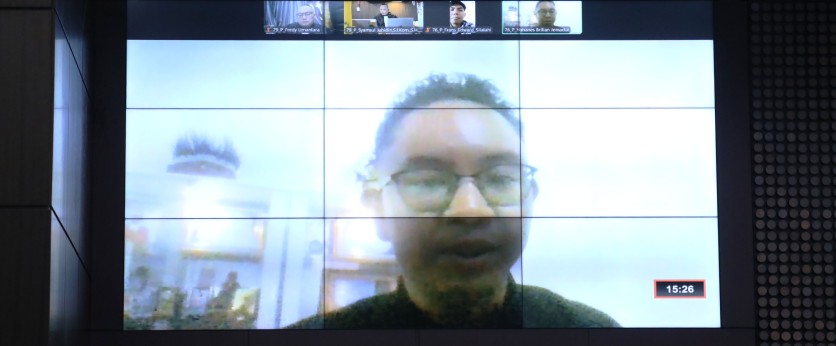
Yohanes Brilian Jemadur submitted revisions to the petition during the judicial review hearing of Law No. 12 of 2012 on Higher Education, held on Wednesday (April 1, 2026) in the Panel Courtroom. Photo: MKRI/Panji
JAKARTA, MKRI — A petitioner in Case No. 76/PUU-XXIV/2026 was absent from the preliminary hearing held on Monday (March 2, 2026). At the Hearing for the Revision of the Petition conducted on Wednesday (April 1, 2026), the petitioners totaled five individuals, namely Yohanes Brilian Jemadur, Defrin Fortinius Ziliwu, Leo Agung Lagu, Yonatan Syahlendra, and Frans Edward Silalahi.
The petitioners subsequently submitted revisions to their petition for judicial review of Article 7 paragraph (4) of Law No. 12 of 2012 on Higher Education (the Higher Education Law) before the Constitutional Court. The petition challenges the governance of religious higher education, which is institutionally separated from the national higher education system and, in practice, frequently gives rise to structural limitations.
“The said regulatory framework, in factual terms, creates institutional dualism in the administration of the national higher education system,” stated Yohanes during the petition revision hearing, which he attended virtually on Wednesday (April 1, 2026).
He further asserted that, as a consequence, higher education is not administered within a fully integrated governance system. Such dualism extends beyond administrative aspects and affects policy standards, institutional capacity, and resource support in the delivery of higher education.
He referred to official data published by Statistics Indonesia (BPS) in 2025, indicating that religious higher education institutions under the Ministry of Religious Affairs comprise 1,001 institutions, employing 44,288 lecturers and serving 1,194,344 students. In contrast, higher education institutions under the Ministry of Higher Education, Science, and Technology consist of 2,840 institutions, with 267,775 lecturers and 9,241,945 students.
These figures demonstrate that millions of Indonesian students pursue higher education under two distinct management systems, each overseen by a different supervising ministry, which, in practice, possess unequal institutional capacities and resource support. Such fragmentation is also reflected in the financing of higher education.
Pursuant to Law No. 17 of 2025 concerning the State Budget (APBN) for Fiscal Year 2026, the higher education budget administered by the Ministry of Religious Affairs amounts to IDR 8,563,732,752,000, whereas the allocation managed by the Ministry of Higher Education, Science, and Technology reaches IDR 43,199,367,315,000. This disparity in institutional capacity and funding directly affects the ability of higher education institutions to provide educational facilities, conduct research, enhance the quality of lecturers, and strengthen the academic ecosystem—each of which constitutes an essential element in determining the quality of higher education.
Given that the number of students in religious higher education exceeds two million, yet operates within comparatively limited budgetary and policy structures, the situation indicates that the national higher education system functions under two distinct frameworks of policy and financing, thereby potentially resulting in disparities in educational quality. Such differences are not solely attributable to the academic characteristics of the institutions but are also influenced by variations in governance systems and policy support derived from the respective supervising governmental bodies.
In other words, differences in ministerial oversight entail differences in policy formulation, management of academic resources, and institutional development capacity. This condition demonstrates that the quality of higher education is ultimately determined not only by the internal capabilities of higher education institutions but also by the institutional structure and state policies governing the administration of higher education.
Also read:
Students Challenge the Separation of Religious Higher Education from the National Education System
For the record, Article 7 paragraph (4) of the Higher Education Law provides: “In the administration of religious higher education, responsibilities, duties, and authorities shall be exercised by the minister in charge of governmental affairs in the field of religion.”
However, in their petition, the Petitioners request the Court to declare that Article 7 paragraph (4) of the Higher Education Law is contrary to the Constitution of the Republic of Indonesia of 1945, in particular Article 28C paragraph (1), Article 28D paragraph (1), Article 28I paragraph (2), Article 31 paragraph (1), and Article 31 paragraph (3), and therefore has no binding legal force.
Furthermore, the Petitioners request the Court to declare that the administration and management of higher education constitute an integral part of a unified national education system, operating within a single framework of national education policy, as mandated by Article 31 paragraph (3) of the 1945 Constitution. (*)
Author : Mimi Kartika
Editor : Lulu Anjarsari P.
PR : Andhini S. F.
Translator : Nies Lindy
Explore Case No. 76/PUU-XXIV/2026 (in Indonesian)
Disclaimer: The original version of the news is in Indonesian. In case of any differences between the English and the Indonesian versions, the Indonesian version will prevail.
Wednesday, April 01, 2026 | 16:31 WIB 58