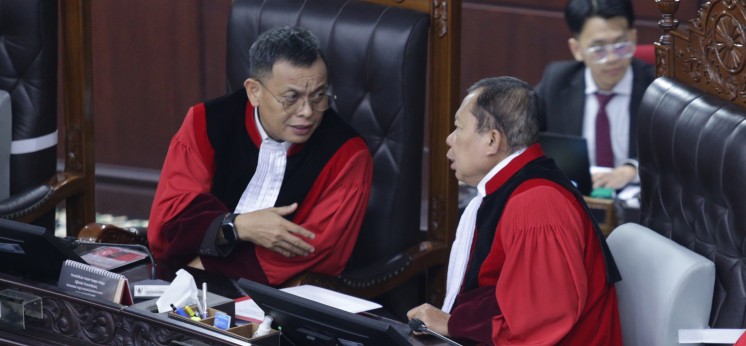
Decision Pronouncement Hearing of Case No. 83/PUU-XXIV/2026 on the material judicial review of Law No. 17 of 2013 on the Civil Society Organization on Thursday (16/4/2026). Photo by MKRI/Bay.
Jakarta (MKRI) – The Constitutional Court ruled that the material judicial review petition against Law No. 17 of 2013 on the Civil Society Organization (CSO Law) was unacceptable. The petition was filed by advocates ST Luthfiani, Syamsul Jahidin, Henoch Thomas, Popy Desiyantie, Fredy Limantara, Uswatun Hasanah, and Steven Izaac Risakotta.
The pronouncement of Decision No. 83/PUU-XXIV/2026 was held on Thursday, April 16, 2026, in the Plenary Courtroom, Jakarta.
Reading out the Court’s legal consideration, Justice Enny Nurbaningsih stated that Law No. 17 of 2013 on the Civil Society Organization is not related to advocates, especially when viewed against the Petitioners’ descriptions of their legal standing. She noted that the Petitioners treated the law as if it specifically governed advocate organizations via Article 12 paragraph (3), whereas advocates and their organizations are in fact regulated by Law No. 18 of 2003 on Advocates, not by the CSO Law.
Furthermore, Justice Enny mentioned that the provision related to advocates, including their freedom and independent principles regarding appointment, supervision, organizational development, and other aspects of the professional role in upholding justice, is separately set out in Law 18/2013.
“Therefore, the factual allegations put forward do not persuade the Court that the establishment of advocate organizations is also subject to Article 12 paragraph (3) of Law 17/2013, which in essence serves as an umbrella provision for mass organizations,” she said.
No Legal Standing
On the basis of the Petitioners’ arguments, the Court found no convincing indication that their constitutional rights had been infringed or were at real risk of being harmed by Article 12 paragraph (3) of the CSO Law. There was, Justice Enny said, no causal link between the alleged constitutional losses described and evidenced by the Petitioners and the operation of the statutory norm under review.
“Based on the foregoing legal considerations, regardless of whether the alleged unconstitutionality of Article 12 paragraph (3) of Law 17/2013 is proven, the Court has no doubt in stating that the Petitioners lack legal standing to file the a quo petition,” Justice Enny concluded.
Also read:
Petition on CSO Law Probes Proliferation of Advocate Bodies
Petitioners Seek Supreme Court Approval for Establishing Advocate Organizations
During the preliminary hearing on Friday, March 6, 2026, the Petitioners stated that the rapid growth of advocate organizations has created fragmented standards and oversight, which in turn affects the quality of legal services. In their observations, some advocate organizations are lax in their selection and inauguration, and others prioritize membership numbers over integrity and quality.
The Petitioners regard this as a very serious implication. When unfit individuals can easily obtain advocate licences simply because they are sworn in by certain organizations, the quality of legal aid provided to the public becomes increasingly questionable. Justice becomes a commodity that can be bought, while ordinary people who can only rely on free legal aid must accept assistance from advocates affiliated with various organizations whose ethical standards are unclear.
The Petitioner requested to declare Article 11 paragraph (1) letter ‘(a) associations; or’ of Law Number 17 of 2013 on Civil Society Organizations conditionally unconstitutional with the 1945 Constitution and to have no binding legal force insofar as it is not interpreted as: associations do not include advocate organizations. To declare Article 12 paragraph (3) ‘Ratification as a legal entity for an association as referred to in paragraph (2) shall be carried out after seeking consideration from the relevant agencies’ of Law Number 17 of 2013 on Civil Society Organizations unconstitutional with the 1945 Constitution and to have no binding legal force insofar as it is not interpreted as: ratification as a legal entity for an association as referred to in paragraph (2) shall be carried out after seeking consideration from the relevant agencies and the approval of the Supreme Court for advocate organizations.
Decision No. 83/PUU-XXIV/2026 (in Indonesian)
Author: Sri Pujianti.
Editor: N. Rosi.
PR: Andhini SF.
Translator: Rizky Kurnia Chaesario
Disclaimer: The original version of the news is in Indonesian. In case of any differences between the English and the Indonesian versions, the Indonesian version will prevail.
Thursday, April 16, 2026 | 18:16 WIB 47