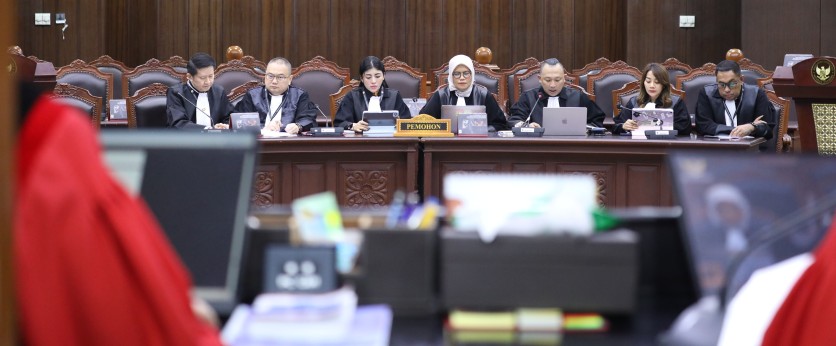
Petitioners who work as advocates delivering the main points of their petition on the judicial review of Law No. 17 of 2013 on Civil Society Organizations (CSO Law) on Friday (6/3) at the Panel Courtroom. Photo by MKRI/Panji.
Jakarta (MKRI) - Eight advocates have filed a petition for judicial review of Article 11 paragraph (1) letter a and Article 12 paragraph (3) of Law Number 17 of 2013 on Civil Society Organizations (CSO Law) against Article 28D paragraph (1) of the 1945 Constitution to the Constitutional Court (MK). The preliminary hearing of Petition Number 83/PUU-XXIV/2026 was held by a Panel Session chaired by Chief Justice Suhartoyo on Friday, March 6, 2026, in the Plenary Courtroom in Jakarta.
The advocates are ST Luthfiani (Petitioner I), Syamsul Jahidin (Petitioner II), Henoch Thomas (Petitioner III), Popy Desiyantie (Petitioner IV), Fredy Limantara (Petitioner V), Uswatun Hasanah (Petitioner VI), and Steven Izaac Risakotta (Petitioner VII).
Article 11 paragraph (1) letter a of the CSO Law provides that “Civil society organizations with legal entity status as referred to in Article 10 paragraph (1) letter a may take the form of: a. associations.”
Article 12 paragraph (3) stipulates that “Ratification as a legal entity for an association as referred to in paragraph (2) shall be carried out after seeking consideration from the relevant agencies.”
According to the Petitioners, the rapid growth of advocate organizations has created fragmented standards and oversight, which in turn affects the quality of legal services. In their observations, some advocate organizations are lax in their selection and inauguration, and others prioritize membership numbers over integrity and quality.
“As a result, being an advocate becomes merely a profession that can be bought with money and connections, rather than earned through struggle and morality,” said ST Luthfiani, reading out the grounds of the petition.
The Petitioners regard this as a very serious implication. When unfit individuals can easily obtain advocate licences simply because they are sworn in by certain organizations, the quality of legal aid provided to the public becomes increasingly questionable. Justice becomes a commodity that can be bought, while ordinary people who can only rely on free legal aid must accept assistance from advocates affiliated with various organizations whose ethical standards are unclear.
The Petitioners’ petitum reads in part: “To declare Article 11 paragraph (1) letter ‘(a) associations; or’ of Law Number 17 of 2013 on Civil Society Organizations conditionally unconstitutional with the 1945 Constitution and to have no binding legal force insofar as it is not interpreted as: associations do not include advocate organizations. To declare Article 12 paragraph (3) ‘Ratification as a legal entity for an association as referred to in paragraph (2) shall be carried out after seeking consideration from the relevant agencies’ of Law Number 17 of 2013 on Civil Society Organizations unconstitutional with the 1945 Constitution and to have no binding legal force insofar as it is not interpreted as: ratification as a legal entity for an association as referred to in paragraph (2) shall be carried out after seeking consideration from the relevant agencies and the approval of the Supreme Court for advocate organizations,” said Fredy Limantara, reading the Petitioners’ petitum.
Legal Standing
In his advice during the Panel Session, Justice M. Guntur Hamzah underlined the need to more specifically elaborate on the Petitioners’ legal standing. “This concerns the Civil Society Organization Law, especially since you are seeking to exclude advocate organizations through it. Where is the causal link? There should be a cause-and-effect relationship; everything is tied to advocates, so try to set out that legal logic,” Justice Guntur explained.
Justice Daniel Yusmic P. Foekh added that the Petitioners should detail the constitutional losses they have actually suffered as a result of the challenged norms. “This needs to be strengthened for everyone’s legal standing. Substantively, there is in fact an ‘association’ spirit here, and the House of Representatives (DPR) currently has a Draft Law on Associations on its agenda under the National Legislation Program (Prolegnas). So it can be considered whether these aspirations are better conveyed to the DPR rather than to the Court,” Justice Daniel advised.
Meanwhile, Chief Justice Suhartoyo asked the Petitioners to clarify whether advocacy organizations fall within the scope of the Civil Society Organization Law. “Civil Society organizations and professional organizations are different. Both must indeed be legal entities and registered, but civil society organizations may take the form of associations or foundations, specifically as legal entities related to civil society organizations. Once this footing is clear, then your legal standing can be properly framed,” Chief Justice Suhartoyo said.
Before adjourning, Chief Justice Suhartoyo granted the Petitioners 14 days to revise their petition. The revised petition must be submitted to the no later than Wednesday, March 25, 2026 at 12.00 Western Indonesian Time, after which the Court will schedule a second hearing to hear the main points of the revised petition.
Case tracking: Petition No. 83/PUU-XXIV/2026
Author: Sri Pujianti.
Editor: N. Rosi.
PR: Andhini SF.
Translator: Rizky Kurnia Chaesario
Disclaimer: The original version of the news is in Indonesian. In case of any differences between the English and the Indonesian versions, the Indonesian version will prevail.
Friday, March 06, 2026 | 10:00 WIB 95