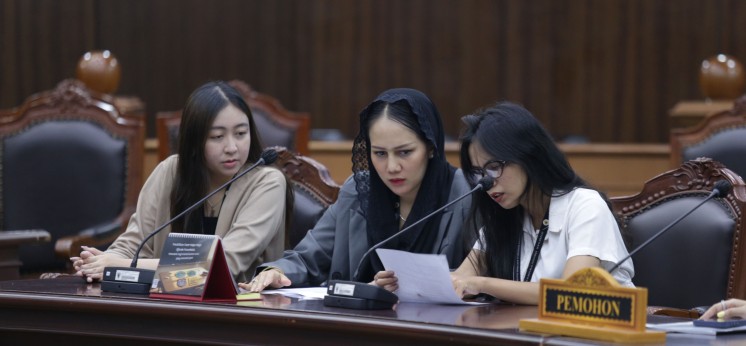
Petitioners at Petition Revision Hearing for Case No. 86/PUU-XXIV/2026, the Material Review of Law No. 8 of 1999 on Consumer Protection, Wednesday (4/1/2026). Photo by MKRI/Bay.
JAKARTA (MKRI) – Bernita Matondang (Petitioner I), Gabby Mayang Sari (Petitioner II), and Evelyn Amanda (Petitioner III) returned to the Panel Hearing for the material review of Law No. 8 of 1999 on Consumer Protection (Consumer Protection Law) on Wednesday, April 1st, 2026. The second hearing for Petition No. 86/PUU-XXIV/2026 was scheduled to hear the main points of the Petitioners' revisions to the petition. Bernita stated that she had revised several sections, including the reasons for the petition, the reduction of the meaning of business actors and the right to sue, the litigation of BPKN's authority, and the argument of novelty.
"Declaring that Article 1 paragraph (1) of Law No. 8 of 1999 on Consumer Protection is contrary to the 1945 Constitution of the Republic of Indonesia and doesn’t have conditional binding legal force as long as the phrase 'all efforts' is not interpreted to include cross-jurisdictional legal protection for consumers who carry out transactions with foreign business actors which give rise to legal consequences in the territory of Indonesia," said Gabby reading out the changes to one of the petitioners' petitions which argues for a constitutional review of Article 1 paragraph (1), Article 18 paragraph (1) letters c and g, Article 34 paragraph (1) letters d and f, Article 45 paragraph (1), and Article 53 of the Consumer Protection Law.
Also read:
Petitioners Challenge Consumer_Protection Law over Google Play Refund Dispute
In the Preliminary Examination Hearing on Monday, March 2nd, 2026, the Petitioners stated that the legal provisions governing the scope of consumer protection, the applicability of standard clauses, access to dispute resolution mechanisms, and the clarity of consumer protection institutions in cross-border digital transaction practices were deemed unable to provide effective legal protection. As an illustration, it was stated that Petitioner I is an active consumer of digital services through the Google Play platform who regularly purchases applications and electronic subscription-based services, thus clearly being included as a legal subject protected by the Consumer Protection Law. In using these services, Petitioner I experienced the activation of digital subscription services that took place without Petitioner I's conscious will. As a result, funds were automatically deducted from Petitioner I's payment method, resulting in real economic losses in the form of a reduction in Petitioner I's personal property rights.
Therefore, Petitioner I submitted a refund request to the service provider through the Google Play electronic system mechanism. However, the refund request was rejected by the business actor. In Petitioner I's view, this factually shows the validity of a one-sided standard clause in an electronic contract that places consumers in an unbalanced position and opens up the possibility of refusing to refund consumer payments as related to the provisions of Article 18 paragraph (1) letters c and g of the Consumer Protection Law.
Petitioner I then filed a complaint with the Consumer Dispute Resolution Agency (BPSK) on February 12, 2026, which was then responded to on February 13, 2026 and February 18, 2026. However, BPSK stated that it was not authorized to handle the dispute in question because the business actor was outside the jurisdiction of Indonesia. The refusal of authority by BPSK shows that the phrase "business actor" in Article 45 paragraph (1) of the Consumer Protection Law doesn’t cover cross-border digital business actors.
As a result, the right to sue which is normatively granted by law has turned into a right that cannot be implemented in practice, which directly closes access to justice for Petitioner I. Thus, the loss experienced by Petitioner I is not an ordinary contractual loss between consumers and business actors, but rather a constitutional loss that arises directly due to the implementation of the norms of the Consumer Protection Law which haven’t provided an effective legal protection mechanism for cross-border electronic transactions.
It was stated that the development of cross-border digital economic transactions has given rise to increasingly complex legal relations, including the potential for a reduction in the economic value of citizens through electronic system mechanisms that occur quickly and without direct interaction. In such conditions, Bernita continued, protection of private property rights no longer depends solely on the contractual relationship between the parties, but on the existence of state legal norms that are able to guarantee effective mechanisms for the protection and restoration of rights. Therefore, the state has a constitutional obligation to ensure that any reduction in the economic value of citizens in digital transactions is accompanied by a guarantee of real legal protection as mandated by Article 28H paragraph (4) of the 1945 Constitution of the Republic of Indonesia. (*)
Track case No. 86/PUU-XXIV/2026
Author : Sri Pujianti
Editor : Lulu Anjarsari P.
PR : Tiara Agustina
Translator : Donny Yuniarto
Disclaimer: The original version of the news is in Indonesian. In case of any differences between the English and the Indonesian versions, the Indonesian version will prevail.
Wednesday, April 01, 2026 | 14:38 WIB 88