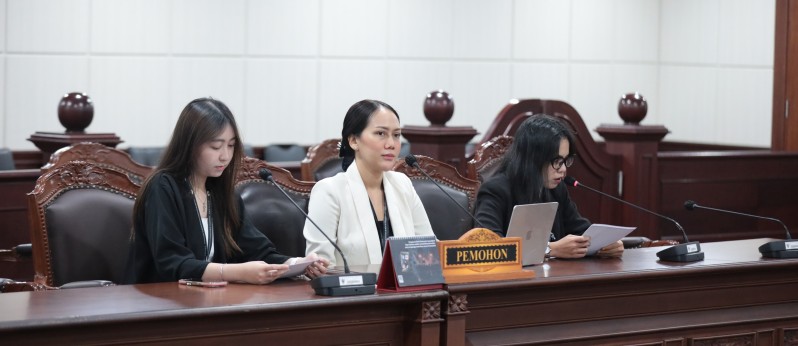
The Petitioners in the judicial review of the Consumer Protection Law presenting the main points of their petition before the panel of constitutional justices at a preliminary hearing, Monday (3/9/2026). Photo by MKRI/IlhamWM.
JAKARTA (MKRI) — Bernita Matondang (Petitioner I), Gabby Mayang Sari (Petitioner II), and Evelyn Amanda (Petitioner III) have filed a judicial review of Law No. 8 of 1999 on Consumer Protection with the Constitutional Court. The preliminary hearing for Case No. 86/PUU-XXIV/2026 was held in the Court’s panel courtroom on Monday (March 9, 2026).
At the hearing chaired by Chief Justice Suhartoyo, Bernita argued that Article 1 paragraph (1), Article 18 paragraph (1) letters c and g, Article 34 paragraph (1) letters d and f, Article 45 paragraph (1), and Article 53 of the Consumer Protection Law contradict the 1945 Constitution.
Article 1 paragraph (1) of the Consumer Protection Law stipulates that consumer protection encompasses all efforts ensuring legal certainty in providing protection to consumers. Meanwhile, Article 18 paragraph (1) letters c and g regulate standard clauses that, among others, allow business actors to refuse the refund of payments made for goods and/or services purchased by consumers and to unilaterally impose new or amended rules during the period in which consumers utilize the services they have purchased.
Article 45 paragraph (1) provides that consumers who suffer losses may file claims against business actors either through institutions tasked with resolving disputes between consumers and business actors or through courts within the general court system. Article 34 paragraph (1) letters d and f encourage the development of community-based consumer protection organizations and authorize them to receive complaints from the public, such organizations, or business actors. Meanwhile, Article 53 stipulates that further provisions regarding the duties and authority of consumer dispute settlement bodies at the regional level shall be regulated by a ministerial decree.
According to the Petitioners, these provisions, particularly those governing the scope of consumer protection, the validity of standard clauses, access to dispute resolution mechanisms, and the institutional framework for consumer protection, have proven inadequate in providing effective legal protection in the context of cross-border digital transactions.
As an illustration, Petitioner I stated that she is an active user of digital services through the Google Play platform, regularly purchasing applications and subscription-based services. In her case, a digital subscription service was allegedly activated without her conscious intent, resulting in automatic deductions from her payment method and causing tangible economic loss through the reduction of her personal funds.
Petitioner I subsequently requested a refund through Google Play’s electronic system. However, the request was rejected by the service provider. In her view, this situation reflects the practical application of unilateral standard clauses in electronic contracts, which place consumers in an unequal bargaining position and allow business actors to refuse refund requests, as related to Article 18 paragraph (1) letters c and g of the Consumer Protection Law.
Following the rejection, Petitioner I filed a complaint with the Consumer Dispute Settlement Agency (BPSK) on February 12, 2026. The complaint received responses on February 13 and February 18, 2026. Nevertheless, the BPSK declared that it lacked jurisdiction to adjudicate the dispute because the business actor involved was located outside Indonesia’s legal jurisdiction. This refusal of authority, according to the Petitioner, demonstrates that the phrase “business actor” in Article 45 paragraph (1) does not cover cross-border digital business entities.
“In conventional legal relations, consumer protection norms provide dispute resolution mechanisms through the BPSK or the general courts. However, in cross-border digital legal relationships, these norms fail to offer an accessible forum for dispute resolution. As a result, the right to file a lawsuit, although normatively guaranteed by law, becomes practically unenforceable,” Bernita explained before the panel.
Consequently, the statutory right to bring legal action becomes ineffective in practice, effectively closing access to justice for the Petitioner. She further argued that the loss she suffered should not be viewed merely as an ordinary contractual dispute between a consumer and a business actor. Rather, it constitutes a constitutional loss arising directly from the application of provisions in the Consumer Protection Law that fail to provide effective legal protection for cross-border electronic transactions.
Bernita also noted that the rapid development of cross-border digital economic transactions has created increasingly complex legal relationships. Such transactions may result in the reduction of citizens’ economic assets through electronic systems operating swiftly and often without direct interaction. In this context, she asserted, the protection of property rights no longer depends solely on contractual relations between parties but also on the existence of state legal norms capable of ensuring effective protection and remedies. Therefore, the state has a constitutional obligation to guarantee legal protection whenever citizens experience economic loss in digital transactions, as mandated by Article 28H paragraph (4) of the 1945 Constitution.
Petitioners’ Petitums
Based on these arguments, the Petitioners request the Court to declare Article 1 paragraph (1) of the Consumer Protection Law, specifically the phrase “ensuring legal certainty”, contrary to the 1945 Constitution and conditionally unconstitutional unless interpreted to mean that legal certainty in consumer protection includes effective legal protection and access to consumer dispute resolution, including in electronic and cross-border digital transactions that produce legal consequences within the territory of the Republic of Indonesia.
They also request the Court to declare Article 18 paragraph (1) letters c and g unconstitutional and conditionally not legally binding unless interpreted to mean that the prohibition of standard clauses also applies to electronic contracts and digital services that create legal relationships between business actors and consumers and produce legal consequences for consumers within Indonesia’s jurisdiction, including those conducted through cross-border electronic systems.
Furthermore, the Petitioners ask the Court to declare Article 34 paragraph (1) letters d and f unconstitutional and conditionally not legally binding unless interpreted to mean that the duty to receive complaints includes facilitating, following up, and coordinating the settlement of complaints from Indonesian consumers against business actors domiciled outside Indonesia through international cooperation mechanisms.
The Petitioners also request the Court to declare Article 45 paragraph (1), particularly the phrase “business actor”, contrary to the Constitution and conditionally not legally binding unless interpreted to include any business actor whose activities produce legal consequences for consumers within Indonesia, including through electronic systems or cross-border digital commerce.
Finally, they seek a ruling that Article 53 of the Consumer Protection Law, specifically the phrase “Level II Region”, is unconstitutional and conditionally not legally binding unless interpreted as “regency/city,” in accordance with the current regional governance system.
Forced Interpretation of Articles
During the panel’s advisory session, Constitutional Justice M. Guntur Hamzah reminded the Petitioners to carefully formulate their arguments to avoid ambiguous interpretations of legal norms.
“Among the five principal petitums, Article 1 paragraph (1) is a definitional provision and the very core of the law. Whenever we discuss consumer protection, everything refers back to this article. If interpreted as guaranteeing effective legal protection, the understanding may become biased. Effectiveness is not a matter of the norm itself, it is the result of implementation,” Guntur explained.
Before closing the hearing, Chief Justice Suhartoyo granted the Petitioners 14 days to revise their petition. The revised petition must be submitted to the Court’s Registrar’s Office no later than Wednesday, March 25, 2026, at 12:00 p.m. The Court will then hold a second hearing to examine the revised petition.
Author: Sri Pujianti
Editor: Lulu Anjarsari P.
PR: Tiara Agustina
Translator: Yuanna Sisilia
Disclaimer: The original version of the news is in Indonesian. In case of any differences between the English and the Indonesian versions, the Indonesian version will prevail.
Monday, March 09, 2026 | 14:31 WIB 101