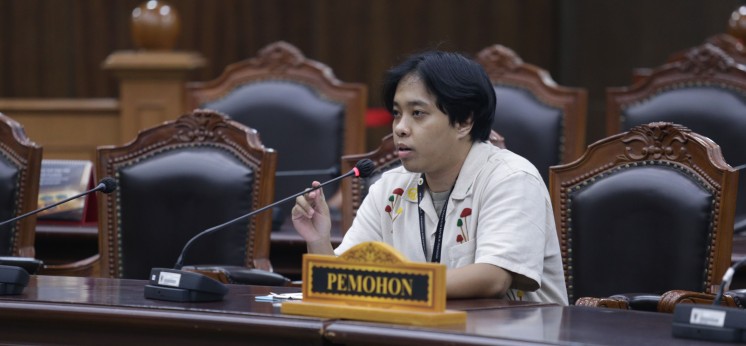
Yusuf Shamawarmansyah, the Petitioner, during the hearing on revisions to Petition No. 80/PUU-XXIV/2026 for the judicial review of Law No. 1 of 2023 on the Criminal Code, Wednesday (April 1, 2026). Photo: Public Relations/Bay.
JAKARTA, MKRI — Yusuf Shamawarmansyah has submitted revisions to his petition challenging Article 308(1) of Law No. 1 of 2023 on the Criminal Code (KUHP) before the Constitutional Court. According to the Petitioner, the criminal provision concerning acts causing fire, explosions, or flooding that endanger public safety for persons or property should also apply when such acts endanger individual lives.
“Declaring Article 308(1) of Law No. 1 of 2023 (State Gazette of the Republic of Indonesia of 2023 No. 1, Supplement to the State Gazette No. 6842) contrary to the 1945 Constitution and conditionally without binding legal force insofar as it is not interpreted to include ‘acts that also endanger individual lives’,” Yusuf stated in reading the revised petitum during the hearing on Wednesday (April 1, 2026) at the Constitutional Court.
The Petitioner essentially agrees that endangering public safety constitutes a genus of endangering individual safety. In such a relationship, endangering many people necessarily includes endangering at least one individual. However, the reverse does not apply: endangering a single individual cannot automatically be construed as endangering public safety.
On this basis, the Petitioner seeks judicial clarification of the a quo provision to delineate the boundary between acts that endanger public safety and those that endanger only individual safety, in order to prevent improper interchangeable application. He argues that transforming the offenses of arson, explosion, or flooding into crimes requiring public endangerment is analogous to redefining homicide as an offense requiring multiple fatalities.
To illustrate this construction, the Petitioner compares terrorism offenses which involve the loss of multiple lives—as a genus of homicide, which involves the loss of a single life. Accordingly, a person who causes multiple deaths may certainly be charged under provisions prohibiting the taking of a single life. Conversely, a person who causes only one death cannot be charged under provisions prohibiting mass-casualty crimes such as terrorism.
Based on this reasoning, the Petitioner contends that an individual who endangers public safety may also be charged under provisions addressing harm to individual safety, such as Article 187(2) of the former Criminal Code since the narrower elements are encompassed within the broader offense. However, a person who endangers only individual safety cannot be charged under provisions addressing public safety, including the a quo norm.
Also read:
Student Challenges Limits of Offense Endangering Public Safety
Article 308(1) of the Criminal Code provides: “Any person who commits an act resulting in a fire, explosion, or flood that endangers public safety for persons or property shall be punished with imprisonment of up to nine (9) years.” The Petitioner questions whether individuals whose actions endanger only individual lives fall outside the scope of criminal liability under this formulation.
According to the Petitioner, the provision fails to establish clear and consistent conceptual boundaries for the phrase “endangering public safety for persons or property.” This lack of clarity presents not only theoretical concerns but also practical challenges in law enforcement.
Such ambiguity, he argues, opens the door to contestation and varying interpretations of the offense’s scope, from the investigation stage through trial proceedings. As a result, the issue extends beyond abstract legal drafting and directly affects legal certainty in practice.
Article 308(1) of the new Criminal Code is described as a normative and systematic transformation of two previously distinct provisions in the old Criminal Code Articles 187(1) and 187(2) which embodied different forms of legal protection. However, the Petitioner argues that the new formulation fails to explicitly preserve this normative linkage, rendering the provision conceptually unclear.
He further asserts that Article 308(1) raises not only drafting concerns but also deeper constitutional issues, particularly the disruption of logical and systemic coherence among criminal law norms. This, in turn, undermines legal certainty for citizens, who can no longer reasonably predict the legal consequences of their actions—especially in cases falling within the gray area between individual harm and public danger.
The Petitioner maintains that the current formulation of Article 308(1) potentially infringes upon his constitutional right to legal certainty as guaranteed under Article 28D(1) of the 1945 Constitution, as the provision fails to maintain coherence, consistency, and rationality with its historical normative sources.
Explore the Case: Petition No. 80/PUU-XXIV/2026
Author : Mimi Kartika
Editor : N. Rosi
Public Relations: Fauzan Febriyan
Translator : SO
Disclaimer: The original version of the news is in Indonesian. In case of any differences between the English and the Indonesian versions, the Indonesian version will prevail.
Wednesday, April 01, 2026 | 15:46 WIB 52