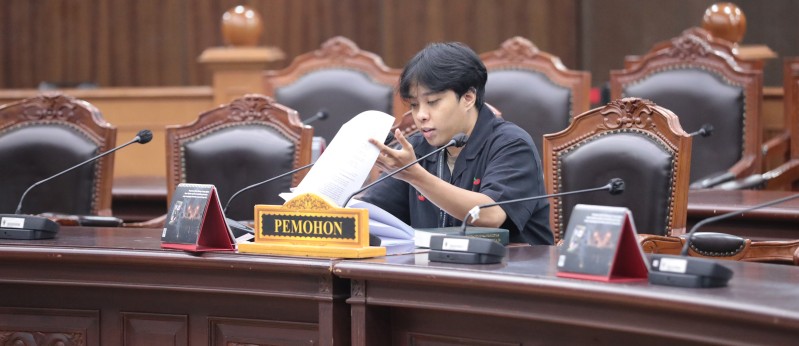
Yusuf Shamawarmansyah, a university student filing a judicial review of the Criminal Code, presents his arguments before the panel of Constitutional Court justices, Monday (March 3, 2026). Photo: Public Relations/IlhamWM.
JAKARTA, MKRI — Yusuf Shamawarmansyah, a university student, has filed a petition for judicial review of Article 308(1) of Law No. 1 of 2023 on the Criminal Code (KUHP) with the Constitutional Court. The Petitioner challenges the criminal provision concerning acts causing fire, explosions, or flooding that endanger public safety for persons or property, arguing that it contravenes Article 28D(1) of the 1945 Constitution, which guarantees the right to legal certainty.
“The ambiguity of this norm has the potential to result in the Petitioner’s report being dismissed on the grounds that the elements of the offense are not fulfilled, should the Petitioner experience, witness, observe, or even become a victim of an act of arson, explosion, or flooding that endangers only individual safety,” Yusuf stated during the preliminary examination hearing of Petition No. 80/PUU-XXIV/2026 on Tuesday (March 3, 2026) in the Constitutional Court courtroom, Jakarta.
Article 308(1) of the Criminal Code provides: “Any person who commits an act resulting in a fire, explosion, or flood that endangers public safety for persons or property shall be punished with imprisonment of up to nine (9) years.” The Petitioner questions whether individuals whose actions cause fire, explosions, or flooding that endanger individual lives—but not “public safety for persons or property” as formulated—would fall outside the scope of criminal liability.
According to the Petitioner, the provision fails to establish clear and consistent conceptual boundaries for the phrase “endangering public safety for persons or property.” This lack of clarity, he argues, creates not only theoretical concerns but also significant practical implications in law enforcement.
Such ambiguity may invite contestation, reinterpretation, and debate over the meaning and scope of the offense. In practice, this could lead to divergent interpretations from the stages of preliminary inquiry and investigation through to adjudication in court. As such, the issue extends beyond abstract normative concerns and directly affects legal certainty in application.
Article 308(1) of the new Criminal Code is described as a normative and systematic transformation of two previously separate provisions in the old Criminal Code—Articles 187(1) and 187(2) which carried distinct protective purposes. The Petitioner argues that interpretation of the new provision should remain connected to its normative origins; however, in its current formulation, such linkage is no longer explicit, rendering the provision obscure.
He further contends that Article 308(1) gives rise not only to drafting deficiencies but also to deeper constitutional concerns, particularly the disruption of logical and systemic coherence among criminal law norms. This, in turn, undermines legal certainty for citizens, who can no longer reasonably predict the legal consequences of their actions—especially in cases falling within the gray area between individual harm and public danger.
The Petitioner maintains that the current formulation of Article 308(1) potentially infringes upon his constitutional right to legal certainty as guaranteed under Article 28D(1) of the 1945 Constitution. He argues that the provision fails to preserve coherence, consistency, and rationality with the norms from which it historically derives.
In his petition, the Petitioner requests the Court to declare Article 308(1) unconstitutional and conditionally invalid, unless it is interpreted to include acts “that also endanger individual lives.”
The case is being heard by a panel of justices chaired by Chief Justice Suhartoyo, alongside Constitutional Justices Daniel Yusmic P Foekh and M Guntur Hamzah. During the advisory session, Justice Daniel emphasized that the Petitioner must more clearly articulate the specific constitutional harm allegedly arising from the application of Article 308(1).
Such an allegation, he noted, is essential for establishing legal standing. “Because that will go to the substance of the petition, but if legal standing is not satisfied, then the Court will not proceed to examine the merits,” Daniel remarked.
Before adjourning the hearing, Chief Justice Suhartoyo stated that the Petitioner is granted one opportunity to revise the petition within 14 days. The revised submission, in both soft and hard copy, must be received by the Court no later than Monday, March 16, 2026, at 12:00 WIB.
Explore the Case: Petition No. 80/PUU-XXIV/2026
Author : Mimi Kartika
Editor : N. Rosi
Public Relations: Fauzan Febriyan
Translator : SO
Disclaimer: The original version of the news is in Indonesian. In case of any differences between the English and the Indonesian versions, the Indonesian version will prevail.
Tuesday, March 03, 2026 | 15:35 WIB 60